
Home › Blog › Solo travel portraits
Portrait Photographer Hanoi at Night: Light, Spots & Timing
By the Hanoi Photoshoot team · 2026-11-06
Night portraiture in Hanoi demands shooting during the "blue hour"—roughly 17:30–19:00 in winter, 18:00–19:30 in summer—when residual daylight mixes with street lamps and neon. The city's best night spots are the Old Quarter's narrow alleys (natural amber glow, tight framing), Hoan Kiem Lake's promenade (fewer crowds after 19:30, reflective water), and the train tracks area (harsh tungsten overhead, moody silhouettes). Expect humidity, traffic noise, and crowds until sunset; book us 2–3 weeks ahead to secure a makeup and styling slot. Most sessions run 2–3 hours. We handle pose coaching for non-models, light metering, and white balance shifts as dusk turns urban. Hanoi Photoshoot by Cáo Studio includes in-house ao dai rental and hair if you want cultural context. No session guarantees usable frame count—that depends on your mobility, comfort holding still in dim light, and weather. Avoid overly busy tourist zones after 20:00 unless you want crowd chaos in background. Check dates on WhatsApp
What makes Hanoi night light different from other cities?
Hanoi's urban light is chaotic by design. The city mixes French colonial street lamps (dim, warm) with motorcycle headlights, neon shop signs, and unshielded apartment windows. Unlike Southeast Asian resort towns, there's no planned "golden hour" district—light is fragmented. The Old Quarter's alley system traps ambient glow, creating pockets of 5–8 stops dynamic range (very contrasty). Train Street's overhead tungsten bulbs cast hard shadows at night, useful for mood but punishing for skin tone. Old Quarter photo guide shows exact alleys with repeatable light. The advantage: authentic, non-staged backdrop. The challenge: you must arrive 15 minutes early to scout and meter, because street light flickers and vehicle traffic shifts every 60 seconds. This is why timing and location are not interchangeable—a 10-minute delay moves your subject into shadow or glare. No other Hanoi photographer guides will tell you the exact minute-by-minute light shift; we do because we shoot there weekly.
Which Hanoi spots hold light best after dusk?
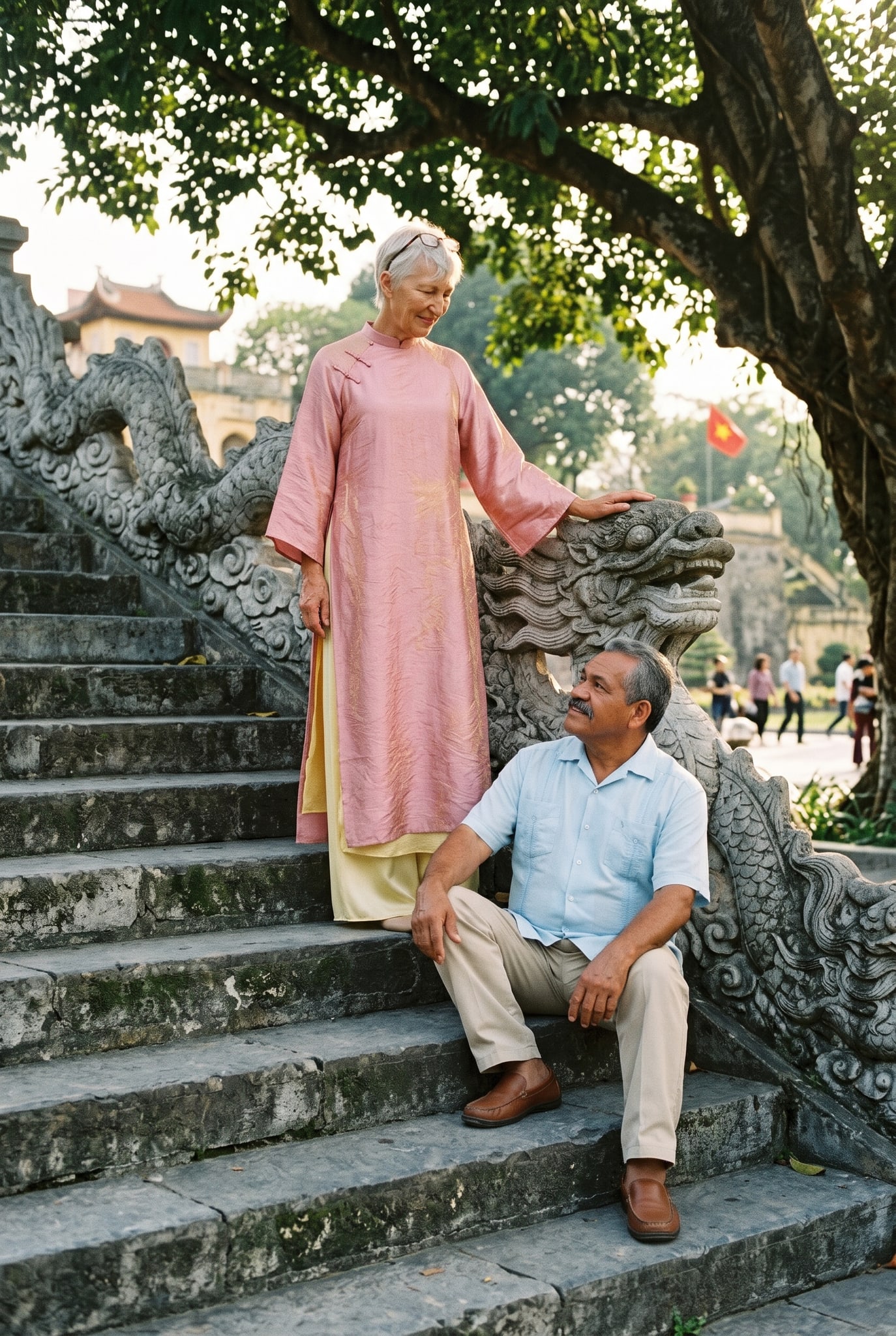
Hoan Kiem Lake photo guide is the single best night location because water reflects street lamps and residual sky glow evenly. Shooting 18:30–19:15, you get soft fill from the lake, directional key light from the promenade lamps, and minimal crowd interference if you position yourself near the north shore. The lake's perimeter is public; no permits required. By 20:00 the light drops to 2–3 stops, forcing ISO 1600+, which we manage with careful metering.
Train Street photo guide offers moody tungsten overhead if you shoot between 19:00–20:30. The tracks are legally accessible only when no train is present; we confirm schedules 24 hours ahead. Skin tone renders orange under tungsten—some clients want this for vintage feel, others hate it. You must communicate this beforehand.
Tamarind Avenue (Old Quarter tree-lined street) balances moving vehicle light with leaf dapple. Shoot around 18:45–19:30; after 20:00, motorcycles create unstable shadows.
French Quarter colonial buildings (darker stone, fewer signs) are quieter but require 1–2 stops more exposure, raising noise risk. Best for silhouette or moody vignette portraits.
| Spot | Best Time Window | Light Type | Crowd Level | Noise (Traffic) | Skin Tone | Best For |
|---|---|---|---|---|---|---|
| Hoan Kiem Lake | 18:30–19:15 | Reflected lamp + sky | Low (north shore) | Moderate | Neutral, flattering | Clean, serene mood |
| Train Street | 19:00–20:30 | Hard tungsten overhead | Low (day-trip hours) | Very high | Warm/orange cast | Moody, vintage look |
| Old Quarter alleys | 18:00–19:30 | Ambient + neon blend | High (foot traffic) | Very high | Variable (mixed sources) | Authentic, gritty feel |
| French Quarter | 18:45–20:00 | Soft shadow, dim lamps | Very low | Low | Cool, deep | Cinematic, portrait study |
How do you avoid blown highlights and crushed shadows at night?
Hanoi's night light is high-contrast because streetlamps (5000K, isolated) sit next to dark walls (zero fill). JPEG shooters lose either face detail or background. Here's what we do: shoot in RAW only, meter for skin (spot meter on cheek), accept background at −3 to −4 stops, then recover in post. Use back-button focus under low light; autofocus hunts if ambient is too dim. If your subject is backlit by a neon sign, position them 1–2 meters forward so the glow frames, not overwhelms. Expose for the brightest light on the face; let background drop. This is counterintuitive—most night photographers try to "balance" light and fail. We accept contrast as a feature, not a bug. Pro tip: shoot a test frame at 18:30, check histogram, then lock settings until the light drops another 2 stops (usually 19:15). After that, re-meter every 3 minutes. No app catches Hanoi street light flicker—you must do it manually. This is why our night sessions cost more per hour than day shoots: we're meter-checking, not just posing.
What should you wear for flattering night portraits?
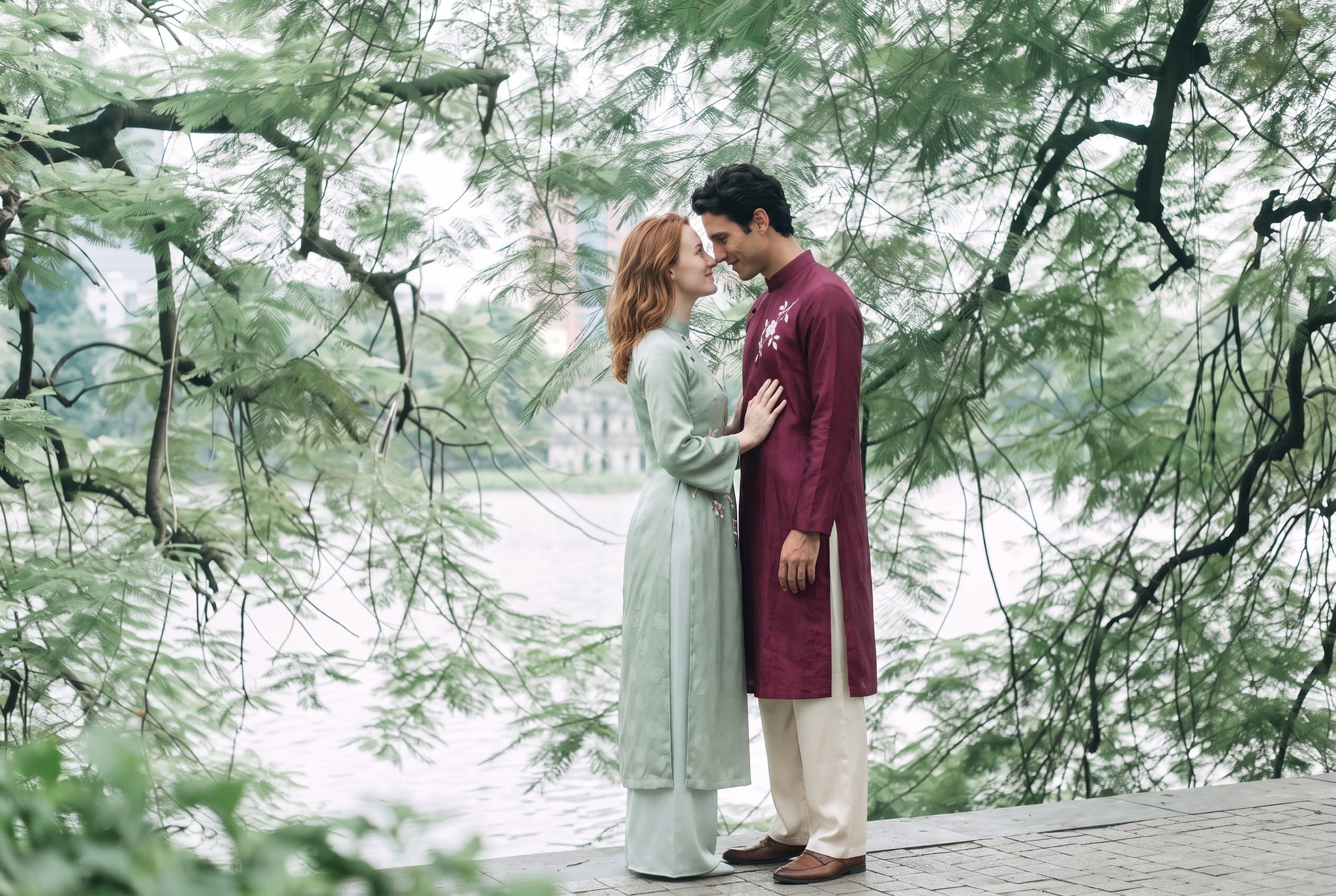
Darker clothing (navy, black, deep burgundy) reads better under orange tungsten and neon than pastels. Jewel tones (emerald, sapphire) pop against amber street light without clashing. White and pale gray wash out under tungsten unless backlit deliberately. Texture matters: matte fabrics (cotton, linen, suede) scatter light evenly; shiny nylon creates glare spots that are hard to remove in post. If you rent an ao dai photoshoot with us, we choose lighter silk tones that glow under streetlight—traditional white silk ao dai is stunning at 18:45 when rim-lit from the side. Avoid busy patterns; fine stripes or florals break up and merge into visual noise on camera at low light. Bring a second outfit: darker option for moody frames, lighter for contrast frames. Jewelry should be understated—shiny metal earrings and necklaces catch sodium vapor and create orange spots that look like focus errors. Our styling team will advise during the pre-shoot consultation.
How does humidity and heat affect night portrait sessions in Hanoi?
Hanoi's humidity never drops below 60%, even at night. Summer (May–September) runs 75–95% humidity, pushing 28–32°C after sunset. This affects you, not just the camera. Sweat on the face creates shine that reflects streetlight harshly; dark circles appear deeper; makeup (if worn) will oxidize and shift tone. We recommend a matte primer and powder, regardless of gender. Your hair will frizz or flatten—we supply styling products and touch-up time between frames. The camera itself is more resilient: Hanoi's humidity rarely causes condensation indoors after an evening session. Batteries drain 10–15% faster in heat; bring a spare. The real issue is YOUR comfort: a 3-hour session in 85% humidity and 30°C, standing still for posing, is exhausting. We build in 5-minute rest periods every 30 minutes, always near water or shade. Winter (November–February) is 50–70% humidity, much easier—your skin stays dry, makeup holds, and you can shoot until 20:30 without fatigue. Spring (March–April) and autumn (September–October) are ideal: 60–75% humidity, 22–26°C at dusk. This is why we recommend off-peak seasons if you're sensitive to heat. Humidity also affects light: haze increases atmospheric glow, reducing contrast by 0.5–1 stop. Summer sessions need +0.5 EV compensation; winter sessions can drop −0.25 EV.
What are the rules and safety issues for night shoots in central Hanoi?
Hanoi's three main night photo zones (Old Quarter, Train Street, Hoan Kiem Lake) are public spaces. No permit required for still photography; video shoots sometimes trigger local police requests (rare, usually resolved with polite explanation). Train Street has special rules: shooting is allowed only when no train is present. Trains run 6:00–22:00, with gaps ranging from 30 minutes to 4 hours. We check the schedule 24 hours ahead and confirm time with local guides on-site. Never stand on the tracks; position yourself on the platform or adjacent street. Temples near Hoan Kiem (Ngoc Son) close at 17:30; shooting their exterior is fine after hours. The French Quarter has no formal restrictions but is patrolled; if questioned, show your passport and explain you're a tourist. Traffic: motorcycles dominate Hanoi streets. Stay alert, never back up while framing, and use the alley system where possible (narrower, slower traffic). Avoid rooftops without explicit permission; some hotels allow it, others don't. Safety for solo female shooters: the Old Quarter and Hoan Kiem are well-lit, high-foot-traffic zones and generally safe at 18:00–20:00. After 21:00, consider a guide or partner. We book sessions during daylight-friendly hours and always brief clients on routes and safe zones before arrival. If anything feels unsafe, we relocate immediately—no shot is worth it.
What to check before you book a night portrait session
- Season and month: Confirm whether you're shooting November–February (ideal: cool, dry, 19:00–20:30 usable light) or May–September (compact window, 18:00–19:15, humidity fatigue risk). We recommend off-peak.
- Exact location preference: Choose from Hoan Kiem Lake, Train Street, Old Quarter, or French Quarter. Each has different vibe, light behavior, and crowd patterns.
- Outfit and styling: Do you want ao dai rental (we handle it) or personal clothing? Darker tones photograph better; bring backup outfit. Confirm makeup with us 1 week ahead.
- Duration and pace: Night sessions are slower than day (meter checks, pose refinement); 2–3 hours is standard. Expect fewer total frames than equivalent daytime session, but higher keeper ratio if lighting is managed well.
- ISO and noise tolerance: Are you comfortable with 1600+ ISO and slight grain, or do you want us to shoot wider aperture and accept shallower depth? Discuss before the session.
- Backup plan for weather: Hanoi rain in summer (May–September) can cut a session by 50%. We reschedule free if rain is heavy. Occasional drizzle is workable (reflective puddles, mood-building).
- Post-processing style: Do you want warm tungsten tones preserved, color-corrected to neutral, or cooled for cinematic feel? Confirm with us in the pre-shoot brief.
Which Hanoi session type suits night portraits best?
If you're planning a solo portrait session and want moody, artistic frames, night is your answer—but only if you're comfortable with slower pacing and precise timing. If you're doing a couple photoshoot, night adds romance; Hoan Kiem's reflections and Old Quarter's amber glow are stunning for connection shots. Pre-wedding photoshoot couples sometimes book a 1-hour night add-on after a day session for variety. Night is harder for family photoshoot (small children tire, exposure time is long); consider blue-hour overlap (17:30–18:30) instead. Graduation photoshoot clients sometimes choose night for dramatic, modern aesthetic. Proposal photographer bookings rarely use full night—but twilight (17:00–18:30) is magical for the moment reveal. Headshots at night are unusual unless you want moody corporate branding; daylight is standard. Maternity photoshoot clients prefer day comfort and gentler light; evening is optional if you want silhouette mood. Ao dai photoshoot is stunning at night (silk glows, lantern reflections); we always suggest a twilight + full night combo for maximum range.
FAQ
Is night photography in Hanoi expensive?
Ask us for a quote on WhatsApp. Night sessions require more metering time, longer post-processing (RAW files, noise handling), and potentially a guide for safety—pricing reflects this.
Can I shoot night portraits on my phone?
Night phone photography is technically possible (most phones have night mode), but Hanoi's mixed light sources (tungsten, neon, motorcycle headlights) confuse phone white balance and create color casts. A dedicated camera with manual white balance control gives you 3–5 times more control and cleaner files.
How many usable photos should I expect from a 3-hour night session?
Based on our post-processing workflow, expect 30–50 edited, deliverable frames from 3 hours. Day sessions usually yield 60–100 because light is more stable. Night requires multiple frames per pose due to flicker and focus uncertainty—most are discarded at culling stage.
What if it rains during my night portrait session?
Hanoi's monsoon (May–September) brings sudden rain. We reschedule free if rain is heavy (visibility under 50 meters). Light drizzle is workable—puddles become reflective assets, and mood deepens. We decide 15 minutes before shoot start; you're never charged for a weather reschedule.
Do I need to bring a headlamp or flashlight?
No. Do not bring external light sources—they interfere with ambient metering and confuse white balance. We handle all light analysis. Bring a small flashlight only for personal safety navigating the Old Quarter's alleys to and from the shoot location.
Can we shoot full night (21:00+) in Hanoi?
Technically yes, but not recommended. After 20:30, ambient light drops below 1–2 stops; you'd need 3200+ ISO and wider aperture (very shallow depth of field). Motorcycle traffic is less, but street light becomes the only source—monotonous tungsten. We recommend blue hour + early night (17:30–19:30) for variety and image quality.
Check dates
Send your dates, how many people and the style you like. We reply on WhatsApp in English with spots, timing and a quote.
FAQ
Is night photography in Hanoi expensive?
Ask us for a quote on WhatsApp. Night sessions require more metering time, longer post-processing (RAW files, noise handling), and potentially a guide for safety—pricing reflects this.
Can I shoot night portraits on my phone?
Night phone photography is technically possible (most phones have night mode), but Hanoi's mixed light sources (tungsten, neon, motorcycle headlights) confuse phone white balance and create color casts. A dedicated camera with manual white balance control gives you 3–5 times more control and cleaner files.
How many usable photos should I expect from a 3-hour night session?
Based on our post-processing workflow, expect 30–50 edited, deliverable frames from 3 hours. Day sessions usually yield 60–100 because light is more stable. Night requires multiple frames per pose due to flicker and focus uncertainty—most are discarded at culling stage.
What if it rains during my night portrait session?
Hanoi's monsoon (May–September) brings sudden rain. We reschedule free if rain is heavy (visibility under 50 meters). Light drizzle is workable—puddles become reflective assets, and mood deepens. We decide 15 minutes before shoot start; you're never charged for a weather reschedule.
Do I need to bring a headlamp or flashlight?
No. Do not bring external light sources—they interfere with ambient metering and confuse white balance. We handle all light analysis. Bring a small flashlight only for personal safety navigating the Old Quarter's alleys to and from the shoot location.
Can we shoot full night (21:00+) in Hanoi?
Technically yes, but not recommended. After 20:30, ambient light drops below 1–2 stops; you'd need 3200+ ISO and wider aperture (very shallow depth of field). Motorcycle traffic is less, but street light becomes the only source—monotonous tungsten. We recommend blue hour + early night (17:30–19:30) for variety and image quality.
More like this
Solo travel portraits
How Many Edited Photos Do You Get from a Hanoi Vacation Shoot?
When you book a vacation portrait session in Hanoi with Cáo Studio, the number of edited images you receive depends on session length, location and your brief. We walk through the realistic count, editing timeline, and what affects the final gallery.
Solo travel portraits
Solo Travel Photoshoot Tay Ho: Best Time & Seasons
Tay Ho district offers intimate lakeside and temple backdrops for solo travelers. October–November and March–April deliver soft light, minimal rain, and manageable crowds—ideal for authentic Hanoi portraits without the summer heat or winter haze. #
Solo travel portraits
Solo Travel Photoshoot Hanoi Lotus Pond: Light, Crowds & Posing Tips
Lotus ponds demand early arrival and patience—crowds peak mid-morning. We guide you through seasonal light, posing without modeling experience, and outfit choices that work in water-adjacent settings.