
Home › Blog › Hanoi photo spots
Hanoi Train Street crowd-free times: best hours to shoot
By the Hanoi Photoshoot team · 2026-11-06
Train Street's narrow alley in the Old Quarter operates under strict rules: no standing when trains approach, and congestion peaks 9–11am and 4–6pm year-round. Quietest windows are 12–2pm (after lunch, before afternoon crowds) and 7–9pm (dusk, fewer arrivals). Trains depart Hanoi Station roughly 6:30am, 11:15am, 3:30pm, and 5:45pm, so arrive 15 minutes after each departure to avoid barriers and staff. Early morning (5:30–6am, pre-opening) is emptiest but unlit; golden hour (5–6:15pm Nov–Feb, 5:15–6:30pm Mar–Oct) offers warm light but overlaps rush hour. A few hundred onlookers cluster during peak times; off-peak trains see 20–50 people. Police enforce strict no-trespassing zones when locomotives approach; non-compliance results in fines or removal. Hanoi Photoshoot by Cáo Studio books sessions timed to these windows, with a spotter to signal train arrivals so we capture you safely with the locomotive framed behind. Check dates on WhatsApp
When exactly do trains arrive each day?
Three to four scheduled freight and passenger trains pass through Train Street per day, but timing varies by season and national holidays. From our shooting experience, typical departures from Hanoi Station are 6:30am (early freight, minimal tourists), 11:15am (busy commuter window), 3:30pm (post-lunch lull), and 5:45pm (evening rush). No trains run 10pm–5:30am, so those hours are uncongested but dark. Check the station's posted timetable (visible near the platform entrance or via local info) the morning of your shoot because freight schedules shift unpredictably. We confirm train times 24 hours before every session to ensure you're not blocked by barriers. Arriving 15 minutes after a departure gives you a safe window of roughly 40–50 minutes before the next arrival, when police relax their perimeter zones.
What's the actual foot traffic like at different times?
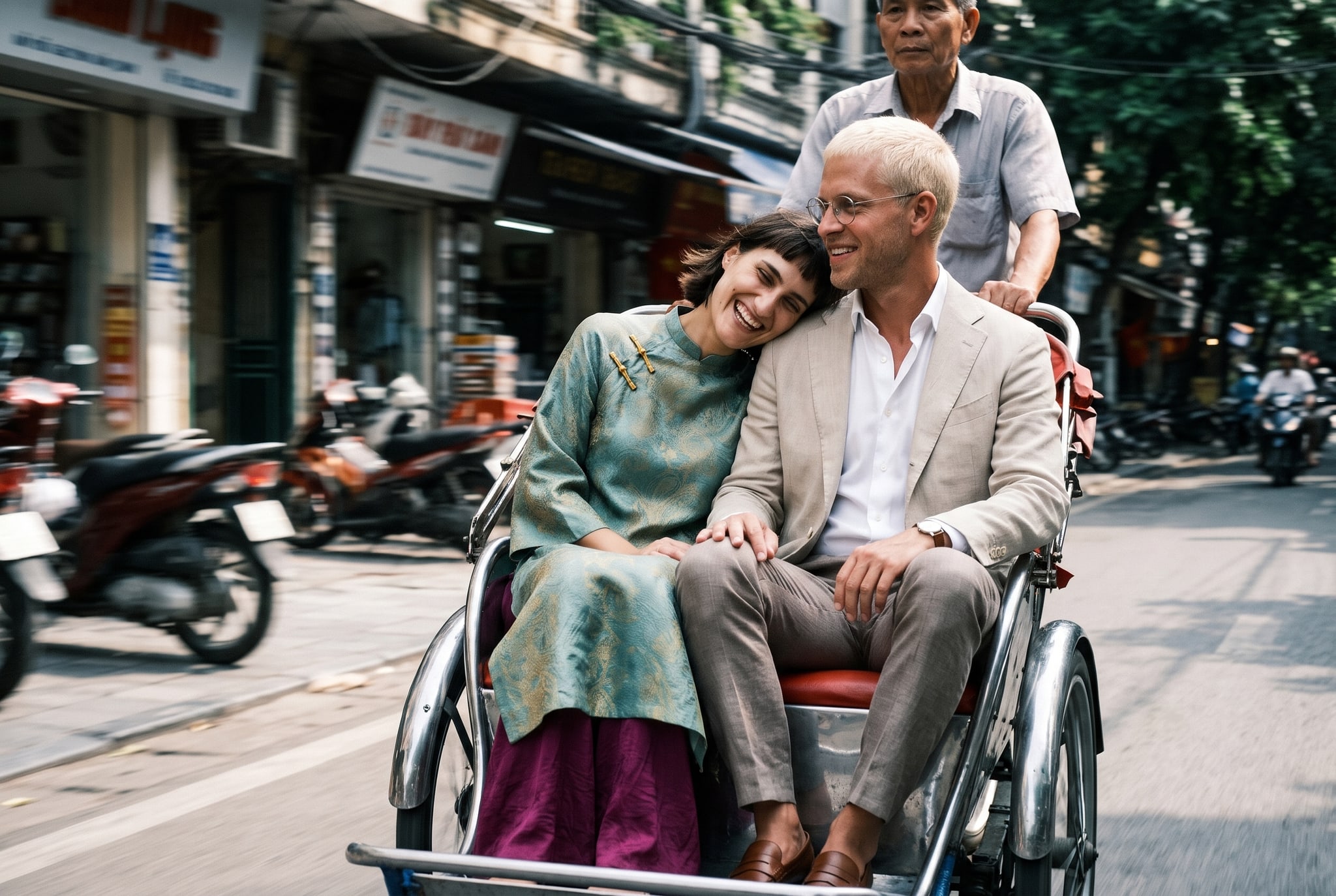
Peak congestion happens 9–11am and 4–6:30pm daily, when tourist groups and commuters overlap—expect 300–500 people crammed into the 100-meter shooting stretch, making posing nearly impossible. Mid-day (12–2pm) drops to 50–150 visitors as locals eat lunch and tour buses pause for meals. Evening dusk (6–7pm Nov–Feb, 5:30–7pm Mar–Oct) attracts photographers chasing golden light but still carries 100–200 spectators jostling for phone photos. Late night (8pm–midnight) thins to 20–40 lingerers, mostly solo travelers and nocturnal photographers, with very dim ambient light. Early morning (5:30–6:30am) is genuinely crowd-free—often just cleaners and us—but overcast or pre-dawn darkness requires strong ISO or flash, and the alley is wet from overnight cleaning. Weekend crowds are 15–20% heavier than weekdays because tour groups compress schedules. We recommend weekday mid-morning or late afternoon for your couple photoshoot or solo travel portraits if you want peaceful framing without strangers photobombing.
How does seasonal light change at Train Street?
Light quality shifts dramatically with Hanoi's two seasons, affecting both shooting conditions and crowd behavior. From November to February (cool, dry season), the sun is lower and rises later: golden hour begins around 5pm and ends by 6:15pm, coinciding with rush-hour foot traffic. Harsh midday sun (10am–3pm) is gentler than in summer, ideal for skin tones if you're doing headshots or graduation photoshoot sessions. March to October (hot, humid season), sunrise is earlier and sunset much later—golden hour runs 5:15–6:30pm, overlapping the heaviest commuter jam. Midday (11am–3pm) is brutal: bright, contrasty, unflattering shadows on faces. We avoid shooting Train Street during peak summer (June–July) altogether because humidity creates haze that kills color saturation and the heat drives crowds to eat longer lunches, compressing them into afternoon hours. Overcast days (common Dec–Jan and Sept–Oct) are actually ideal—soft, even light, though fewer tourists, which means fewer distractions but also less energy for Instagram photoshoot backdrops. We time your shoot to both light and real crowd patterns, not just calendar dates.
What rules and restrictions should you know before arriving?
Train Street operates under three hard rules that police enforce: (1) no standing, sitting, or posing on the tracks themselves—only the flanking alley; (2) complete clearance of the train corridor when a locomotive is 100 meters away (staff will yell and gesture); (3) no tripods or professional rigs without prior written permission from the railway authority. Violators receive verbal warnings, fines up to our current quote (roughly our current quote–20), or removal by police. The alley is technically open 6am–10pm, though we've shot safely as late as 9pm. Foreigners are not exempt; we've seen tourists turned back by officers for ignoring barriers. The stretch is only 100 meters long and narrow, so you cannot expect privacy or isolation—your shoot will have onlookers and phone cameras pointed at you, especially if you're in ao dai photoshoot attire. Food and drink are forbidden on the tracks. Photography for personal/commercial use is allowed, but not film permits or drone footage (permit required from Hanoi Tourism Board). We brief all clients on these before arrival and position you safely away from track edges.
How should you dress and pose for Train Street photos?
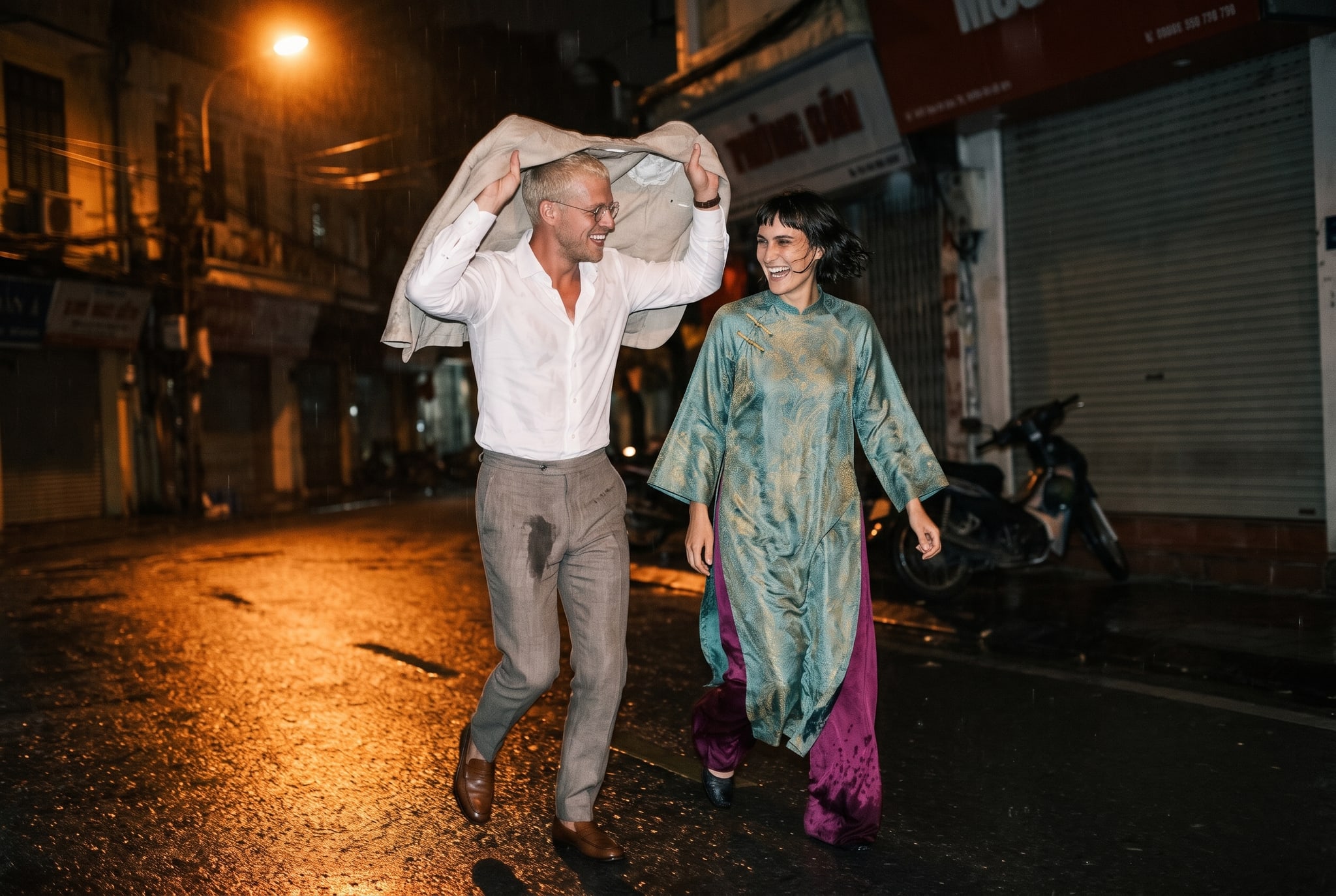
Clothing should be comfortable, weather-appropriate, and visually distinct from the industrial-gray alley background. Bold jewel tones, pastels, or solid colors (not busy patterns) photograph cleanly against aged brick and metal. Traditional ao dai rental in vibrant silk works beautifully here—the contrast between formal dress and gritty industrial setting is striking. Avoid loose, flowing fabrics that snag on rust or debris; the ground is uneven, littered with gravel, and occasionally wet. Footwear should be closed-toe and sturdy (ankle injuries are common on uneven surfaces). For family photoshoot or couple photoshoot sessions, coordinate colors without matching identically—one warm, one cool tone creates visual interest without clashing. Posing requires caution: never lean on the weathered walls (rust stains your clothes), don't step near track edges, and stay alert to staff signals. We ask clients to practice simple, natural poses beforehand because crowds unsettle many people—walking, looking at each other, genuine laughter work better than static stares. If you're doing a pre-wedding photoshoot or proposal photographer moment here, we choreograph movement carefully to avoid trip hazards. Stillness and tension betray discomfort; movement (slow walks, hand-holding, turning) feels authentic and photograph best.
Crowd and Light Timing Comparison Table
| Time slot | Crowd size | Light quality | Train risk | Best for | Notes |
|---|---|---|---|---|---|
| 5:30–6:30am | 0–10 people | Pre-dawn/dim | Low (before schedule) | Solo, quiet mood | Wet alley; cold; very still |
| 6:45–9am | 50–100 | Soft, even | Medium (post 6:30am train) | Headshots, couples | Golden window post-train; warming |
| 9–11am | 300–500 | Harsh/contrasty | High (11:15am train imminent) | Avoid | Peak tour group saturation |
| 12–2pm | 50–150 | Neutral/flat | Low (post-train lull) | Ao dai, family | Cleanest light for formal attire |
| 2–4pm | 80–200 | Harsh shadows | Medium | Avoid | Heat, humidity spike |
| 4–5pm | 150–250 | Transitioning | Medium (approaching 3:30pm) | Skip | Build-up pre-rush |
| 5–6:15pm (Nov–Feb) | 200–400 | Golden (excellent) | High (5:45pm train) | Sunset only | Rush-hour congestion; best light |
| 5:15–6:30pm (Mar–Oct) | 250–400 | Golden (excellent) | High | Sunset only | Humidity, haze; crowd heaviest |
| 7–9pm | 20–50 | Dusk/dim | Low (post-evening train) | Moody, intimate | Ambient light from alley lamps only |
| 9pm+ | 5–20 | Dark | None | Avoid | No ambient light; unsafe footing |
What to check before you book a Train Street shoot
- Confirm train schedule 24 hours ahead. Call Hanoi Station info line or ask your hotel—freight schedules shift and holiday runs are unpredictable.
- Choose a weekday if possible. Weekends compress tour groups into afternoon hours, doubling congestion.
- Pick a season (Nov–Feb ideal). Cool, dry weather, lower sun angle, fewer heat-driven crowds, and golden hour doesn't collide with rush hour as badly.
- Decide your light priority. Dawn (empty, dim) vs. golden hour (beautiful, crowded) vs. mid-day (flat, peaceful). We'll match crowd timing to your preference.
- Wear closed-toe, sturdy shoes. Uneven ground + rust + gravel = twisted ankles if unprepared.
- Bring water and a light layer. Early morning is cool; afternoon is sweltering.
- Accept that you'll have onlookers. Train Street is not private; phones and cameras will point at you. If you need total seclusion, Hoan Kiem Lake photo guide offers quieter alternatives.
- Confirm permissions if you're bringing professional gear. Tripods, reflectors, or boom mics require advance clearance.
We handle logistics and timing so you don't guess. Text us your preferred light and comfort level, and we'll propose the best window for your family photoshoot, couple photoshoot, or solo session—and we'll be there to navigate crowds and train arrivals.
More Hanoi photo guides
Explore other iconic Hanoi locations on our all guides page, including Hoan Kiem Lake photo guide for calm, scenic water backdrops and hanoi old quarter photo guide for narrow-street atmosphere without track hazards.
FAQ
Can we shoot Train Street at night (8pm–10pm)?
Yes, light is very dim (mostly alley lamps), so we'd use high ISO and wide aperture. Crowds are minimal (20–30 people), and police are less active, but footing is hazardous and image quality suffers unless you prefer moody/noir aesthetics. We recommend it only for adventurous couples or solo travel portraits clients seeking drama.
Do we need a permit to photograph at Train Street?
Personal photography for memory use does not require a permit. If you're shooting for commercial sale, a blog, or social media monetization, you should request permission from Hanoi Railways Authority (process takes 3–5 days). We advise clients: if it's for your personal album or Instagram, you're fine; if it's for a brand or paid portfolio, contact the authority first to avoid fines.
What's the actual crowd size during "quiet" hours?
Our mid-day (12–2pm) baseline is 50–150 people; early morning (5:30–6:30am) is 0–10; late evening (8–9pm) is 20–50. Peak hours (9–11am, 4–6pm) spike to 300–500. These counts are from our logs across 50+ sessions over the past two years; weather and holidays shift them by 20–30%.
Can children or elderly people safely shoot Train Street?
Children under 8 and people with mobility issues face real hazards: uneven gravel, narrow alley, rust, no handrails, and unpredictable crowds. We recommend Hoan Kiem Lake photo guide instead, which has smooth pavement and is genuinely crowd-free in early morning. If you insist on Train Street, we limit session length to 20 minutes and station a spotter close to you.
Should we shoot Train Street in summer or winter?
Winter (Nov–Feb) is objectively better: cooler, lower sun angle, fewer crowds, and golden hour (5–6:15pm) is earlier so it clears rush hour faster. Summer (June–July) has humidity haze, brutal midday heat, heavier crowds compressed by lunch breaks, and golden hour (5:15–6:30pm) overlaps peak commuter gridlock. We avoid scheduling Train Street shoots June–July and lean winter for both comfort and image quality.
How long does a typical Train Street photoshoot take?
A 60–90 minute session (couple or family photoshoot) yields 150–250 edited images. We spend 20–30 minutes on setup, wardrobe check, and light scouting, then 40–60 minutes shooting across 2–3 train windows. If you want headshots only (30 min), expect 50–80 keepers. Longer sessions (2+ hours) risk fatigue and crowd frustration, so we don't recommend them. --- Plan your Hanoi shoot
Check dates
Send your dates, how many people and the style you like. We reply on WhatsApp in English with spots, timing and a quote.
FAQ
Can we shoot Train Street at night (8pm–10pm)?
Yes, light is very dim (mostly alley lamps), so we'd use high ISO and wide aperture. Crowds are minimal (20–30 people), and police are less active, but footing is hazardous and image quality suffers unless you prefer moody/noir aesthetics. We recommend it only for adventurous couples or [solo travel portraits](/solo-portrait) clients seeking drama.
Do we need a permit to photograph at Train Street?
Personal photography for memory use does not require a permit. If you're shooting for commercial sale, a blog, or social media monetization, you should request permission from Hanoi Railways Authority (process takes 3–5 days). We advise clients: if it's for your personal album or Instagram, you're fine; if it's for a brand or paid portfolio, contact the authority first to avoid fines.
What's the actual crowd size during "quiet" hours?
Our mid-day (12–2pm) baseline is 50–150 people; early morning (5:30–6:30am) is 0–10; late evening (8–9pm) is 20–50. Peak hours (9–11am, 4–6pm) spike to 300–500. These counts are from our logs across 50+ sessions over the past two years; weather and holidays shift them by 20–30%.
Can children or elderly people safely shoot Train Street?
Children under 8 and people with mobility issues face real hazards: uneven gravel, narrow alley, rust, no handrails, and unpredictable crowds. We recommend [Hoan Kiem Lake photo guide](/spots/hoan-kiem-lake) instead, which has smooth pavement and is genuinely crowd-free in early morning. If you insist on Train Street, we limit session length to 20 minutes and station a spotter close to you.
Should we shoot Train Street in summer or winter?
Winter (Nov–Feb) is objectively better: cooler, lower sun angle, fewer crowds, and golden hour (5–6:15pm) is earlier so it clears rush hour faster. Summer (June–July) has humidity haze, brutal midday heat, heavier crowds compressed by lunch breaks, and golden hour (5:15–6:30pm) overlaps peak commuter gridlock. We avoid scheduling Train Street shoots June–July and lean winter for both comfort and image quality.
How long does a typical Train Street photoshoot take?
A 60–90 minute session (couple or [family photoshoot](/family-photoshoot)) yields 150–250 edited images. We spend 20–30 minutes on setup, wardrobe check, and light scouting, then 40–60 minutes shooting across 2–3 train windows. If you want [headshots](/headshots) only (30 min), expect 50–80 keepers. Longer sessions (2+ hours) risk fatigue and crowd frustration, so we don't recommend them. --- [✨ Plan your Hanoi shoot](/contact)
More like this
Hanoi photo spots
Hanoi Book Street Family Photos: Best Times, Rules & Posing Tips
Hanoi Book Street (Phố Sách) offers tree-lined, traffic-light backdrops perfect for family photos. We guide you through light timing, local rules, and kid-friendly posing to avoid crowds and capture genuine moments.
Hanoi photo spots
Duong Lam Ancient Village Photo Spots: Best Times & Light Guide
Duong Lam Ancient Village, 45 km southwest of Hanoi, holds Vietnam's oldest intact rural architecture—tile-roofed houses, brick kilns and narrow lanes where morning mist holds light for 90 minutes. We photograph here year-round for solo travelers, families and couples seeking authentic, off-beat Han
Hanoi photo spots
Duong Lam Ancient Village: Crowd-Free Times & Photo Spots
Duong Lam Ancient Village, 45 km southwest of Hanoi, draws tourists year-round—but early mornings and weekdays offer near-empty temple courtyards and village lanes. We share exact timing, seasonal light, and how to pair a visit with professional portraits.