
Home › Blog › Hanoi photo spots
Hanoi Old Quarter couple photos: best spots, timing & light
By the Hanoi Photoshoot team · 2026-11-06
The Old Quarter spans roughly 36 colonial blocks between Hoan Kiem Lake and the Red River, built in the 11th century around merchant trades; it's ideal for couple photos because of its texture, narrow lanes that frame subjects tightly, and diffused light in early morning or late afternoon. A typical session runs 2–3 hours and covers 4–6 key spots within walking distance—we navigate crowds, secure access to restricted areas (some alleys and courtyards require permission), and time shots around market hours. Best seasons are October–November and February–March; avoid midday glare and the chaotic Tet holiday period. Hanoi Photoshoot by Cáo Studio (hanoiphotoshoot.com) handles all coordination in English, includes in-house makeup and styling, and manages legal photo permits so you avoid fines on Train Street or temple grounds. Cost varies by session length and retouching; ask us for a quote on WhatsApp. Common mistakes: shooting at noon (harsh shadows), ignoring crowd peaks (10 a.m.–2 p.m. is busiest), and assuming you can freely photograph anywhere—temples, some shops and residential doorways have strict rules we'll explain upfront. Check dates on WhatsApp
Why does the Old Quarter work so well for couple portraits?
The Old Quarter's tight geometry—buildings 4–5 stories high pressed against narrow 2–3 meter lanes—creates natural framing and soft, directional light that flatters skin and removes harsh shadows you'd get in open parks. The layered backdrop (hanging signs, weathered shutters, market goods, motorbikes parked at angles) adds visual story without being distracting; subjects stand out because the frame is dense but balanced. Corners and alcoves let us isolate couples away from foot traffic, and the constant human activity—vendors calling, tourists wandering, cyclos passing—gives authentic context instead of a staged feeling. Conclusion: tight urban geometry, natural light quality, and textured backgrounds make the Old Quarter one of Hanoi's most forgiving settings for non-model couples.
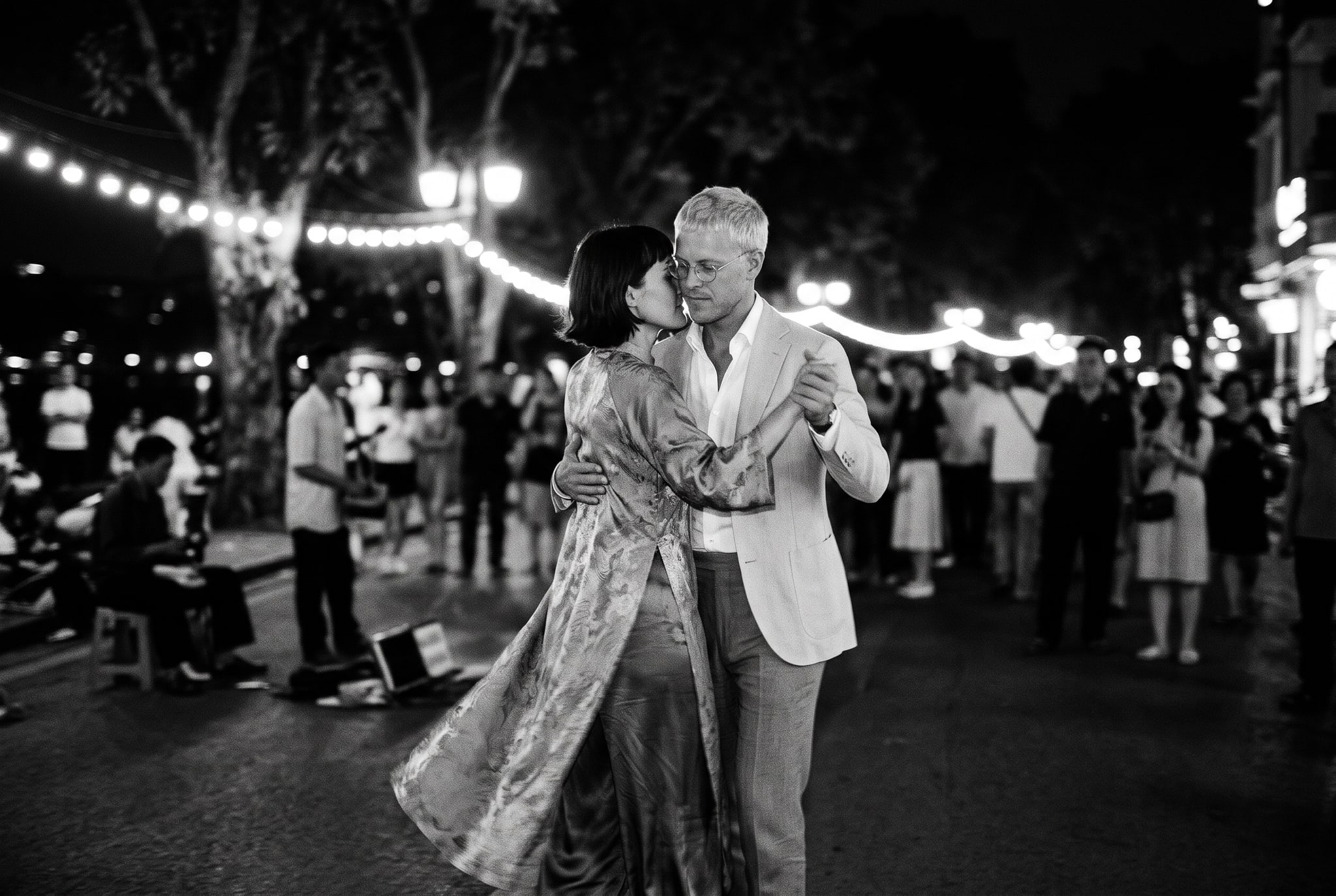
When should we shoot to avoid crowds and get the best light?
Early morning (6–7 a.m., September–March) offers the lowest foot traffic and golden, side-lit rays that wrap around colonial facades; we shoot 30–40 minutes before the first breakfast vendors set up. Mid-afternoon (3–5 p.m., same season) gives similar angle and crowd patterns, though summer light drops earlier. Peak chaos runs 10 a.m.–2 p.m. when tour groups cluster near Hang Ngang Street and the market swells; we avoid these windows entirely. Train Street (Hang Duong) has official photo hours 8–10 a.m. weekdays only; weekends and afternoons are prohibited. Rainy season (May–September) means 4–5 p.m. golden hour compresses; light fades fast. Plan your couple photoshoot at least one week in advance so we confirm weather, secure access permits, and book your time slot. Conclusion: 6–7 a.m. or 3–5 p.m. in cool months gives light and solitude; avoid midday and peak tour windows.
What are the actual rules and restrictions we need to know?
Temples (Quan Su Pagoda, Tran Quoc) forbid commercial shoots without prior written permission from the abbot; personal/engagement photos are sometimes allowed but require respectful dress and modest timing near closing (4–5 p.m.). Train Street (Hang Duong alley) is Hanoi's most regulated spot—official shoots only 8–10 a.m. weekdays, and you need a permit (we file this); afternoon/weekend amateur photos risk a fine of 500,000–our current quote (~our current quote–our current quote). Private shops and homes: never shoot doorways or interiors without asking permission first; many families will say yes if you're polite, but assume "no" until they agree. Street vendors own their pitch—if we want their goods in frame, we tip or ask first. Religious objects (altars, incense) require permission to feature prominently. We carry ID and shoot permits so if challenged, we show legal standing; this avoids delays or fines. Conclusion: obtain written permission from temples and Train Street, ask residents first, and never assume any private space is public.
Which specific Old Quarter streets give the best light and fewest obstacles?
Hang Ngang, Hang Dao and Hang Mam run east–west and catch side light 6–8 a.m. and 4–5 p.m.; they're wide enough for couple poses without constant motorbikes passing (they're still busy, but walkable). Hang Gai leans quieter mornings, features vintage shop fronts and lanterns, and has alcoves near side entrances for portrait isolations. Ta Hien (the tourist bar strip) feels chaotic all day but works at 6–7 a.m. before bars close or 5 p.m. after lunch crowd clears; the red-shuttered colonial buildings frame tightly. Ngo Gai (a narrow alley off Hang Gai) is barely two meters wide, has zero motorbike traffic, and photographs like a film-noir tunnel—perfect for intimate couple silhouettes. Hang Be and Hang Buom are fishier, less commercial, and let us shoot without crowds, though fewer tourists means fewer "life" in the background if you want that feel. Here's a spot selection table based on vibe and timing:
| Street | Width | Light Window | Crowd Level | Vibe | Best For |
|---|---|---|---|---|---|
| Hang Ngang | 3–4m | 6–8 a.m., 4–5 p.m. | Medium | Shops, lanterns | Playful, energetic couples |
| Hang Gai | 2–3m | 6–9 a.m., 5–6 p.m. | Low–Medium | Vintage, calm | Intimate, thoughtful poses |
| Ngo Gai alley | 2m | 6–8 a.m., 5–6 p.m. | Very low | Moody, enclosed | Artistic silhouettes |
| Ta Hien | 3–4m | 6–7 a.m., 5–6 p.m. | High–Medium (early/late) | Vibrant, bohemian | Social, candid energy |
| Hang Be | 3m | 7–8 a.m., 5–6 p.m. | Low | Authentic, less touristy | Authentic-lifestyle couples |
Conclusion: pick a street based on width (tighter = more framing control), light hour (east–west streets favor morning/late afternoon), and desired mood.
How do we prepare outfits, makeup and styling for an Old Quarter shoot?
Avoid pure white or neon colors—the Old Quarter's intense reds, oranges and earth tones will clash or overexpose under midday glare; instead, wear jewel tones (emerald, sapphire, burgundy), pastels (soft blush, cream, sage) or neutrals (charcoal, camel, navy) that harmonize with colonial facades. Layers work—a linen shirt over a tank, a light cardigan—because temperature swings from 6 a.m. cool to afternoon heat, and you can adjust for comfort and silhouette during the 2–3 hour session. Shoes: flat leather sandals, canvas sneakers, or traditional leather flats so you can move quietly over uneven stone lanes; high heels catch cobblestones and slow you down. Jewelry: small, understated pieces (thin watches, delicate rings) so they don't catch light and distract; chunky accessories photograph as clutter in tight lanes. Makeup should resist heat and humidity; we include in-house makeup, hair & ao dai rental so you arrive bare-faced and we apply a longevity formula suited to Hanoi's 70–90% humidity. Hair: tie back if you have long hair so it doesn't cross the face in unplanned ways; a simple bun or braid lets the Old Quarter's textures frame you. Couples often ask: should we match colors or contrast? Answer: coordinated tones (both jewel, both pastel) photograph as "intentional" without looking costume-y; avoid matching outfits exactly, as that reads as twin/costume rather than romantic couple. Book a styling consultation when you check dates on WhatsApp so we curate options before your shoot day. Conclusion: wear harmonious, heat-resistant colors and layers; skip heels and loud jewelry; let us handle makeup and hair so you look fresh after 3 hours of walking.
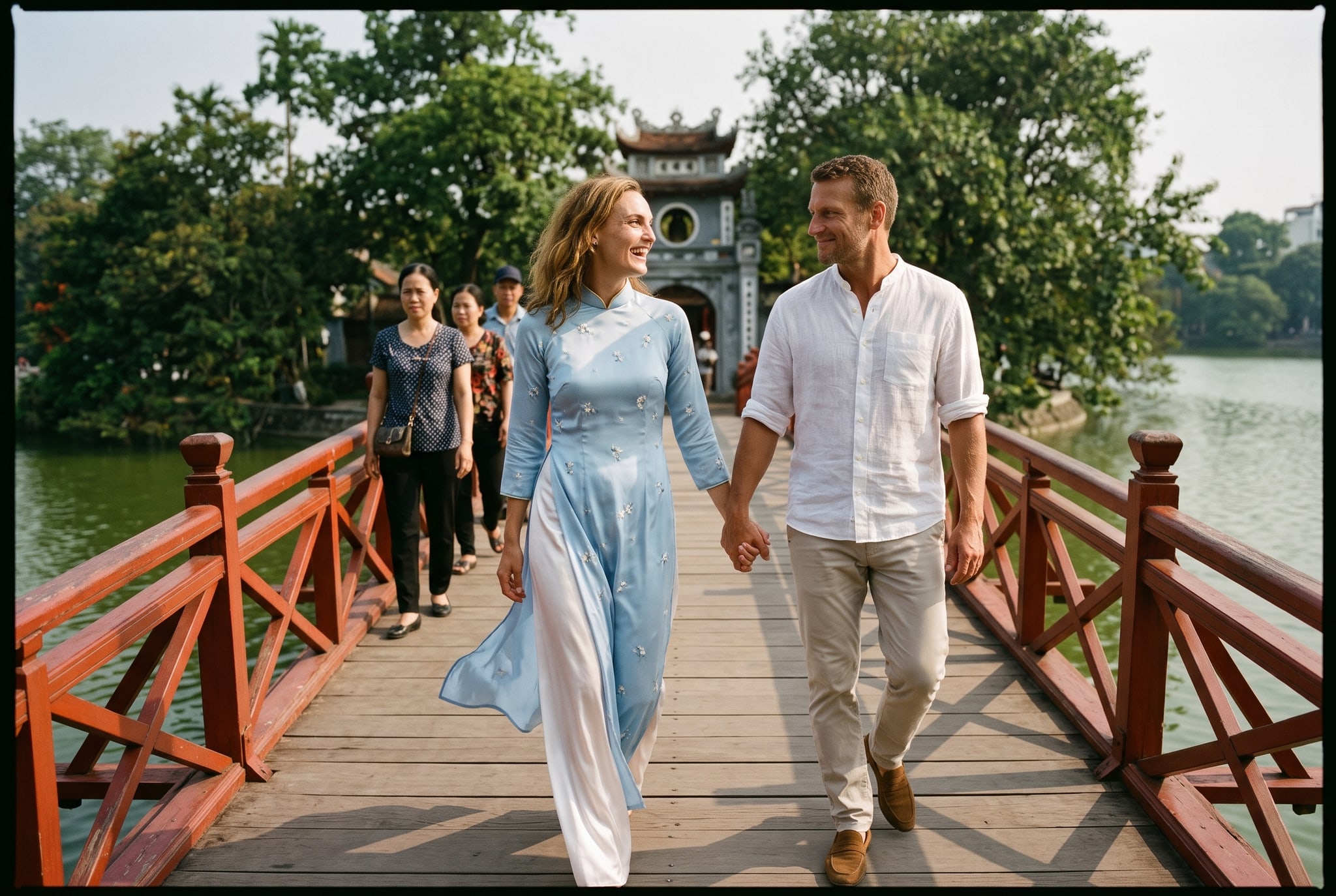
What's the realistic flow of a couple session in the Old Quarter?
You arrive at our studio (central Hanoi location, 10 minutes by taxi from the Old Quarter) at the agreed time. We do 20–30 minutes of makeup, hair and wardrobe check; if you've brought an ao dai, we style it and ensure comfort. We then walk to the Old Quarter entry point (usually Hoan Kiem Lake side or Train Street if the time slot is booked) with a portable reflector and one lighting assistant. Shot 1 (0–20 min): we scout the current crowd and light angle; we might start on a quieter side street if morning light is still low and dramatic. Shots 2–3 (20–60 min): we move to 2–3 primary locations based on light and couple energy—usually one open-feeling spot (Hang Ngang or Hang Gai), one enclosed/intimate (Ngo Gai alley), and one market or vendor setup if you want lifestyle context. Mid-session reset (60 min mark): we pause for water, outfit adjustment, or a quick location change if light has shifted; this is when we check that you feel comfortable and address any posing concerns. Shots 4–6 (60–150 min): we shoot detail-oriented frames (hands, embraces, walking transitions, silhouettes) and let couples interact naturally so we capture genuine moments rather than forced smiles. Pack-up (150 min): we head back to studio, you get final photos on our backup drives, and we begin post-processing (usually 5–7 business days for a full edit). Common timing issues: light disappears 10–15 minutes earlier than forecast on overcast days, so we compress the last two locations into one tighter sequence; motorbike density spikes 7:30–8 a.m. so we shoot quicker in dense windows. Conclusion: plan 3–4 hours door-to-door; light and crowd reality may shift your location sequence, but we always deliver the same number of unique frames.
What should couples check before booking their Old Quarter session?
- Confirm your preferred light hour (6–7 a.m., 3–5 p.m., or off-season dusk) and we'll verify weather forecasts 48 hours before; rain voids light but doesn't cancel the shoot unless you choose to reschedule.
- Agree on outfit colors together via our styling consultation; send reference photos of what you're considering and we'll advise harmony and heat-resistance.
- Check visa/ID status: non-Vietnamese couples need valid passport copies or tourist cards so we can file photo permits if Train Street is in your itinerary; this takes 2–3 working days.
- Discuss any religious or cultural sensitivities: if you're visiting temples or sacred areas, let us know so we ensure respectful timing and dress codes.
- Request any specific locations or moments: anniversary date symbols, business proposal elements, or family reunion timing—we'll plan the sequence and logistics around that anchor.
- Confirm retouching scope: skin smoothing, color grading, background cleanup, and delivery format (digital files, album, prints, Instagram-ready crops) so there's no surprise during delivery.
Can we do an ao dai shoot instead of or alongside the couple session?
Yes—many couples choose an ao dai photoshoot in Hanoi either as a separate session or integrated into a 4–5 hour extended shoot where they change outfits mid-session. A full ao dai couple shoot typically runs 2–2.5 hours; we provide the garment, styling, and all traditional jewelry, so you arrive without preparation. The Old Quarter's heritage vibe pairs perfectly with ao dai—colonial shutters and silk robes create historical continuity that feels authentic. Book an extended session if you want both Western couple wear and ao dai; it costs more but lets you access different venues (temples open early for ao dai, training grounds or lakeside parks work better in afternoon light). Discuss this when you contact us. Check dates on WhatsApp
Is the Old Quarter suitable for pre-wedding or proposal planning?
The Old Quarter works beautifully for proposal setups because hidden alcoves, intimate alleys, and bustling markets can be arranged so a partner doesn't expect the moment; we scout the exact corner beforehand, coordinate with you on surprise timing, and position ourselves discretely to capture the first-kiss reaction without being intrusive. For pre-wedding photoshoot planning, the Old Quarter is popular as one session within a multi-day Hanoi itinerary—it works best as an engagement moment or playful couple sequence rather than a full pre-wedding series (which often includes Hoan Kiem Lake, countryside, and studio looks). If you're planning a proposal photographer moment here, let us know at least 2 weeks in advance so we coordinate access, scout lighting, and prepare a backup indoor location in case weather fails. The Old Quarter's narrow lanes mean we can't set up formal arches or massive flower arrangements, so romantic gestures need to be intimate-scale (handwritten notes, small rings, close conversation) rather than public spectacle. Conclusion: the Old Quarter excels for surprise proposals and engagement energy but is secondary to Hoan Kiem Lake or countryside for full pre-wedding series planning.
FAQ
Do we need a permit to take couple photos in the Old Quarter?
Private couple shoots don't require a permit unless you're on Train Street (we file that), but if you hire a professional photographer (us), we carry a business ID and shoot authorization so if challenged by local authorities, we show legal standing. We handle all paperwork; you don't need to worry.
What happens if it rains on our shoot day?
Rain doesn't cancel the shoot—colonial architecture creates natural rain shelters (building overhangs, market stalls, narrow alcove roofs), and the wet stone and reflection actually enhance moody, atmospheric photos. We reschedule only if lightning or flooding blocks access; mild rain is an asset.
Can we include friends or family in a couple shoot?
Yes—a family photoshoot session can be adapted to the Old Quarter, though tight lanes mean we usually shoot smaller groups (2–4 people) so everyone stays in frame together. Larger families are better suited to open parks like Hoan Kiem Lake. Discuss group size when you book.
How many edited photos do we receive?
A standard 2–3 hour couple session includes 80–120 final edited images (color-graded, skin-smoothed, light adjusted); we deliver all digital files within 5–7 business days. Prints and albums are optional add-ons.
Is the Old Quarter safe to walk around early morning (6–7 a.m.)?
Yes—the Old Quarter is heavily populated by early-morning vendors, cyclo drivers, and locals buying breakfast; we're never alone, and the streets are well-lit and actively monitored. Early morning is actually safer than late evening and has the best light.
Can we shoot the Old Quarter during Tet (Lunar New Year)?
No—Tet (late January–February) shuts down most shops and businesses for 3–7 days, crowds are unpredictable, and many alleys are decorated with temporary installations; light and access are unreliable. We recommend October–November or March instead.
What's the difference between shooting the Old Quarter versus Train Street?
Train Street (Hang Duong) is one narrow alley with a single train track and is heavily regulated (8–10 a.m. weekdays only); the Old Quarter is 36 blocks with dozens of photogenic streets, open all hours, and far fewer restrictions. Train Street is a famous single-spot shoot; the Old Quarter is an extended exploration. See our Train Street photo guide for comparison details.
How close do we need to live to Hanoi to book a couple shoot?
We serve international travelers and expats staying in Hanoi for at least 1–2 days; if you're visiting from another city, we can integrate the Old Quarter session into a multi-day Hanoi itinerary or pair it with a day trip (ask us about solo travel portraits or extended packages). Our sister site vietnamphotoshoot.com covers other cities if you're also shooting in Da Nang or Ho Chi Minh City. --- Plan your Hanoi shoot
Check dates
Send your dates, how many people and the style you like. We reply on WhatsApp in English with spots, timing and a quote.
FAQ
Do we need a permit to take couple photos in the Old Quarter?
Private couple shoots don't require a permit unless you're on Train Street (we file that), but if you hire a professional photographer (us), we carry a business ID and shoot authorization so if challenged by local authorities, we show legal standing. We handle all paperwork; you don't need to worry.
What happens if it rains on our shoot day?
Rain doesn't cancel the shoot—colonial architecture creates natural rain shelters (building overhangs, market stalls, narrow alcove roofs), and the wet stone and reflection actually enhance moody, atmospheric photos. We reschedule only if lightning or flooding blocks access; mild rain is an asset.
Can we include friends or family in a couple shoot?
Yes—a [family photoshoot](/family-photoshoot) session can be adapted to the Old Quarter, though tight lanes mean we usually shoot smaller groups (2–4 people) so everyone stays in frame together. Larger families are better suited to open parks like Hoan Kiem Lake. Discuss group size when you book.
How many edited photos do we receive?
A standard 2–3 hour couple session includes 80–120 final edited images (color-graded, skin-smoothed, light adjusted); we deliver all digital files within 5–7 business days. Prints and albums are optional add-ons.
Is the Old Quarter safe to walk around early morning (6–7 a.m.)?
Yes—the Old Quarter is heavily populated by early-morning vendors, cyclo drivers, and locals buying breakfast; we're never alone, and the streets are well-lit and actively monitored. Early morning is actually safer than late evening and has the best light.
Can we shoot the Old Quarter during Tet (Lunar New Year)?
No—Tet (late January–February) shuts down most shops and businesses for 3–7 days, crowds are unpredictable, and many alleys are decorated with temporary installations; light and access are unreliable. We recommend October–November or March instead.
What's the difference between shooting the Old Quarter versus Train Street?
Train Street (Hang Duong) is one narrow alley with a single train track and is heavily regulated (8–10 a.m. weekdays only); the Old Quarter is 36 blocks with dozens of photogenic streets, open all hours, and far fewer restrictions. Train Street is a famous single-spot shoot; the Old Quarter is an extended exploration. See our [Train Street photo guide](/spots/hanoi-train-street) for comparison details.
How close do we need to live to Hanoi to book a couple shoot?
We serve international travelers and expats staying in Hanoi for at least 1–2 days; if you're visiting from another city, we can integrate the Old Quarter session into a multi-day Hanoi itinerary or pair it with a day trip (ask us about [solo travel portraits](/solo-portrait) or extended packages). Our sister site vietnamphotoshoot.com covers other cities if you're also shooting in Da Nang or Ho Chi Minh City. --- [✨ Plan your Hanoi shoot](/contact)
More like this
Hanoi photo spots
Hanoi Book Street Family Photos: Best Times, Rules & Posing Tips
Hanoi Book Street (Phố Sách) offers tree-lined, traffic-light backdrops perfect for family photos. We guide you through light timing, local rules, and kid-friendly posing to avoid crowds and capture genuine moments.
Hanoi photo spots
Duong Lam Ancient Village Photo Spots: Best Times & Light Guide
Duong Lam Ancient Village, 45 km southwest of Hanoi, holds Vietnam's oldest intact rural architecture—tile-roofed houses, brick kilns and narrow lanes where morning mist holds light for 90 minutes. We photograph here year-round for solo travelers, families and couples seeking authentic, off-beat Han
Hanoi photo spots
Duong Lam Ancient Village: Crowd-Free Times & Photo Spots
Duong Lam Ancient Village, 45 km southwest of Hanoi, draws tourists year-round—but early mornings and weekdays offer near-empty temple courtyards and village lanes. We share exact timing, seasonal light, and how to pair a visit with professional portraits.