
Home › Blog › Makeup, hair and ao dai rental
Ao Dai Rental Hanoi Poses: What Moves Work Best
By the Hanoi Photoshoot team · 2026-11-06
Ao dai rental in Hanoi works best when poses emphasize the tunic's long silhouette and flowing side panels—never pin them behind you. Stand with shoulders back, weight on one leg, and let the fabric cascade naturally; walking shots, seated poses on steps, and sideways frames show the split skirt's grace. Most renters shoot 2–4 hours across Old Quarter temples, Hoan Kiem Lake, or Train Street, returning the tunic same day. Our in-house rental at Cáo Studio Hanoi includes styling advice for your body type and the day's light conditions. Avoid stiff arms, overly crossed legs that bunch fabric, and backlit sun—early morning or late afternoon light flatters the delicate embroidery and silk sheen without washing out color. Check dates on WhatsApp
What posture makes ao dai flow look effortless?
Ao dai elegance depends almost entirely on posture: shoulders relaxed, chest open, hips level. Tilt your pelvis slightly forward to avoid slouching—the tunic's cut exaggerates poor alignment. Arch gently at the waist to create a line that draws the eye down the center placket. In motion, let your arms swing from the shoulders, not swinging from the elbows; stiff elbows trap the side panels and flatten the silhouette. When seated, cross legs at the ankle—not the knee—so the split skirt drapes openly over the chair's edge. This posture works across all our shoot types: ao dai photoshoot in Hanoi sessions, solo travel portraits, and couple photoshoot frames rely on this foundation.
One key insight: the tunic was designed when Vietnamese women wore their hair in elaborate up-dos and stood with upright spines. Modern slouch kills the silhouette instantly.
Which hand and arm placements avoid blocking fabric?
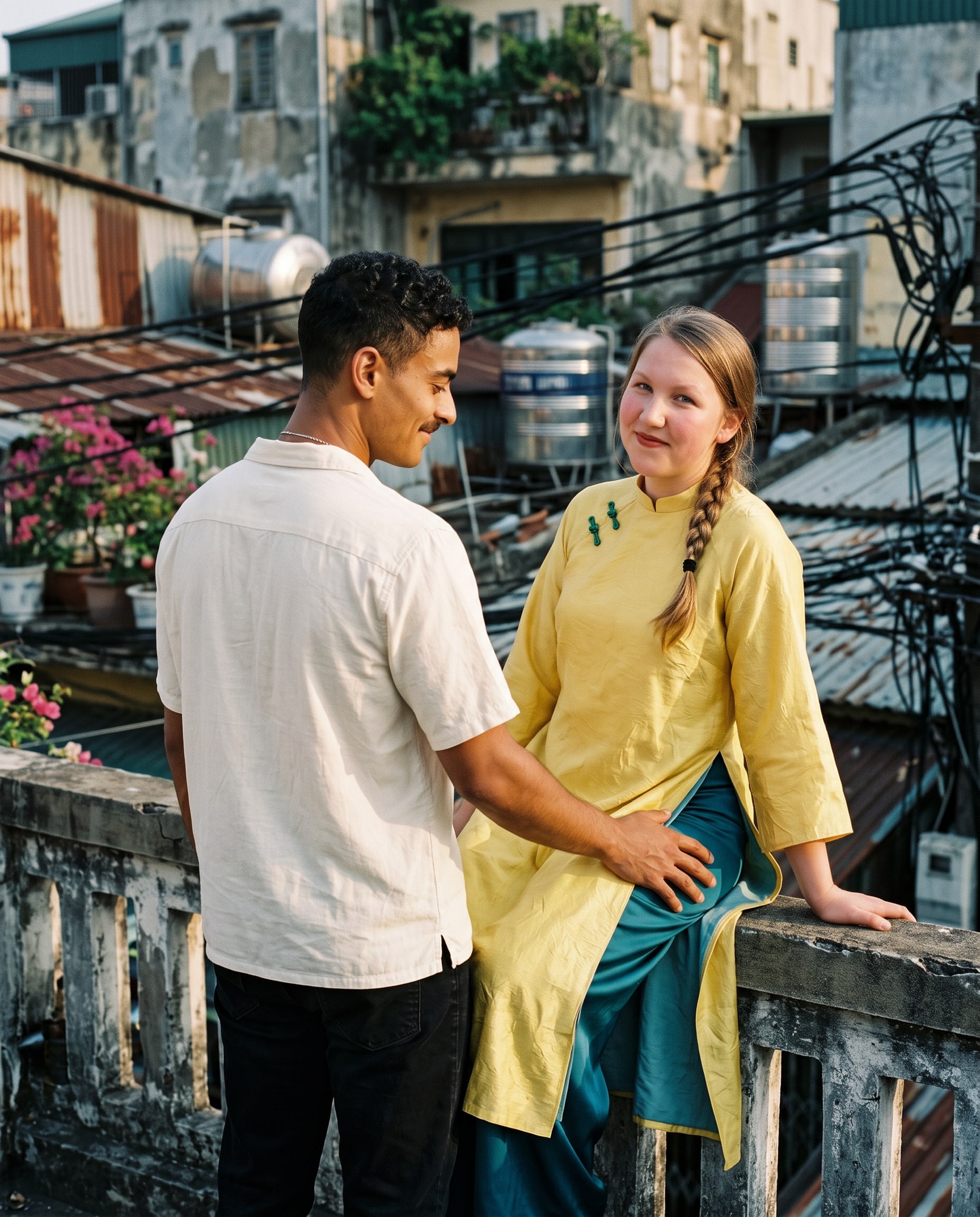
Your hands anchor the frame but can easily swallow the tunic's graphic impact. Avoid crossing arms across your torso—this bunches the side panels and breaks the vertical line. Instead, rest one hand on your thigh (if seated) or let arms hang naturally at your sides with a soft bend. If holding props—like flowers or a parasol—keep them off-center and well below the waist so they frame rather than obscure. Walk with hands slightly forward of your body, palms open to sky, never clasped or fisted. For family photoshoot poses with children, mothers should hold kids on the hip (the tunic's asymmetry handles this well) rather than in front. When standing, place one hand on a post, pillar, or railing—this creates energy without rigidity. For portrait close-ups, angle your head ⅜ turn toward camera; bring the lower hand to your collarbone or chest, elbow soft, to draw attention to your face and the tunic's shoulder embroidery.
The worst habit we see: locked elbows with hands in pockets or clasped tight. This reads as defensive and hides the garment's entire upper half.
How does Hanoi's light by hour change your pose strategy?
Hanoi's tropical sun demands timing discipline. Before 7:30 a.m., light is golden and soft on east-facing locations like Old Quarter heritage houses and Hoan Kiem Lake's eastern shore—ideal for walking poses where the tunic's silk catches backlighting. Shadows are directional and forgiving, so sideways frames work beautifully. Between 9 a.m. and 3 p.m., direct overhead sun bleaches color and creates harsh shadows under the eyes; this is training time or break time, not prime shoot time. If you must shoot midday, move into temple courtyards or dense tree coverage at Old Quarter gardens—the dappled shadow flatters tunic embroidery and skin tone. After 4 p.m., golden hour returns from the west; shoot on Old Quarter's narrow streets (shadows run east) or west-facing temple steps. Train Street's famous 5 p.m. train moment pairs beautifully with ao dai: position yourself sideways so the tunic's split skirt plays against the track angle, weight forward on your front leg. By 6:30 p.m., light is soft but fading fast—poses must be clean and symmetrical since detail work vanishes.
Based on our calendar across all seasons, late afternoon in November–January (cool, lower sun angle) delivers the best ao dai frames—prepare poses that use side light and walking momentum.
What fabric weights and colors pose differently?
Our rental collection spans traditional silk (heavier, glossier) and modern cotton-blended tunic options. Silk versions weigh 1.2–1.5 kg per tunic and respond differently to motion than cotton blends (~800 g): silk tunic fabrics cling slightly in still poses and create momentum in walking shots, while cotton blends feel lighter and look crisper for seated frames. Darker colors—navy, burgundy, black—photograph with dimensional depth and work brilliantly in morning or evening light. Pastels—mint, peach, cream—require overcast conditions or strong backlighting to avoid washed-out frames; these sing on cloudy days or at 5+ p.m. in season. Jewel tones (emerald, sapphire, deep gold) hold vibrancy across all light conditions and flatter most skin tones in our makeup and styling sessions. Heavily embroidered designs (brocade shoulders, beaded hems) photograph best in controlled light and closer frames; we recommend these for studio or temple courtyard shoots, not busy street scenes where detail gets lost. Simpler, solid tunics with minimal embroidery work for movement-heavy shoots like Train Street or walking tours.
| Fabric Type | Weight | Best Light | Best Pose Style | Why |
|---|---|---|---|---|
| Silk (traditional) | 1.2–1.5 kg | Golden hour, backlighting | Walking, spinning, standing profile | Catches light, fabric momentum visible |
| Cotton blend | ~800 g | Overcast, midday shade | Seated, close portraits, stationary | Crispness, no clinging, detail shows |
| Light pastels | Variable | Late afternoon, cloudy | Soft poses, shade, against textures | Bright sun washes them out |
| Jewel tones | Variable | All light | All poses, especially motion | Retain vibrancy, flatter diverse tones |
| Heavy embroidery | Variable | Morning sun, dappled shade | Close frames, temple steps, slow walk | Detail visible, no blur or distance loss |
The takeaway: rental choice shapes your pose toolkit. Ask us during booking which tunic suits your location and time.
Why do certain Hanoi locations demand specific poses?
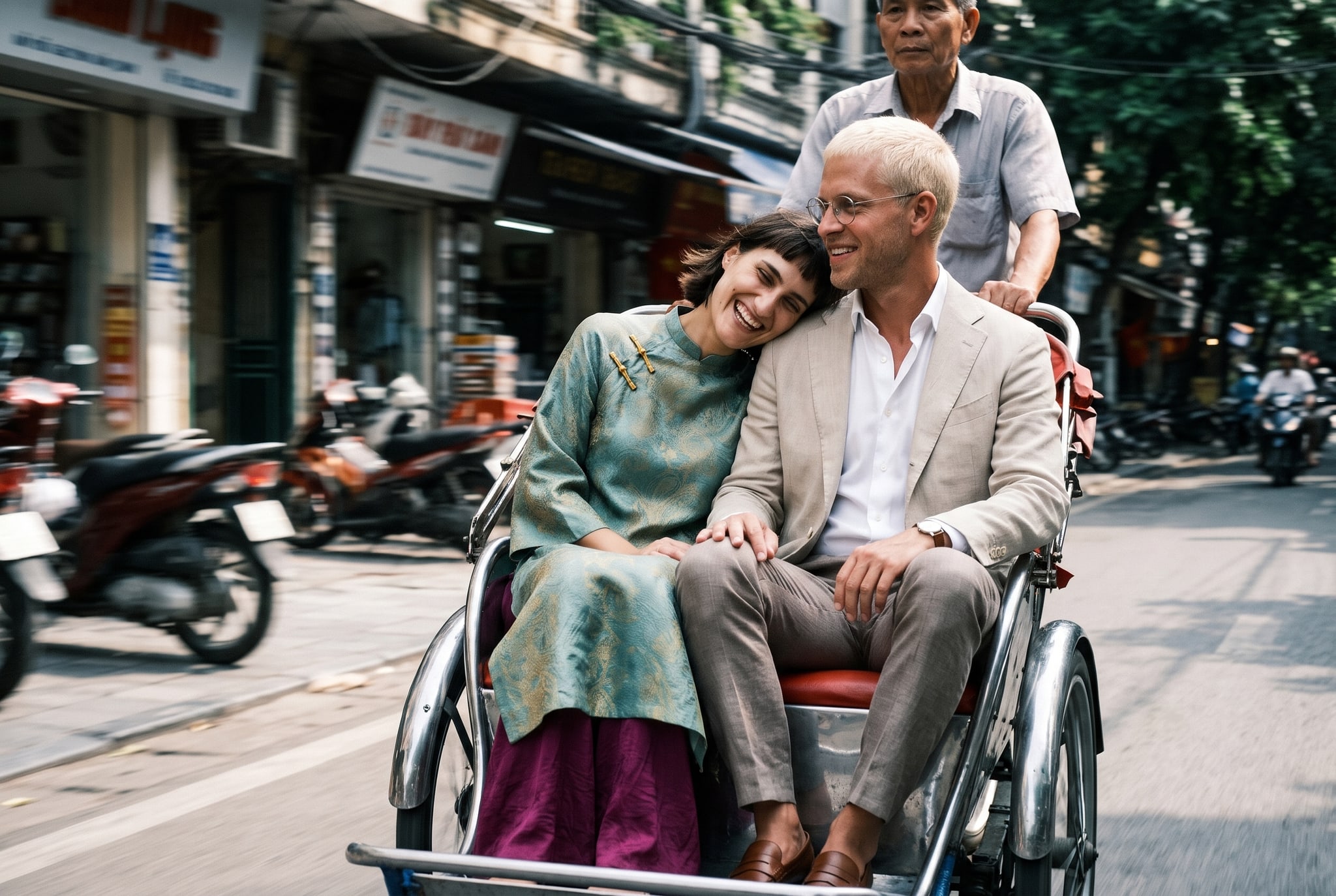
Location dictates pose grammar. Hoan Kiem Lake offers long sightlines—use the water's reflection by standing edge-on, so your tunic and its mirror image create symmetry. The lake's east bank gets morning light; shoot walking poses that move toward or away from the water, letting fabric trail. Temples like Quan Thanh or Tran Quoc reward slow, reverential stances: stand centered in stone doorways, hands folded at waist, to honor architecture and garment together. Avoid running or dynamic leaps in temples—poses must feel meditative. Old Quarter's narrow streets create natural framing with shopfronts and shutters as backdrop; here, still poses work better than motion, since tight alleys give no space to recover from blur. Use the street's diagonal light by standing parallel to storefronts and turning your torso ¾ toward camera. Hanoi Train Street demands safety and timing: stand still, off the rails, sideways to the camera so the train's angle complements your tunic's line. Walking poses on Train Street are restricted for safety—check local rules beforehand. Pre-wedding shoots on couple photoshoot sessions often pair two tutored-pose styles in one location: forehead-to-forehead at temples, holding-hands walks by the lake, laughing-over-shoulder frames in streets. Solo or graduation photoshoot frames in parks benefit from layered poses: sit on lawn with tunic spread around you, stand with diploma held at hip, walk toward camera down tree-lined paths.
Each location has a pose "grammar" baked into its geometry and foot traffic—we show you this during coordination.
Plan your Hanoi shoot
What should you check before renting and posing?
Before booking, confirm: (1) your exact body measurements (bust, waist, hips, inseam) so we order the right fit—loose fabric hides posture, tight fabric restricts movement; (2) your shoot location and time window, since this determines fabric weight and color choice; (3) any mobility limits (knee issues, back tightness, pregnancy)—we adjust poses accordingly; (4) your comfort level with heritage etiquette—temples require shoes removed and covered shoulders, which affects posing flow; (5) return time and condition expectations—we inspect tunic seams and embroidery post-shoot, so avoid kneeling directly on rough stone or sitting in deep water.
Test your posture at home before the shoot day. Stand in front of a mirror, shoulders back, weight forward on one leg, arms relaxed. Notice how your natural slouch or arch reads. Spend 5 minutes in this stance so it feels automatic during the shoot—nervous tensing destroys the effortless look.
Bring hair in an updo or braid if possible; loose hair obscures the tunic's neckline and embroidery. Avoid bright nail polish if your hands will be visible (earthy or nude shades ground the frame). Wear slip-on shoes for temple visits so you're not fumbling with laces and disrupting posture. Eat a light meal 1–2 hours before the shoot; hunger and fatigue collapse posture fast.
How do non-models stay comfortable and confident during poses?
Comfort is confidence. We never ask for "unnatural" movements; every pose we suggest is one Vietnamese women have held for centuries. Start with standing frames (easiest) and build to seated or walking (more complex). Between shots, shake out your shoulders and take three deep breaths—tension erodes posture. If a pose feels wrong in your body, tell us immediately; we adjust. Most renters worry about "looking stiff," but stiffness comes from holding your breath or overthinking. Focus instead on a point behind the camera (not the lens itself), soften your gaze, and think of a calm memory—this reads as serene, not robotic. For maternity photoshoot clients in our rental, we position the tunic to frame the belly and recommend gentle, weight-shifted poses that feel safe. For proposal photographer moments in tutus, we practice hand transitions so the proposal moment feels organic, not choreographed.
One honest truth: the best frames happen when you forget you're being photographed. This takes 30–45 minutes of shooting. The first 10 minutes you'll feel self-conscious. By minute 30, muscle memory kicks in and your face relaxes. We pace shoots to get you past that threshold.
FAQ
Do I need experience modeling to pose in an ao dai?
No. We teach pose technique during the shoot; 80% of our renters have never done a photoshoot. The tunic's structure does much of the work—your job is posture and relaxation, not runway skills.
What's the best time of year to rent and shoot ao dai in Hanoi?
November through January offers cool temperatures (18–22°C), lower sun angles, and less humidity, so posture stays comfortable and fabric holds shape. Avoid May–September (heat, sweat, frizz) for outdoor all-day sessions.
Can I wear an ao dai for a couple photoshoot, or only solo?
Both. One partner in ao dai, one in formal Western wear, creates beautiful contrast. Paired ao dai (matching or complementary colors) for couple photoshoot sessions works too; we coordinate styling during booking.
Should my tunic hem touch the ground or stay above the ankle?
Tunic hem should kiss your ankle bone (about 1–2 cm clearance). If too long, you'll trip on stairs or in temples; if too short, the silhouette feels cut off. We measure during fitting.
What happens if I sweat or stain the rental during the shoot?
Light perspiration is normal and expected. We handle pre- and post-shoot cleaning. Visible stains (mud, food, makeup) incur a damage fee; we explain this at rental check-in. Avoid sitting in damp locations or eating during the shoot.
Can I pose in the rental outside Hanoi (e.g., Ha Long, Ninh Binh)?
Our rentals are for Hanoi and day-trip spots only (within 30 km radius). Multi-day or out-of-province travel requires a separate agreement. For shoots in other cities, see our sister site vietnamphotoshoot.com.
How long does a typical ao dai rental and photoshoot take?
Rental pickup and styling: 30 min. Shoot time: 2–4 hours depending on your package. Return and inspection: 20 min. Plan 4–5 hours total for the experience.
Check dates
Send your dates, how many people and the style you like. We reply on WhatsApp in English with spots, timing and a quote.
FAQ
Do I need experience modeling to pose in an ao dai?
No. We teach pose technique during the shoot; 80% of our renters have never done a photoshoot. The tunic's structure does much of the work—your job is posture and relaxation, not runway skills.
What's the best time of year to rent and shoot ao dai in Hanoi?
November through January offers cool temperatures (18–22°C), lower sun angles, and less humidity, so posture stays comfortable and fabric holds shape. Avoid May–September (heat, sweat, frizz) for outdoor all-day sessions.
Can I wear an ao dai for a couple photoshoot, or only solo?
Both. One partner in ao dai, one in formal Western wear, creates beautiful contrast. Paired ao dai (matching or complementary colors) for [couple photoshoot](/couple-photoshoot) sessions works too; we coordinate styling during booking.
Should my tunic hem touch the ground or stay above the ankle?
Tunic hem should kiss your ankle bone (about 1–2 cm clearance). If too long, you'll trip on stairs or in temples; if too short, the silhouette feels cut off. We measure during fitting.
What happens if I sweat or stain the rental during the shoot?
Light perspiration is normal and expected. We handle pre- and post-shoot cleaning. Visible stains (mud, food, makeup) incur a damage fee; we explain this at rental check-in. Avoid sitting in damp locations or eating during the shoot.
Can I pose in the rental outside Hanoi (e.g., Ha Long, Ninh Binh)?
Our rentals are for Hanoi and day-trip spots only (within 30 km radius). Multi-day or out-of-province travel requires a separate agreement. For shoots in other cities, see our sister site vietnamphotoshoot.com.
How long does a typical ao dai rental and photoshoot take?
Rental pickup and styling: 30 min. Shoot time: 2–4 hours depending on your package. Return and inspection: 20 min. Plan 4–5 hours total for the experience.
More like this
Makeup, hair and ao dai rental
Photoshoot with Makeup Hanoi: Poses & Professional Styling
We combine professional makeup, hair and styling with guided posing for every Hanoi photoshoot session—so you look natural, not stiff.
Makeup, hair and ao dai rental
Photoshoot with Makeup Hanoi English Speaking | Cáo Studio
Cáo Studio's Hanoi team combines professional photography with in-house makeup, hair and ao dai rental, all coordinated in English for international travelers. We handle styling before every shoot type—from solo travel portraits to pre-wedding sessions—so you step in front of the camera camera-ready
Makeup, hair and ao dai rental
Ao Dai Rental Tay Ho Tips: Peak Light, Crowds & Styling
Tay Ho offers West Lake's golden-hour reflections and temple backdrops, but timing and outfit choice make or break your ao dai session. We share exact light windows, seasonal crowds, and how to style borrowed áo dài so it photographs sharply.