
Home › Blog › Solo travel portraits
Vacation Photographer Hanoi Poses: Non-Model Guide
By the Hanoi Photoshoot team · 2026-11-06
Vacation photographer poses in Hanoi work best when they match the landmark, light quality and your comfort level—not rigid rules. We shoot solo travel portraits across Hanoi's day-trip spots: Hoan Kiem Lake (6–8 a.m. golden hour, noon crowds), Old Quarter (shadowed alleys before 10 a.m., colorful backdrops), and Train Street (dawn access only, tight crowds). A typical session is 60–90 minutes, includes in-house makeup and styling, and costs what you'd ask us for a quote on WhatsApp. Most mistakes: staring at the lens, rigid arms, overposed hands, and shooting in harsh midday sun. Non-models succeed by moving through the frame (walking toward or past the camera), resting one shoulder lower, angling your chin slightly down and away, and letting your gaze drift to a point beyond the lens. We guide each pose in real time, so you forget you're being photographed. Hanoi Photoshoot by Cáo Studio specializes in travelers—we know which poses feel natural for people who don't model, and we adjust for your posture and confidence level. Check dates on WhatsApp
What poses actually work at Hoan Kiem Lake in morning light?
Golden hour at Hoan Kiem Lake (6–8 a.m. December–February) is your best window: warm sidelighting flatters skin, long shadows create depth, and the lake is nearly empty. Crowds arrive by 9 a.m. We position you perpendicular to the water, shoulder toward the camera, one foot forward—this creates distance and narrows your silhouette naturally. Let your arms hang loose or rest one hand on your thigh; raised or crossed arms read as tense. Look past the camera toward the water or the bridge; direct eye contact to the lens feels unnatural for non-models. Walk slowly along the promenade while we shoot—movement dissolves self-consciousness and creates momentum in the frame. Avoid facing the water directly (your back to the camera) unless you want a contemplative shot; most travelers prefer seeing their face. Midday (11 a.m.–3 p.m.) produces harsh shadows under eyes and washed-out skin, so we only use the covered pavilion area or move to the Old Quarter instead. Morning light and a gentle, anchored stance are non-negotiable for Hoan Kiem portraits.
How do you pose naturally in Old Quarter's tight, shadowed alleys?
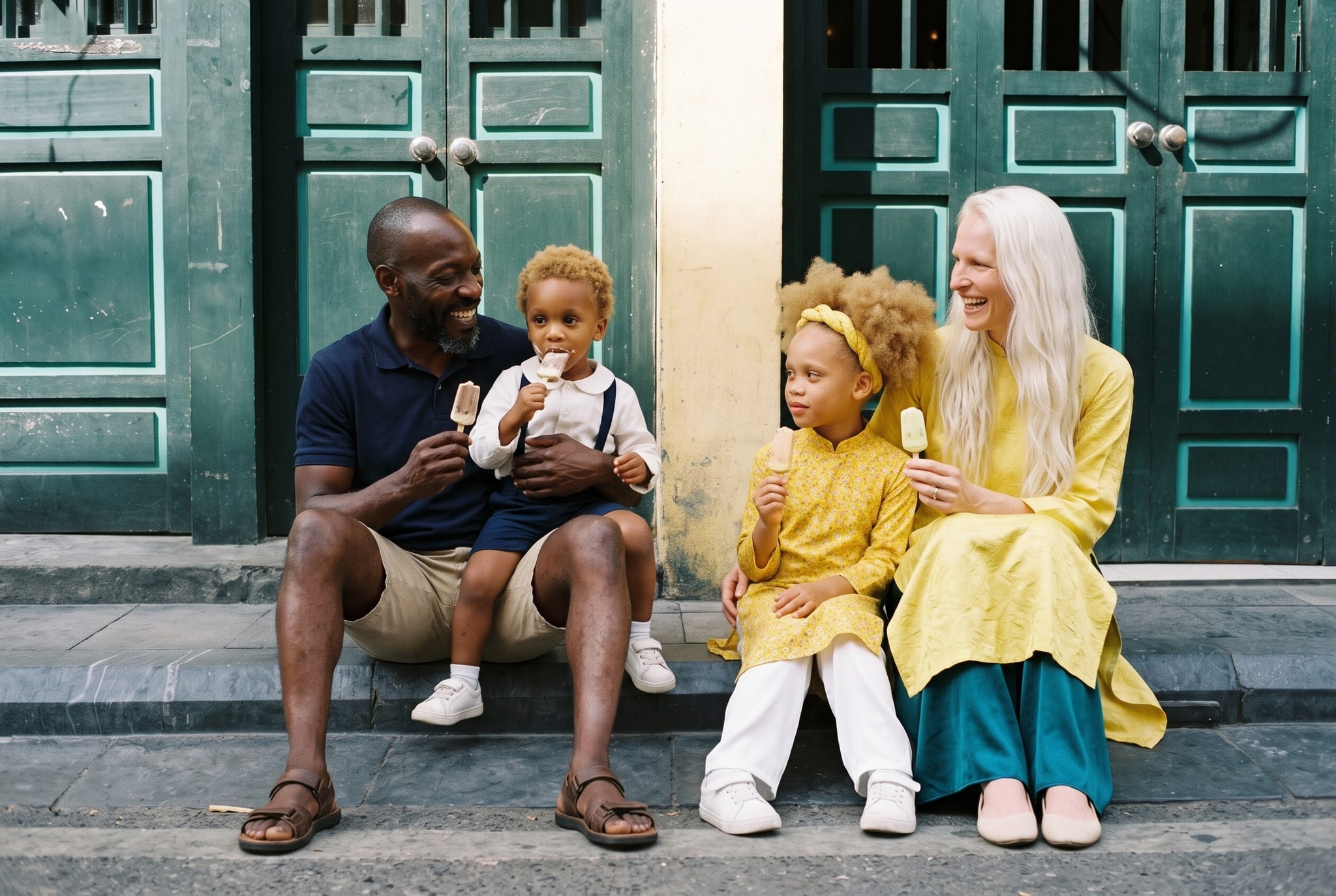
The Old Quarter's narrow streets (Hang Dau, Hang Gai, Hang Bac) are shadowed until mid-morning, which flatters faces but requires confident posing since there's nowhere to step back. Position yourself against a weathered shopfront or colonial wall; let the texture frame you without competing. Angle your body 45 degrees to the wall (not flush against it), weight on your back foot, front shoulder relaxed down. Tilt your head slightly toward the camera, not down—this avoids a double-chin look and engages your eyes with the light. Look directly at the lens for one or two frames, then break gaze to an alley corner or storefront sign; the "broken gaze" sequence looks candid in the final edit. Avoid straddling the alley center—you'll feel trapped and your posture locks. Lean against a post, doorway, or pillar; this gives your arms somewhere natural to rest. Crowds peak by 10 a.m., so we shoot 7–9 a.m. for solitude and soft light bouncing off narrow walls. The Old Quarter's cramped framing forces intimacy with your portrait, so relaxed shoulders and a slight smile (not a grin) read as approachable and present in these tight spaces.
Why do poses at Train Street fail in busy seasons?
Train Street (Pham Hung, Hanoi) permits photography only during police-enforced dawn windows (5:30–6:30 a.m., varies by season) and hundreds of tourists now compete for the same three-meter railway stretch. A failed pose here means: tense shoulders from rush, rigid stance from cold, tourists photobombing, harsh direct sun by 6:15 a.m., or the train arriving mid-shoot and scattering everyone. We arrive 90 minutes early, position you on the rails (camera angle low, looking down the track), with one foot forward and torso angled toward the light. Keep your gaze soft and distant—Train Street's claustrophobic geometry makes staring at the lens look aggressive. Move between two poses: straddling the rails with hands in pockets, then side-stepping toward the camera while looking back. This repetition lets us catch the moment you stop performing. Many poses fail because travelers lock their jaw and smile from tension; we remind you to breathe and think of a memory, not the camera. Train Street is cramped, time-limited, and crowded—only book this if you accept chaos and can move quickly between positions without overthinking each shot.
Which body angles work best for non-models in different seasons?
| Season | Light Quality | Best Body Angle | Why It Works |
|---|---|---|---|
| Dec–Feb (7–9 a.m.) | Soft golden, long shadows | 45° to light source, shoulder forward | Flatters jaw, creates dimension, no squinting |
| Dec–Feb (9 a.m.–3 p.m.) | Direct side light, glare | 90° perpendicular, back to light | Haloed rim light, no face shadows |
| Mar–May (6–8 a.m.) | Intense, quick transition | Body angled away, face turned to camera | Avoids harsh shadows under eyes and cheekbones |
| Mar–May (10 a.m.–2 p.m.) | Overly bright, heat haze | Sheltered spots only (pavilions, alleys) | Protects from blown highlights and squinting |
| Jun–Aug (5:30–7 a.m.) | Humid, misty, soft | Straight-on angle, shoulders level | Mist diffuses light evenly, reduces shadows |
| Jun–Aug (7 a.m. onward) | Overcast, flat light | Slight shoulder tilt, texture backdrop | Overcast needs vertical definition, walls add it |
| Sep–Nov (7–9 a.m.) | Warm, dry, strong | 45° to light, one foot back | Clearest light, most forgiving angle |
| Sep–Nov (9 a.m.–4 p.m.) | Hot, high contrast | Profile or three-quarter, structured tilt | Profile minimizes squinting, structure reads as intentional |
Seasons shift Hanoi's light intensity, humidity, and crowd density—your pose must adapt. Winter (Dec–Feb) allows midday shoots because the sun is lower; summer (Jun–Aug) forces dawn-only sessions. Non-models often fight the angle instead of flowing into it; we adjust your stance in real time based on the hour and cloud cover you see on the day.
What arm and hand placements look natural (not stiff or awkward)?
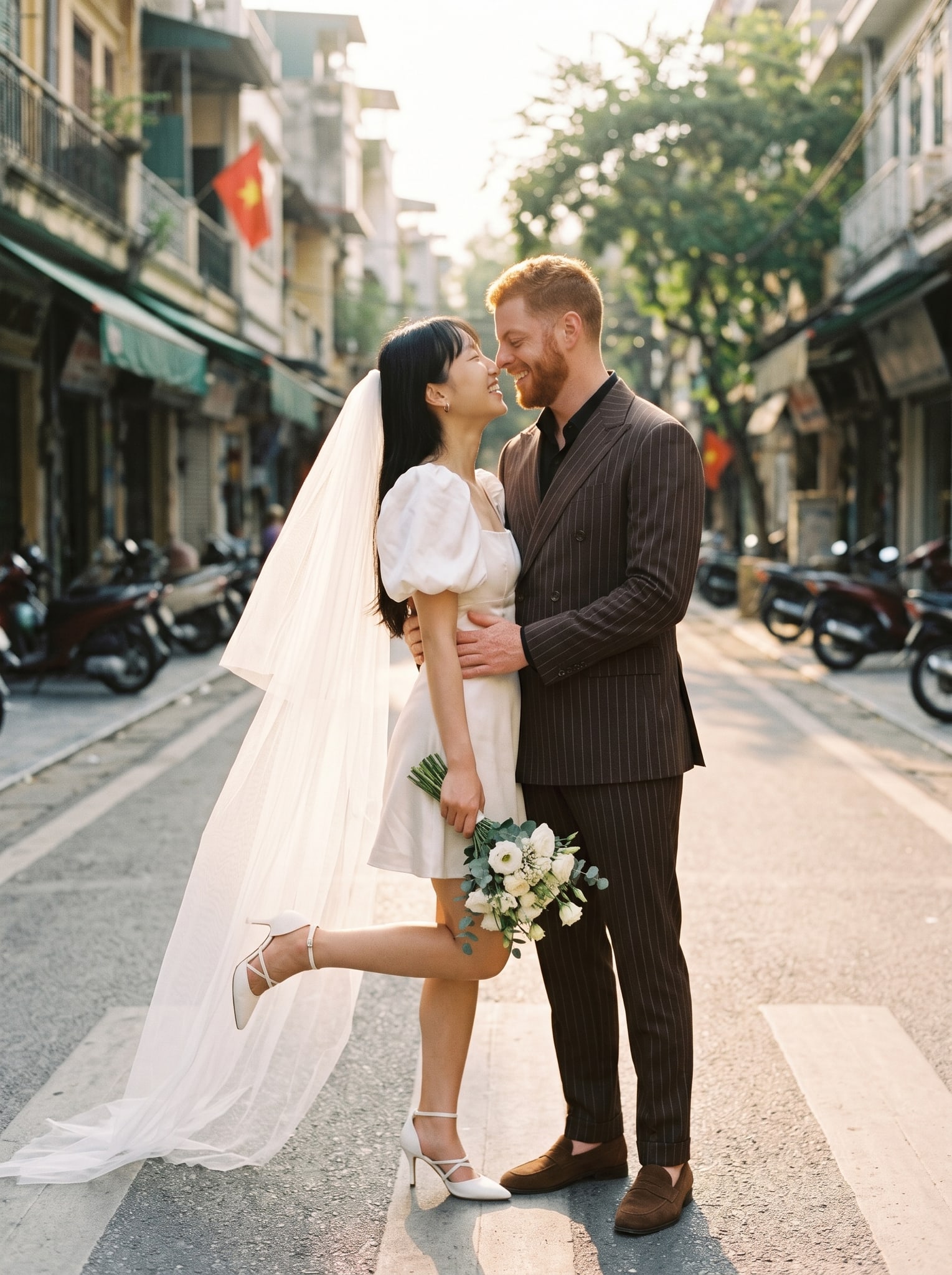
Hands betray nervousness faster than any other body part. Avoid: crossed arms (defensive), both hands in pockets (hiding), arms at your sides (parade stance), or forced "models' hands" with fingers splayed. Instead, rest one hand on your thigh or back pocket—this anchors the upper body and gives asymmetry. Let the other arm hang naturally, or tuck fingers into your jeans waistband at an angle. If standing, shift weight to your back foot and let your front-side arm hang loose; the back-side arm can rest on a wall, chair, or pillow if one's nearby. For sitting poses (park bench, steps, café), place both forearms on your thighs with hands clasped loosely, or rest one elbow on your knee—this closes the frame and reads as contemplative. Never splay your fingers; curl them gently or let them relax into a loose fist. If you're walking (most candid approach), let your arms swing naturally; we shoot as you move, not posed mid-stride. The rule: if your hands feel effortful, so does the photo. We guide you into each arm position and you only hold it for 3–5 frames—holding longer invites stiffness and your arm will tense. Natural hands look loose, purposeful, and invisible in the final portrait.
How to breathe, hold your gaze, and stop looking "posed"?
The difference between a stiff portrait and a natural one is rhythm. We use a three-step frame: first, you're in position but looking away (natural, unfocused gaze); second, you glance at the lens for 1–2 frames (connection without intensity); third, you break gaze again or look past the camera (candid, present). We shoot continuously, so you're never "held" in a single expression. Breath matters: hold your breath for one frame (sharpness), then breathe out slowly and naturally on frame two—breath holds tense your neck and jaw. Look past the camera at a landmark, alley, or distant point; this removes the pressure of "smiling at the camera." Many non-models believe they must smile constantly; we encourage a soft, resting expression with a micro-smile (mouth slightly closed, lips relaxed). If you smile wide on every frame, your face exhausts and the expression reads as forced. We shoot 200–400 frames per session so your real personality emerges across the sequence; one or two frames always capture you in genuine repose. Tell us if you're cold, tired, or uncomfortable—posing is easier when you're not suffering. Heat, hunger, and tension all collapse posture and expression; we break every 15 minutes and move to shade or comfort. A natural pose is a moving target, not a held position.
What to check before you book
- Light window: Confirm the season and ideal shoot time (we'll advise 7–9 a.m. for most spots). Midday shoots are risky unless you're in shade.
- Crowds: Train Street needs dawn access; Old Quarter and Hoan Kiem Lake are quieter before 9 a.m. Avoid weekends in high season.
- Mobility: If you have back pain or mobility limits, tell us—we adjust poses and choose flat, accessible spots like the lake promenade over stairs or Train Street's cramped rails.
- Outfit: Wear colors that contrast with the backdrop (darker tones in bright alleys, lighter in shadow). Avoid busy patterns or logos. We advise on this in pre-shoot chat.
- Expectation: We're not fashion photographers—we capture real moments of you in Hanoi, not a fake "models' shoot." If you want heavily styled, fashion-focused work, manage that expectation upfront.
- Makeup and hair: We offer in-house makeup, hair and ao dai rental—this ensures continuity and saves time. Confirm if you want this or bring your own.
- Delivery: We deliver edited images within 2 weeks, in color and converted-to-black-and-white options. Ask for a quote on WhatsApp to confirm timeline and revision rounds.
Ready to pose naturally in Hanoi?
We specialize in travelers and expats who don't model. Non-models often create the most authentic portraits because they're not performing a "photo pose"—they're just being present in a beautiful place. Our solo travel portraits service walks you through each moment, adjusts for your comfort, and shoots continuously so awkwardness disappears by frame 50. Book a shoot at Hoan Kiem Lake photo guide, Old Quarter, or Train Street, and we'll handle posing, timing, and light so you can focus on having a good day.
Plan your Hanoi shoot
FAQ
I'm very stiff in photos. Can you teach me poses before the shoot?
Yes. We do a WhatsApp video call 48 hours before to demo poses, show you the landmark, and address anxiety. We also shoot 200+ frames so your real self emerges mid-session. Stiffness usually dissolves by frame 40.
What if I'm short or have a larger build—will poses look different?
Absolutely. We customize angles to your frame: shorter travelers often look best in three-quarter angles with a textured backdrop; wider builds benefit from side-angled or profile shots that create definition. We adjust on the day and never use a "one-size" approach.
Is 90 minutes enough for a full Hanoi vacation shoot?
Yes. A 90-minute session covers 2–3 locations (e.g., Hoan Kiem Lake, Old Quarter alley, café), with 30–40 minutes per spot. If you want more variety, we offer extended sessions—ask us for a quote on WhatsApp.
Can you pose me like Instagram influencers do?
We can, but honestly, Instagram poses often look performed and date quickly. We favor natural, documentary-style posing that ages well and reflects who you actually are. If you want a mix of both, we'll include a few "aesthetic" frames among the naturals.
What happens if it rains on the shoot day?
We reschedule or move to covered Old Quarter alleys and indoor cafés. Rain actually creates moody, dramatic light—it's a bonus if you're open to it. We'll discuss this in pre-shoot planning.
Do I need to bring a wardrobe change?
It's optional but recommended. One outfit change (30 minutes) adds variety without cost. We can shoot one location in both outfits or two locations with one outfit each. Pack one outfit darker, one lighter for contrast.
Check dates
Send your dates, how many people and the style you like. We reply on WhatsApp in English with spots, timing and a quote.
FAQ
I'm very stiff in photos. Can you teach me poses before the shoot?
Yes. We do a WhatsApp video call 48 hours before to demo poses, show you the landmark, and address anxiety. We also shoot 200+ frames so your real self emerges mid-session. Stiffness usually dissolves by frame 40.
What if I'm short or have a larger build—will poses look different?
Absolutely. We customize angles to your frame: shorter travelers often look best in three-quarter angles with a textured backdrop; wider builds benefit from side-angled or profile shots that create definition. We adjust on the day and never use a "one-size" approach.
Is 90 minutes enough for a full Hanoi vacation shoot?
Yes. A 90-minute session covers 2–3 locations (e.g., Hoan Kiem Lake, Old Quarter alley, café), with 30–40 minutes per spot. If you want more variety, we offer extended sessions—ask us for a quote on WhatsApp.
Can you pose me like Instagram influencers do?
We can, but honestly, Instagram poses often look performed and date quickly. We favor natural, documentary-style posing that ages well and reflects who you actually are. If you want a mix of both, we'll include a few "aesthetic" frames among the naturals.
What happens if it rains on the shoot day?
We reschedule or move to covered Old Quarter alleys and indoor cafés. Rain actually creates moody, dramatic light—it's a bonus if you're open to it. We'll discuss this in pre-shoot planning.
Do I need to bring a wardrobe change?
It's optional but recommended. One outfit change (30 minutes) adds variety without cost. We can shoot one location in both outfits or two locations with one outfit each. Pack one outfit darker, one lighter for contrast.
More like this
Solo travel portraits
Vacation Photographer Hanoi in the Rain: Season Guide
Rain in Hanoi transforms outdoor shoots into moody, intimate scenes—but only if you prepare. We break down monsoon seasons, light quality, locations that work wet, and why indoor studio pivots save your session.
Solo travel portraits
Vacation photographer Hanoi during Tet: lunar new year guide
Tet transforms Hanoi's streets into a photographer's paradise—but timing, temple rules and crowd logistics make the difference between stunning portraits and a chaotic shoot. We walk you through every decision.
Solo travel portraits
Solo Travel Photoshoot Hanoi: 1 Hour vs 2 Hours—What's Right for You?
Solo travelers often wonder whether to book a short Hanoi photoshoot or invest in a longer session. We compare both formats—what you'll actually get, where to shoot, timing and light challenges—so you choose without guesswork.