
Home › Blog › Ao dai photoshoot in Hanoi
Traditional Dress Photoshoot Hanoi West Lake: Light, Crowds & Timing
By the Hanoi Photoshoot team · 2026-11-06
West Lake's northern shore—especially around Tran Quoc Temple and the lakeside promenade—delivers classic ao dai backgrounds with softer morning light and thinner crowds than central Hanoi. We recommend shooting between 6:00–8:00 AM (April–September) or 7:00–9:30 AM (October–March) to avoid midday haze and tourist peaks. Sessions typically run 1.5–2 hours on foot, mixing temple grounds (respecting photography restrictions), tree-shaded paths and water-edge reflections. Bring lightweight layers; mornings cool quickly. We handle ao dai rental, makeup and hair in-house, then coordinate timing by season and temple opening hours. Avoid mid-June to mid-August (intense heat and monsoon moisture). Check temple entry rules 24 hours ahead via WhatsApp—some restrict commercial shoots on weekends. Check dates on WhatsApp
What makes West Lake different from Hoan Kiem Lake for ao dai?
West Lake is 40% larger, quieter, and ringed by residential temples rather than urban commerce. Hoan Kiem Lake photo guide attracts dense tourist clusters by 9:00 AM; West Lake's northern arm stays sparse until 10:00 AM even in peak season. Temple grounds on West Lake's edges (Tran Quoc, Quan Thanh) permit photography near architecture and gardens without the crowd friction you face at Hoan Kiem's public walkways. Water reflections work best at West Lake in early light because vendors and joggers arrive later. Trade-off: West Lake requires a 15–20 minute taxi from central Hanoi, so plan an extra 30 minutes for transport and site scouting.
How do seasons and light hours really change the shot?
Spring (Feb–Apr): 6:30–7:30 AM gives soft directional light, haze-free water. Temperatures 18–22°C. Humidity low. Mosquitoes minimal. Summer (May–Sep): Shoot by 6:00–7:00 AM only; by 8:00 AM, UV index peaks and moisture creates blown-out skin tones. Afternoons (4:00–6:00 PM) work if clouds roll in. Bring water and lightweight cotton ao dai to avoid sweat marks. Autumn (Oct–Nov): 7:00–8:30 AM ideal. Crisp air, no glare, 20–24°C. Best month overall for color saturation and skin tone. Winter (Dec–Jan): 7:30–9:00 AM; sunrise is late. Morning mist over water creates dreamy bokeh around 8:00–8:30 AM. Cold (12–16°C) means ao dai wrinkles less, but bring a shawl between setups.
Light degrades after 9:30 AM year-round; avoid 11:00 AM–3:00 PM entirely. A smartphone light meter (lux reading) drops from ~1000 at 6:30 AM to ~50,000 by 10:00 AM—harsh shadows and color shifts kick in fast.
Which temple spots allow photography and which don't?
Tran Quoc Temple (northeast corner): Oldest temple in Hanoi. Photography allowed in courtyards and gardens; interior shrine restricted on Sundays and festival days. Arrive by 6:30 AM to photograph the pagoda silhouette and lotus pond undisturbed. Staff usually present by 7:00 AM; greet politely in Vietnamese or English.
Quan Thanh Temple (western shore): Smaller, fewer visitors. Photography unrestricted outside the main altar room. Entrance free; no official "quiet hours."
Avoid: Central temple sanctums, especially if monks are chanting or ceremonies are underway. Never photograph worshippers without consent. Weekend temple visits draw 2–3× more pilgrims; weekday mornings (Tue–Fri) are 70% less crowded.
We confirm temple access status the night before each shoot via local contacts; rules can shift during Tet, Vesak or renovation periods. Book a makeup, hair & ao dai rental session with us 48 hours ahead so we can alert you to any same-day closures.
How do you avoid the crowds and peak times?
| Time Slot | Season | Crowd Level | Light Quality | Notes |
|---|---|---|---|---|
| 6:00–7:00 AM | Apr–Sep | Minimal (≤5 people/path) | Excellent, warm directional | Risk: temple gates still locked (unlock ~6:30 AM) |
| 7:00–8:30 AM | Oct–Nov | Light (≤15 people/path) | Excellent, soft | Golden window; best for most shoots |
| 8:00–9:00 AM | Dec–Mar | Moderate (≤30 people/path) | Good, high-angle sun | Acceptable; water still clear |
| 9:00–10:30 AM | Any | High (≤80+ joggers, tour groups) | Fair to poor, harsh contrast | Avoid unless clouds present |
| 4:00–5:30 PM | Any | High, then declining | Fair, sidelit, golden | Shadows elongate dramatically; works for silhouettes only |
Strategy: Book a 6:00 AM pickup; shoot temple grounds 6:30–7:30 AM, then move to promenade paths and water-edge setups 7:30–8:30 AM while morning joggers haven't peaked. By 8:45 AM, retreat to shaded groves or tree tunnels (Phu Tay Ho area) for midday ao dai touch-ups before a light lunch break. Afternoon sessions (4:00–5:00 PM) work only if skies cloud, which occurs ~60% of days in monsoon months (May–Sep, Oct–Nov). Never assume afternoon light; always have a morning backup date queued.
What outfit, posing and styling tips work for non-models?
Ao dai fit: Loose-fitting áo dài (not tailored tight) photographs wider and drapes more gracefully in breeze. Avoid shiny synthetic fabrics; cotton-silk blends diffuse light naturally. We provide rental ao dài in classic solid colors (navy, burgundy, cream, teal) and subtle prints; these work with West Lake's natural palette without competing with water reflections. If you bring your own, test it indoors under morning-like light first.
Posing for non-models:
- Walking shots: Walk slowly toward or along the water; let arms hang naturally. Instructor cues you to pause every 3–4 steps. Avoid rigid "fashion" poses; natural gait reads better in editorial style.
- Standing near water: Weight on back leg; front leg slightly bent. Turn shoulders 45° away from camera. Rest one hand on the ao dai hem or hold it lightly. This angle slims and adds depth.
- Sitting on temple steps or grass: Knees together, torso upright. Tilt head slightly toward shoulder. Hands resting on lap or touching ao dai folds—this draws eye to fabric detail.
- With architectural framing: Stand under arches or between pillars, looking slightly off-camera. Foreground blur (trees, fabric) creates dimensionality.
Hair & makeup: We provide in-house styling. Loose waves or half-up buns suit ao dai and don't date the photos. Matte foundation and warm eyeshadow (golds, terracottas) work in morning light; avoid heavy contouring (reads harsh on water reflections). Lip color: muted reds, roses or nudes photograph consistently across lighting. Water-resistant makeup essential; morning dew and mist settle on skin.
Props & accessories: Avoid cluttering the frame. Fresh flowers, prayer beads or silk scarves work if held, not worn. Umbrellas (traditional lacquered or silk) add cultural authenticity on overcast mornings; test in advance so you're comfortable handling one while walking.
We guide you through posing before the shoot; most clients feel natural by shot 15–20. Never apologize for being "not a model"—our style prioritizes authentic emotion and cultural context over catwalk stiffness.
What are the real logistics and what goes wrong?
Transport: Taxi from central Hanoi to West Lake's northern entrance costs 80,000–our current quote (4–our current quote equivalent, rough fare only) and takes 15–25 minutes depending on traffic. We coordinate pickup via WhatsApp. Leave 15 extra minutes during rush hours (7:00–8:30 AM weekdays). Ride-share apps also available; GPS pin West Lake's Tran Quoc Temple entrance.
What goes wrong:
- Oversleeping or traffic delays: Arriving after 8:00 AM in summer forfeits golden light. We send 24-hour and 1-hour reminders; set your own alarm too.
- Wet ao dai after mist: Dew settles thick on silk 6:00–7:30 AM. We bring microfiber towels and allow 10 minutes for gentle blotting before the first frame.
- Temple gates locked early: Tran Quoc unlocks 6:30 AM most days, but may delay during maintenance or ceremonies. We check this 12 hours prior.
- Unexpected crowds: Festivals, school group visits or national holidays swell numbers 5–10×. We reschedule you to a quieter weekday if notified in time.
- Harsh humidity or haze: June–August mornings sometimes stay hazy until 8:30 AM due to overnight moisture. Expect softer (less contrasty) images; plan a second session if you need crisp detail.
What to check 24 hours before:
- Weather forecast (check rain probability for your 6–9 AM window).
- Temple entry alerts (we send these; confirm receipt).
- Ao dai and makeup trial (request a 15-minute styling chat if first-time client).
- Comfortable walking shoes (temple paths can be uneven; avoid heels or brand-new footwear).
Ask us for a quote on WhatsApp; we'll outline logistics, contingencies and exact timing by season. Ao dai photoshoot sessions here include 1.5–2 hours on foot, 1 hour of post-session edits, and a private gallery within 5 business days.
FAQ
Can we do a couple ao dai shoot at West Lake and keep it to under 2 hours?
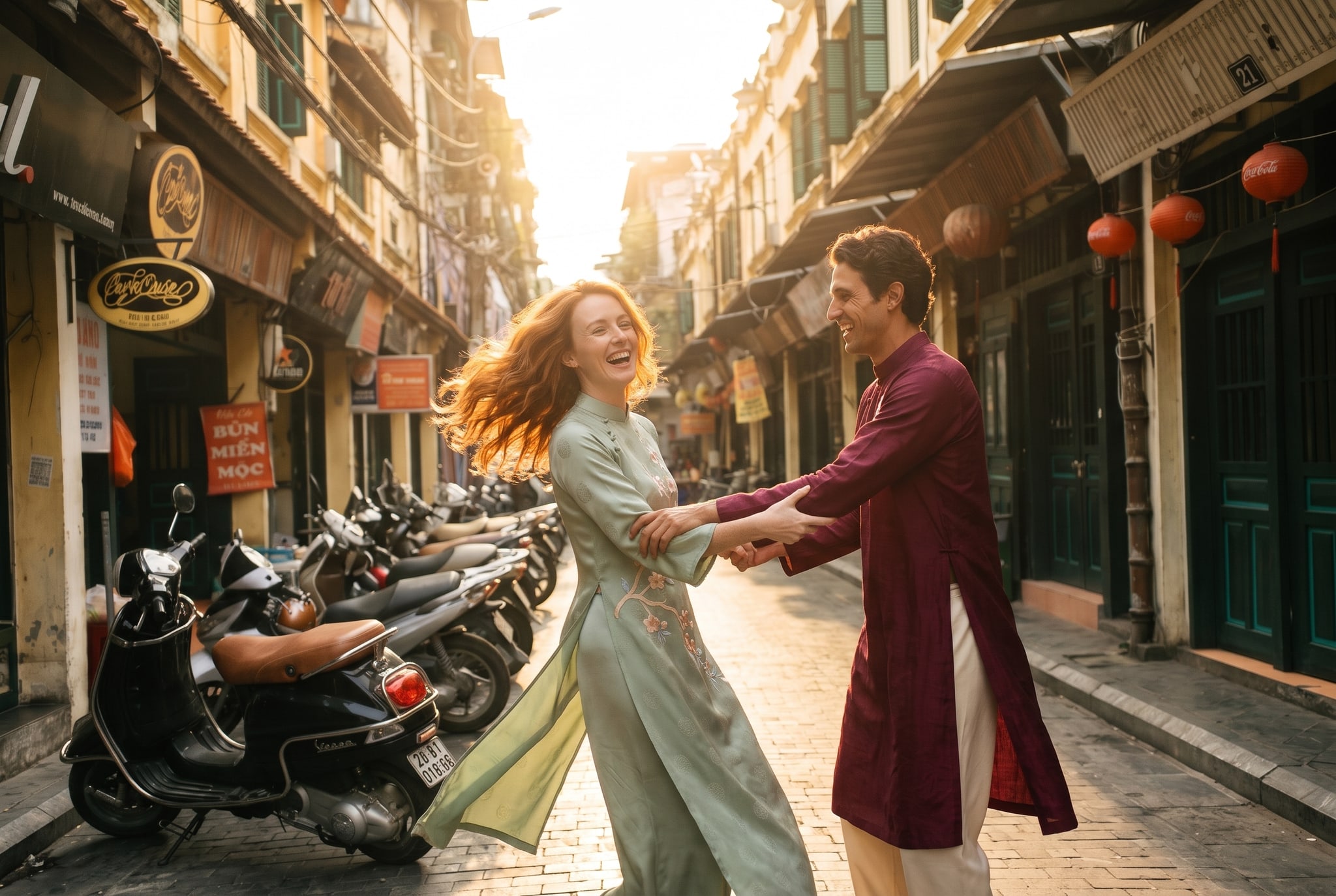
Yes. Couple sessions run 1.5–2 hours, mixing temple grounds (30 min), promenade walk (30 min) and reflective water shots (30 min). Morning light holds steady 6:00–8:30 AM, so you're not racing the sun. Couple photoshoot here bundles two rental ao dai and coordinated hair/makeup in-house, making logistics smooth.
Is West Lake safe and legal for a commercial photo session?
Yes. West Lake is public parkland. Photography for personal use is unrestricted. Commercial shoots (e.g., for a business, publication or paid portfolio) may require a local permit in rare cases; we handle this if flagged. Temple grounds permit photography in courtyards and gardens; interior shrines do not. We comply with all local rules and brief you on etiquette beforehand.
What if the weather is bad on shoot day?
Light rain (drizzle) often enhances moody ao dai images; we proceed unless lightning is visible. Heavy rain delays the session to a backup date at no added cost. Forecast uncertainty? Book a "flexible" session with a 3-day reshoot window; ask us for rescheduling terms on WhatsApp when you reserve.
How far in advance should I book a West Lake ao dai shoot?
We recommend 2–4 weeks to secure dates, allow time for outfit fittings and confirm season-specific temple hours. Last-minute bookings (1–3 days) are possible if we have availability; reply times slow during monsoon season (May–Sep) due to scheduling density. Contact us via WhatsApp for real-time slot checks.
Do I need to hire a separate makeup artist or guide?
No. Makeup, hair & ao dai rental are in-house at Hanoi Photoshoot by Cáo Studio. We provide styling, ao dai rental and photographer all as one coordinated package. You bring yourself; we handle the rest. No hidden vendors or third-party markups.
Can we shoot at other Hanoi spots after West Lake?
Absolutely. After a 1.5-hour West Lake session, you have energy for a second location if weather and light allow. Old Quarter photo guide is a 15-minute taxi away; we sometimes chain shoots there. Confirm a two-location plan in advance so we pace ao dai preservation and makeup freshness. Ask for a multi-location quote on WhatsApp.
Check dates
Send your dates, how many people and the style you like. We reply on WhatsApp in English with spots, timing and a quote.
FAQ
Can we do a couple ao dai shoot at West Lake and keep it to under 2 hours?
Yes. Couple sessions run 1.5–2 hours, mixing temple grounds (30 min), promenade walk (30 min) and reflective water shots (30 min). Morning light holds steady 6:00–8:30 AM, so you're not racing the sun. [Couple photoshoot](/couple-photoshoot) here bundles two rental ao dai and coordinated hair/makeup in-house, making logistics smooth.
Is West Lake safe and legal for a commercial photo session?
Yes. West Lake is public parkland. Photography for personal use is unrestricted. Commercial shoots (e.g., for a business, publication or paid portfolio) may require a local permit in rare cases; we handle this if flagged. Temple grounds permit photography in courtyards and gardens; interior shrines do not. We comply with all local rules and brief you on etiquette beforehand.
What if the weather is bad on shoot day?
Light rain (drizzle) often enhances moody ao dai images; we proceed unless lightning is visible. Heavy rain delays the session to a backup date at no added cost. Forecast uncertainty? Book a "flexible" session with a 3-day reshoot window; ask us for rescheduling terms on WhatsApp when you reserve.
How far in advance should I book a West Lake ao dai shoot?
We recommend 2–4 weeks to secure dates, allow time for outfit fittings and confirm season-specific temple hours. Last-minute bookings (1–3 days) are possible if we have availability; reply times slow during monsoon season (May–Sep) due to scheduling density. Contact us via WhatsApp for real-time slot checks.
Do I need to hire a separate makeup artist or guide?
No. [Makeup, hair & ao dai rental](/makeup-and-styling) are in-house at Hanoi Photoshoot by Cáo Studio. We provide styling, ao dai rental and photographer all as one coordinated package. You bring yourself; we handle the rest. No hidden vendors or third-party markups.
Can we shoot at other Hanoi spots after West Lake?
Absolutely. After a 1.5-hour West Lake session, you have energy for a second location if weather and light allow. [Old Quarter photo guide](/spots/hanoi-old-quarter) is a 15-minute taxi away; we sometimes chain shoots there. Confirm a two-location plan in advance so we pace ao dai preservation and makeup freshness. Ask for a multi-location quote on WhatsApp.
More like this
Ao dai photoshoot in Hanoi
Ao Dai Photoshoot at Ho Chi Minh Mausoleum: Best Time & Tips
Ho Chi Minh Mausoleum area offers dramatic colonial architecture and red flags perfect for ao dai portraits, but timing and permit rules are critical.
Ao dai photoshoot in Hanoi
Ao Dai Photoshoot at Lotus Pond Sunrise in Hanoi
Lotus ponds offer Hanoi's most serene ao dai backdrop at dawn, but timing and location scouting are critical for empty frames and soft light. We share exact hours, seasonal water levels and how to avoid tourist crowds.
Ao dai photoshoot in Hanoi
Ao Dai Photoshoot Duong Lam Ancient Village: Best Time & Hanoi Guide
Duong Lam Ancient Village—45 minutes northwest of central Hanoi—offers weathered brick lanes, lotus ponds and colonial-era storefronts perfect for ao dai portraits. Best light and crowd conditions occur October–November and February–March mornings.