
Home › Blog › Hanoi photo spots
Tay Ho photo spots: insider guide to Hanoi's best scenic shoots
By the Hanoi Photoshoot team · 2026-11-06
Tay Ho's photo appeal lies in its blend of water views, mature tree canopy and low tourist density compared to central Hanoi. The district centers on Tay Ho Lake (also called West Lake), ringed by temple compounds, fishing villages and colonial-era architecture. For photoshoots, the best hour windows are 06:00–07:30 (soft golden light, minimal crowds) and 16:30–17:30 (same quality, evening ferry activity adds life). A typical session runs 2–3 hours and costs less per hour than Old Quarter shoots due to fewer permit complexities. Tay Ho suits ao dai photoshoot in Hanoi sessions, couple photoshoot work and solo travel portraits equally. Avoid midday (11:00–15:00: harsh shadows, peak heat). We coordinate all logistics—styling, transportation, temple access—on WhatsApp; ask us for a quote. Check dates on WhatsApp
Which Tay Ho temples allow photography without permits?
Tran Quoc Pagoda (the oldest standing temple in Hanoi, on a small peninsula) welcomes photographers before 07:00 and after 17:00 without formal request, though respectful dress (shoulders and knees covered) is required year-round. Pho Quang Nunnery, set back from the lake shore, permits still photography if you ask the resident monks politely in person or ask us to coordinate ahead. Yen Phu Water Puppet Theater (on the lake's east bank) does not allow interior photography but the exterior courtyard and lotus pond are open sunrise to sunset. Never shoot during active prayer hours (typically 05:30–06:30 and 18:00–19:00). Rule: arrive in neutral, closed-toe shoes; ask before framing any person or altar. Temples enforce these rules consistently; breaking them results in ejection and ban for future sessions.
What outfit and ao dai colors work best in Tay Ho's light?
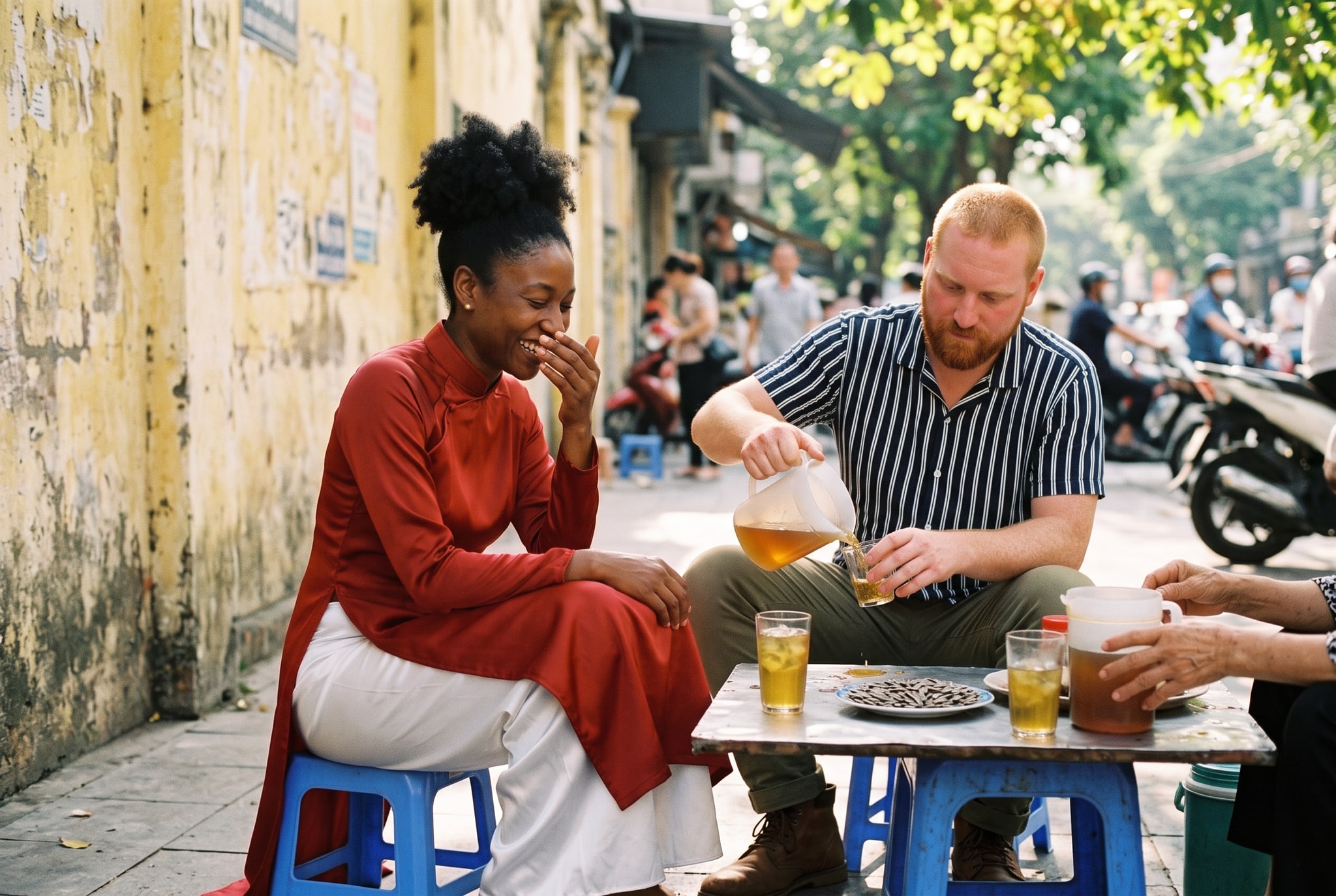
Tay Ho's mature trees and water reflections favor jewel-tone ao dai—emerald, sapphire, burgundy—because the canopy diffuses direct sunlight and saturates color depth. Pastels (blush, cream, pale yellow) photograph flat under tree shade; reserve them for open-water foreground shots during golden hour. For non-ao dai outfits, earth tones (olive, terracotta, navy) anchor you against the green backdrop; bright white or neon risks blown-out reflection in water and glare off concrete. Layering matters: morning mist near water (May–September) clings until 08:00, so bring a light shawl. Our makeup and styling team preps every client on-site; we carry a curated ao dai rental selection sized XS–XL to ensure fit and authenticity. Winter (November–February) calls for deeper jewel tones; summer (June–August) can handle slightly bolder hues because humidity lowers contrast.
How do light and season change throughout the year in Tay Ho?
Season Comparison Table:
| Season | Golden-hour start | Sky clarity | Tree foliage | Humidity | Best shooting window |
|---|---|---|---|---|---|
| Nov–Feb (dry) | 06:45–07:15 | Clear, strong | Thin, dappled | 45–60% | 06:30–07:45, 16:15–17:45 |
| Mar–May (pre-monsoon) | 06:00–06:30 | Hazy, softer | Dense green | 60–75% | 06:00–07:00, 17:00–18:00 |
| Jun–Sep (monsoon) | 05:45–06:15 | Overcast, diffuse | Saturated | 75–90% | 05:45–06:45, 18:00–19:00 |
| Oct–early Nov (transition) | 06:30–07:00 | Clear, warm | Turning yellow | 60–70% | 06:30–07:30, 16:30–17:45 |
Winter light is hardest (strong shadows) but most dramatic; use side-lit temple walls. Monsoon light is softest (overcast diffusion) but skies are gray; compose to show water rather than sky. Peak foliage density is April–May and July–August, ideal for canopy-dappled ao dai shots. We adjust posing and angle by season; ask us for specifics when you book.
Which Tay Ho streets and alleyways avoid crowds and look cinematic?
Nghi Tam peninsula's narrow lanes (north of Tran Quoc Pagoda) remain quiet until 07:30 weekdays; you'll find weathered garden walls, bougainvillea vines and elderly locals fishing—natural human interest without tourist overlay. Yen Phu village lanes (south lakeside) are narrow, tree-lined and pass through active fishing-net repair zones—authentic backdrop, low foot traffic, but respect locals' work spaces and ask permission before framing people. Avoid Ho Tay Road (the main perimeter) 07:30–09:00 and 16:00–18:00 (commuter traffic, noise). Parking is easiest on side streets near Yen Phu Water Puppet Theater; the road has public parking but fills quickly during Vietnamese holidays. For couple photoshoot intimacy, Yen Phu's quieter arms win over the crowded main beach. For family photoshoot sessions with children, the wide grass near Pho Quang Nunnery offers safety and backdrop depth.
What are the unwritten rules and real risks at Tay Ho's photo locations?
Sacred sites: never sit on temple steps, never pose in front of active altars, never eat or smoke within the temple compound. Locals' fishing nets: if a shot includes nets or boats, ask the owner's permission first (a polite hand gesture works). Parking: never leave valuables visible in rental scooters; use only official parking zones. Pickup trucks and motorcycles arrive 06:30–07:00 during weekday mornings—use the lake-side paths to avoid traffic. Monsoon season (June–September) brings sudden downpours (30 min, then clears); have an umbrella and a backup indoor spot (we can suggest covered temple courtyards). Construction: Tay Ho Road improvements have shifted parking and access; we verify current conditions on every booking. Wildlife: monitor children around the water's edge—the lake is not a swimming location and local stray dogs are territorial near food stalls (avoid after 11:00). Group sessions (≥8 people) need advance notice; the narrow lanes cannot accommodate large groups safely.
Should you book a Hanoi photoshoot session in Tay Ho or elsewhere in the city?
Tay Ho suits quiet reflection, intimate couple work and tradition-forward ao dai sessions. It's slower-paced than Hanoi's Old Quarter (dense alleys, throngs, permit complexity), less monumental than Hoan Kiem Lake (iconic but crowded sunrise), and calmer than Train Street (narrow, railway timing-dependent, safety risk). If you want iconic Hanoi symbolism in one afternoon, choose Hoan Kiem or Old Quarter. If you want authentic slow living, water reflections and space for posing, Tay Ho wins. We typically recommend combining Tay Ho (2–3 hours early morning) with a second neighborhood in the same session for variety; a full-day Hanoi itinerary may include Tay Ho sunrise, a midday styling break, then Old Quarter golden hour. First-time visitors and solo travel portraits clients prefer Tay Ho's lower sensory load; pre-wedding and proposal photographer sessions often close with a Tay Ho evening shoot for intimacy after a bigger public venue.
What to check before you book a Tay Ho photoshoot with us
Timing: Confirm your ideal month and day of the week (weekday shoots have 60% fewer tourists than Saturday/Sunday; we block off 06:00–07:45 slots first). Outfit clarity: Share ao dai color and any rental needs; our makeup and styling team matches hues to the season's light. Physical comfort: Tay Ho involves walking 2–3 km over uneven temple paths, alleyway cobblestones and occasional stairs; wear supportive shoes that can be easily removed for temple entry. Group size: Confirm headcount (solo, couple, family ≤5); groups larger than 8 require separate logistics planning. Weather backup: In monsoon season (June–September), we reschedule or pivot to covered temple courtyards; ask us about your specific date's forecast. Transportation: We arrange scooter pickup from your hotel or meeting point; specify your location when you book. Permits and fees: Temple donations (typically 20,000–our current quote per site, based on typical visitor practices) are your choice; we do not charge photography fees at Tay Ho locations—ask us for a quote on our service.
FAQ
Can we shoot ao dai inside Tran Quoc Pagoda itself?
Yes, before 07:00 or after 17:00, when monks are not in active prayer. Midday (11:00–15:00) the interior is open but brightly lit and crowded; avoid. Interior shots require respectful positioning—never pose in front of the main altar. We position you in side courtyards or the entrance stairway instead.
What is the best month to visit Tay Ho for photography?
October–November (cool, clear skies, yellow-turning foliage) and March–April (green canopy, soft pre-monsoon light) are ideal. December–January is clear but harsh. June–August is diffuse and humid but colors are saturated. February has unpredictable cold rain; avoid.
Do we need a drone permit to shoot video at Tay Ho?
Yes, drone footage over Hanoi requires advance Vietnamese aviation authority approval; we do not offer aerial video services. Static photography and ground-level video are unrestricted if you respect temple and local rules.
How early do we need to arrive to avoid crowds at Tran Quoc Pagoda?
Arrive by 06:30 to secure solo or couple shots; by 07:15 the site fills with domestic tourists and monks preparing for morning rituals. Evening (after 17:30) is empty but has less dramatic light.
Can we combine Tay Ho with other Hanoi spots in one day?
Yes. We often book 2–3 hours in Tay Ho (06:00–09:00), break for styling and rest, then move to Old Quarter or Hoan Kiem for evening light. Day-trip combinations cost less than separate bookings; ask us for a multi-location quote.
Is Tay Ho safe for solo travelers doing a photoshoot?
Completely safe. We accompany all solo clients; our team speaks English and handles positioning so you can relax. Tay Ho has low theft and is well-lit at dawn. Women travelers feel comfortable here year-round.
Check dates
Send your dates, how many people and the style you like. We reply on WhatsApp in English with spots, timing and a quote.
FAQ
Can we shoot ao dai inside Tran Quoc Pagoda itself?
Yes, before 07:00 or after 17:00, when monks are not in active prayer. Midday (11:00–15:00) the interior is open but brightly lit and crowded; avoid. Interior shots require respectful positioning—never pose in front of the main altar. We position you in side courtyards or the entrance stairway instead.
What is the best month to visit Tay Ho for photography?
October–November (cool, clear skies, yellow-turning foliage) and March–April (green canopy, soft pre-monsoon light) are ideal. December–January is clear but harsh. June–August is diffuse and humid but colors are saturated. February has unpredictable cold rain; avoid.
Do we need a drone permit to shoot video at Tay Ho?
Yes, drone footage over Hanoi requires advance Vietnamese aviation authority approval; we do not offer aerial video services. Static photography and ground-level video are unrestricted if you respect temple and local rules.
How early do we need to arrive to avoid crowds at Tran Quoc Pagoda?
Arrive by 06:30 to secure solo or couple shots; by 07:15 the site fills with domestic tourists and monks preparing for morning rituals. Evening (after 17:30) is empty but has less dramatic light.
Can we combine Tay Ho with other Hanoi spots in one day?
Yes. We often book 2–3 hours in Tay Ho (06:00–09:00), break for styling and rest, then move to Old Quarter or Hoan Kiem for evening light. Day-trip combinations cost less than separate bookings; ask us for a multi-location quote.
Is Tay Ho safe for solo travelers doing a photoshoot?
Completely safe. We accompany all solo clients; our team speaks English and handles positioning so you can relax. Tay Ho has low theft and is well-lit at dawn. Women travelers feel comfortable here year-round.
More like this
Hanoi photo spots
Thang Long Imperial Citadel Family Photos: Light, Rules & Outfit Tips
Thang Long Imperial Citadel (Hanoi Citadel) is a UNESCO World Heritage site in central Hanoi with dramatic stone gates, courtyards and moats ideal for family portraits. We share exact timing, light patterns, clothing advice and what often goes wrong—so your session yields authentic, well-lit images.
Hanoi photo spots
Tay Ho: How to get there for a photoshoot
Tay Ho district sits 8–12 km northwest of Hanoi's Old Quarter, accessible by taxi, motorbike or rideshare in 20–40 minutes depending on traffic. We'll walk you through entry rules, best light, crowds and how to book a seamless shoot there.
Hanoi photo spots
Phung Hung Mural Street Couple Photos: Light, Crowds & Posing
Phung Hung Street in Hanoi's Old Quarter is a working neighborhood turned street-art hotspot—perfect for couples who want colorful, lived-in authenticity without the Hoan Kiem Lake crowds.