
Home › Blog › Hanoi photo spots
Hanoi Train Street Ao Dai Photos: Best Light, Rules & Timing
By the Hanoi Photoshoot team · 2026-11-06
Train Street (Phố Đường Tàu) in Hanoi's Old Quarter sits on active tracks where tourist crowds peak between 7–9am and 4–6pm, creating congestion but also side-lit energy in winter (Oct–Feb). Best light is dawn (5:30–6:30am, soft gold, empty lane) or late afternoon (5–6pm, warm amber, fewer families). An ao dai shoot here takes 45–90 minutes; we coordinate permissions, timing and posing for non-models. The lane is narrow, hemmed by colonial shophouses and overhead wires—ao dai fabric catches beautifully but can snag on walls. Rule: no tripods on tracks (trains still run 10–12 times daily), no lingering mid-lane, no posing on the rails themselves. Budget for early-morning bookings (transport, crew arrival) or twilight shoots (permit complexity). We handle crew, makeup, hair and ao dai rental; ask us for a quote on WhatsApp. Check dates on WhatsApp
Why is Train Street Hanoi's most-shot ao dai location?
Train Street's appeal lies in its compression: colonial architecture, active heritage, tonal simplicity, and ao dai's theatrical drape all converge in one 100m lane. The narrowness forces composition—ao dai fills the frame naturally, and the receding rails create vanishing-point depth. Morning light rakes across shophouse facades, casting the ao dai wearer in silk-textured detail. Unlike Hoan Kiem Lake (open, diffuse light) or the Old Quarter (chaotic storefronts), Train Street isolates your subject. Crowds are predictable enough to avoid; trains add earned authenticity.
The trade-off: congestion, noise, heat, legal grey zones for foreign crews, and physical risk if you're on-set during active hours. Most shooters accept this for the visual payoff.
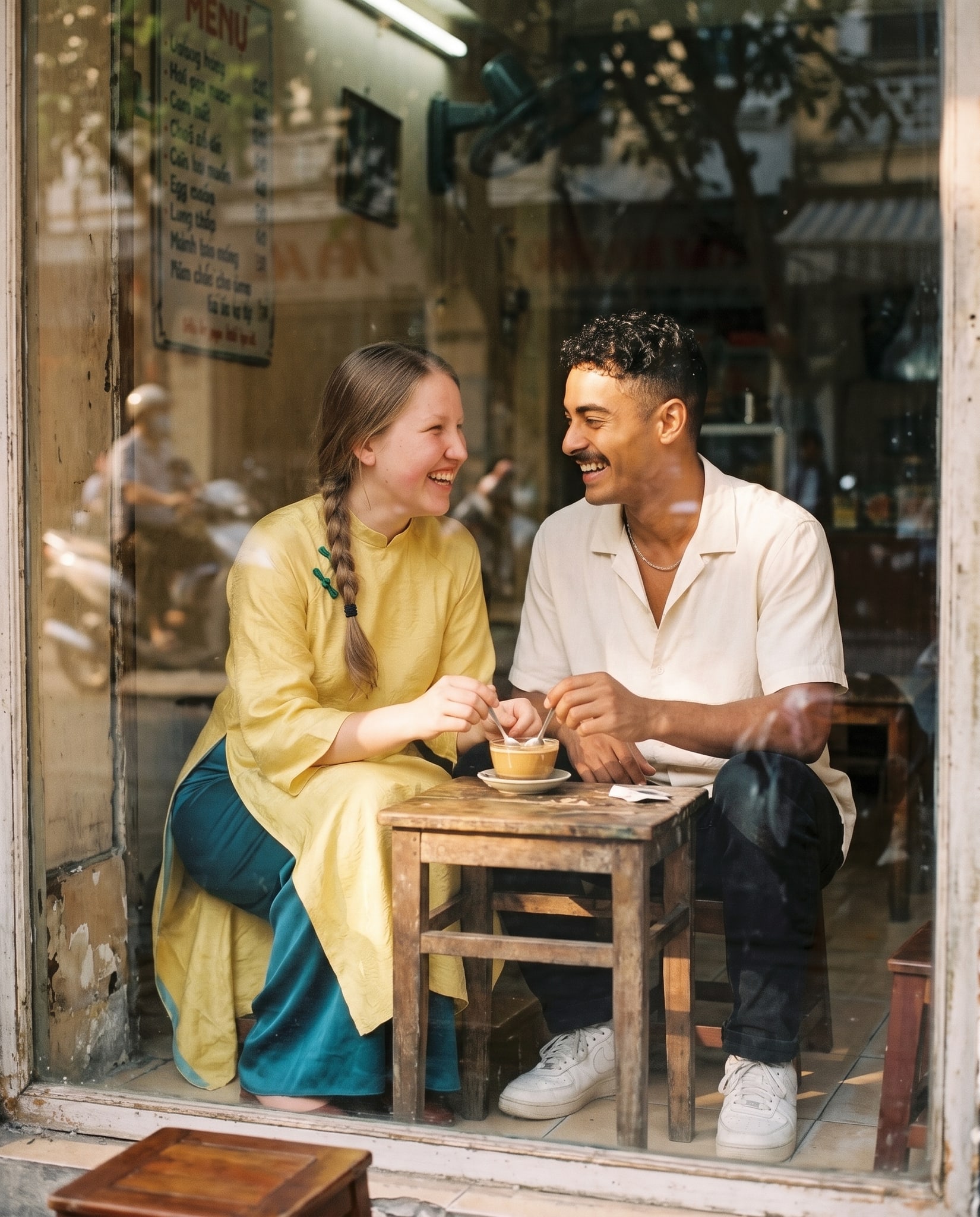
What time of day delivers the best light at Train Street?
Early morning (5:30–6:30am, Oct–Feb) offers low-angle gold light that grazes ao dai pleats and shophouse brick. The lane is empty—no tourist clusters, no vehicle fumes, no umbrella shadows. Humidity is manageable. Downside: crew and client coordination before dawn; 4am WhatsApp confirmations.
Late afternoon (5–6pm, year-round) gives warm amber and the lane quiets as tour groups eat dinner. Shadows lengthen; the ao dai's hem catches detail. Winter produces stronger color saturation; summer's haze softens contrast.
Midday (11am–2pm) is unusable: harsh overhead light flattens fabric, shophouse shadows darken one side, and tourist density peaks. We avoid this entirely.
Rainy season (May–Sep) adds cloud-diffused softness but muddy light and wet cobbles; ao dai hems stain, and crew movements become risky on wet stone. We prioritize October–March shoots.
| Time Slot | Light Quality | Crowds | Permits | Best For | Avoid If |
|---|---|---|---|---|---|
| 5:30–6:30am | Soft gold, raking | Empty | None needed | Ao dai detail, traditional beauty | Crew fatigue, traffic unpredictable |
| 9am–11am | Bright, top-lit | Moderate families | None needed | Quick turnarounds, mixed groups | Harsh shadows, heat builds |
| 12pm–4pm | Harsh overhead | Peak tourist volume | N/A—stay away | N/A | All light/crowd reasons |
| 5–6pm | Warm amber, long shadows | Moderate groups | Permit advised | Romance, pre-wedding, couples | Inconsistent permit enforcement |
| 6:30–7:30pm | Blue hour, artificial glow | Few locals, tours leave | Permit likely required | Moody, stylized | Low light means ISO push, cost up |
What are the unwritten rules and real safety issues at Train Street?
Trains run 10–12 times daily (schedules online but subject to delay); never frame a shot that includes a train in motion—sudden movement ends focus, and crew distraction causes falls on wet stone. We position clients on the pedestrian curb or shophouse threshold, never mid-tracks.
Permit enforcement is inconsistent. Tour groups operate without official permission; foreign film crews (with equipment, paid models, makeup crew) may face requests to cease if police or railway staff arrive mid-shoot. We coordinate quietly, use minimal crew, and stop immediately if asked. No drones, ever—railway authority explicitly bans them.
Shophouse owners sometimes object if we block their door. We time shoots to avoid 6–8am (business opening) and confirm entry with the shopkeeper beforehand.
Physical hazard: the lane is 1.5m wide in places; ao dai trains 1.5m long; clients backing for a wide shot can trip on uneven stone or shophouse steps. We brief posing techniques: small steps, eyes forward, one crew member behind to spot.
Heat and humidity spike May–September; ao dai clients sweat visibly, hair frizz worsens, and makeup melts after 30 min. Winter shoots (Oct–Feb) extend sessions to 90 min comfortably.
How does seasonal light change your ao dai composition at Train Street?
Winter (Oct–Feb): Sun at a lower angle in the south; morning light hits the east wall of the lane, creating a defined "lit side" and shadow relief on the client. Ao dai pleats read in shadow detail. Color saturation is highest because humidity is lowest. Clients wear heavier ao dai (embroidered, layered) without wilting. We prefer this season.
Summer (May–Sep): Sun is directly overhead; shophouse windows produce reflective glare; the ao dai appears "floating" without textural depth. Humidity flattens color and washes fabric contrast. Clients must shower or re-do makeup after 20 min on-set. We book shorter sessions, start earlier (5am), or offer alternative venues (covered walkways in the Old Quarter, Hoan Kiem Lake shade).
Shoulder months (Mar–Apr, Sep–Oct): Stable 25–28°C; light is transitioning but workable. Air quality improves in late October. We book these confidently.
This seasonal variance matters for design choice: winter suits traditional embroidered ao dai (detail shines in raking light); summer works for plain silks or pastels (high contrast reads even in flat light).
What's the difference between a solo ao dai shoot and couple or family sessions here?
A solo ao dai photoshoot at Train Street is 60–75 minutes: one client, minimal crew (photographer, makeup artist, assistant), easy flow between poses. The lane's narrowness becomes an asset—we frame depth, reflections in windows, the ao dai's movement against the static colonials.
A couple photoshoot takes 75–120 minutes: two clients in complementary ao dai or modern dress, posing together, hand placement, eye contact, and story setup. Train Street's tight geometry forces intimate framing—close-ups of hands, fabric touch, subtle connection—rather than wide poses. The rail perspective works: couple walking away from camera, rails converging, creates narrative depth.
A family photoshoot (3–4 people, mixed ages) complicates Train Street: coordinating a child's attention on a narrow lane with train noise is difficult. Families often prefer the open space of Hoan Kiem Lake or a pagoda courtyard. If a family insists on Train Street, we time for 6–6:45am (quietest) and limit it to 60 min.
For pre-wedding photoshoot or proposal photographer bookings, Train Street suits couples with minimal guests and a 90-min vision (ceremony dress + casual outfit, or surprise moment + portrait set). We secure a permit and schedule for late afternoon to allow setup without rush.
Solo clients: best for portrait-focused, introspective mood. Couples: best for intimacy and editorial flow. Families: better elsewhere; Train Street only if child under 6 absent.
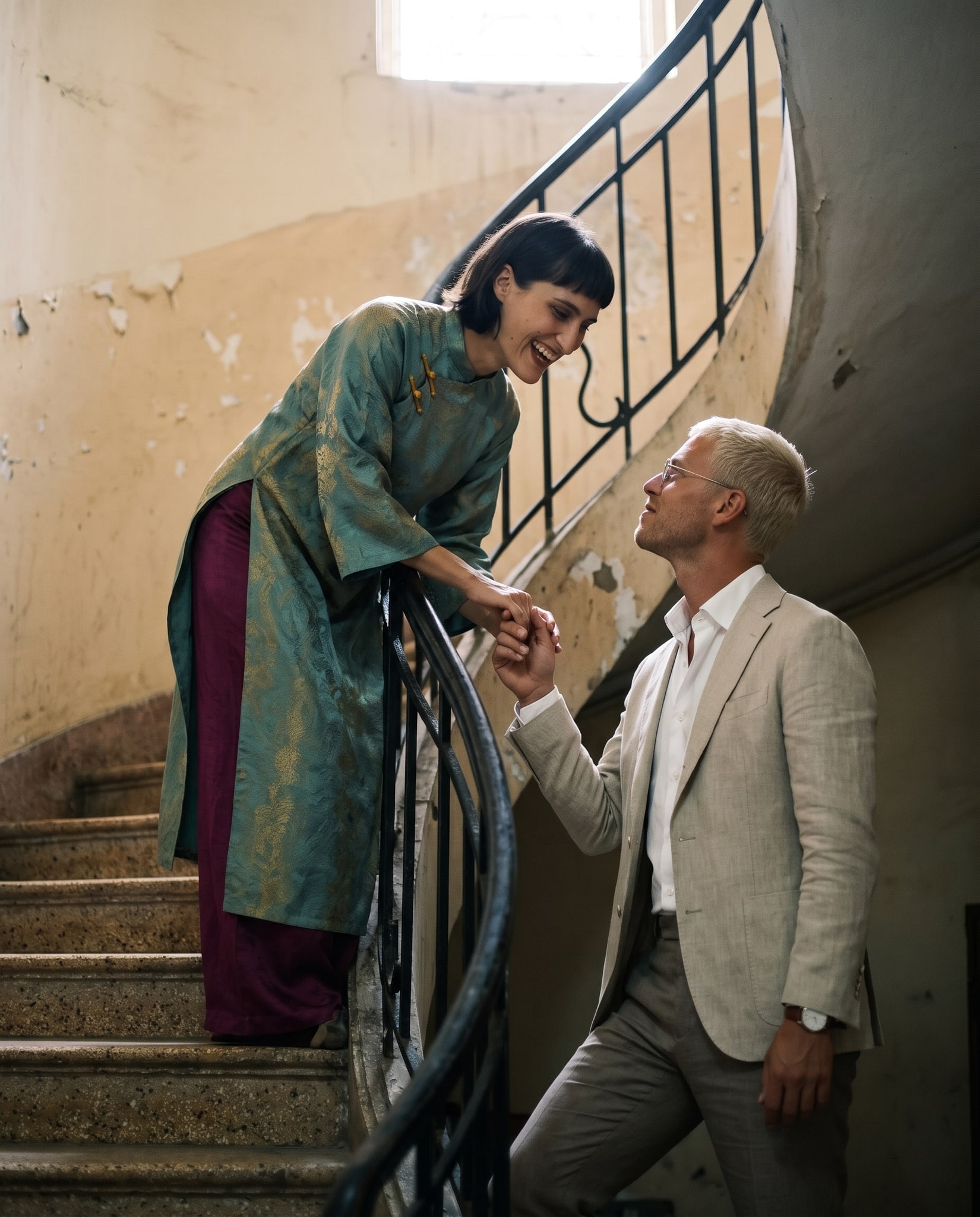
How do you prepare an ao dai client for Train Street's physical and sensory reality?
Before the shoot, we confirm via WhatsApp:
- Ao dai choice: We rent from makeup, hair & ao dai rental stock or the client brings their own. Heavy embroidered ao dai (1.2–1.5kg) tires clients faster in heat; lightweight silk (0.4kg) is safer on narrow footing. We recommend lighter fabrics for summer or evening shoots.
- Footwear: High heels (>5cm) are a fall risk on wet cobbles and uneven stone; we suggest flat sandals, ballet flats, or low block heels (3–4cm max). Footwear is framed out or soft-focused in wide shots, so aesthetic is secondary to safety.
- Posing technique: Train Street demands small, controlled movements. We teach:
- Stand with weight centered, feet hip-width apart.
- Ao dai folds naturally; don't pull or rearrange mid-take (it looks forced).
- Eyes follow the light source (shophouse shadow line) or camera, never down (ao dai drape reads better with lifted chin).
- Backward movement: always have crew spotting; one hand on the shophouse wall or our shoulder.
- Noise and distraction: Early morning is quiet; late afternoon brings increased street noise (motorbikes, shop chatter). We brief clients: a siren or horn in a take is normal; we shoot many frames, one will be clean. We brief them to ignore distractions and hold their expression.
- Heat management: Bring water; we take 10-min breaks every 30 min. Makeup artist carries blotting paper and setting spray. In summer, breaks extend to 15 min. We text a real finish time if a client is visibly fatigued.
How does Train Street compare to other Hanoi ao dai venues?
Hoan Kiem Lake photo guide: Open water, soft north-facing light (mornings), fewer obstructions. Ao dai floats against reflective surface. Best for dreamy, wide-angle story. Longer sessions (120+ min) because space is abundant and client comfort is higher. Crowds peak 7–9am and 5–7pm, but spread across the lake; Train Street crowds compress into 100m.
Hanoi Old Quarter photo guide: Chaotic storefronts, varied architecture, higher permit friction. Ao dai competes with visual noise. Better for narrative (client navigating markets) than stand-alone portrait. Crowds are constant but chaotic; Train Street has predictable ebb/flow.
Train Street photo guide itself: Compressed, architectural, authentic, tonal simplicity. Ao dai dominates the frame. Fast sessions (60–90 min) because posing area is limited. Crowds are tourist-heavy but schedule-able around 5:30–6:30am. Permit edge cases.
Decision framework for clients:
- Introspective solo or detail-focused couple? Train Street.
- Family narrative or group energy? Hoan Kiem Lake or Old Quarter.
- Dreamy, soft editorial? Hoan Kiem Lake.
- Cultural authenticity, heritage? Train Street or Old Quarter.
- First time in Hanoi, unsure of preference? Book a solo travel portraits session at Hoan Kiem Lake first; Train Street second if drawn to urban grit.
What to check before you book a Train Street ao dai shoot
- Time slot availability: We coordinate months in advance for peak season (Oct–Feb). Early morning (5:30am) requires crew pre-arrival and your punctuality. Late afternoon may need permit verification.
- Ao dai rental fit: Try on 2–3 styles at our studio or via video call beforehand. Sizing runs small; we list measurements and allow 1–2 returns before the shoot if needed. Plan this 1–2 weeks prior.
- Weather forecast: Rain is common May–Sep; we reschedule or offer covered Old Quarter alternatives if downpour is predicted. Check 3 days before; we confirm by WhatsApp 24 hours before.
- Crew language: All coordination is in English via WhatsApp. On-set photographer and makeup artist speak English; crew can brief you clearly and answer real-time questions.
- Physical fitness: Train Street walk is flat but emotionally intense (narrow lane, noise). If you have mobility concerns, tell us; we adapt posing to shophouse threshold or suggest alternatives.
- Budget: Ask us for a quote on WhatsApp. Pricing varies by time slot (early morning premium), ao dai style, and session length. We include photographer, makeup, hair, ao dai rental, and digital files.
Plan your Hanoi shoot
Pages from our team you may need
- ao dai photoshoot in Hanoi
- couple photoshoot
- family photoshoot
- solo travel portraits
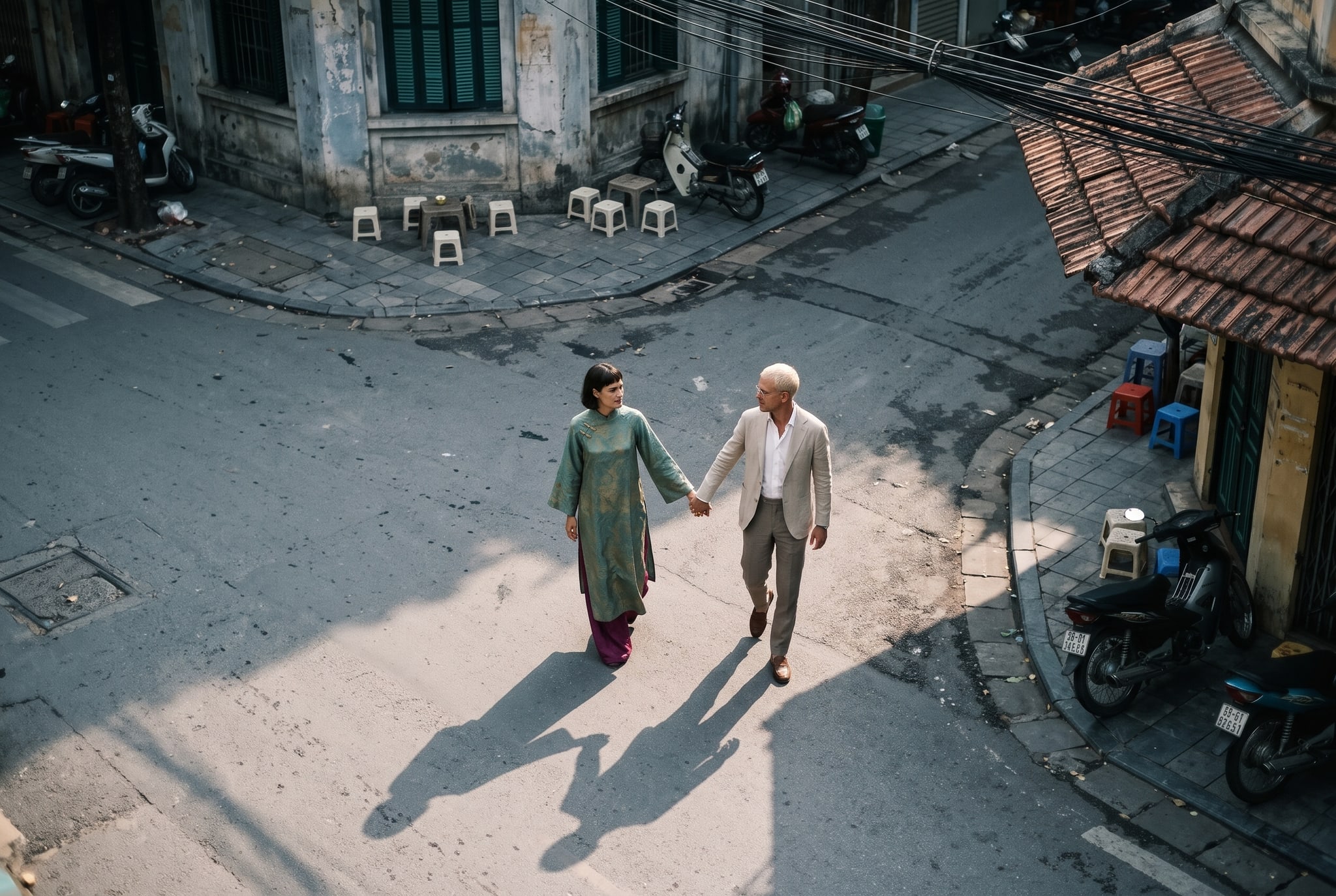
FAQ
Can we shoot Train Street with a train passing?
No. Active trains create sudden movement, distract crew, and pose collision risk. We confirm train schedules (they run ~12 times daily) and schedule shoots between them. If a train approaches during your session, we pause, step clear, and resume afterward. Never frame the rails expecting train drama—it's unpredictable and unsafe.
Is a permit required for a foreign crew and ao dai client at Train Street?
Permit enforcement is inconsistent. Tourist groups don't typically obtain one; foreign crews with visible equipment (makeup chair, lighting, 3+ staff) may be asked to cease if police or railway staff pass. We operate quietly, use minimal crew, and stop immediately if requested. We advise clients upfront: Train Street is not 100% guaranteed. If legal certainty is critical, we recommend Hoan Kiem Lake or pagoda venues instead.
What's the best ao dai style for Train Street's visual style?
Solid, jewel-tone ao dai (emerald, burgundy, navy) reads best against the tonal brick and shadow of the lane. Embroidered ao dai shines in winter morning light (raking angle reveals texture detail). Pastels and pale silks work in summer or evening (less contrast wash-out). Avoid busy prints—they fragment in busy shophouse backdrop. We advise during styling consultation; makeup, hair & ao dai rental can show you live fits.
How long should we budget for a Train Street shoot including hair and makeup?
Add 45–60 min for makeup and hair in our studio (beforehand) or on-site (45–60 min), depending on style complexity. Then 60–90 min for the shoot itself. Total 2–2.5 hours block. We recommend arriving 15 min early for final checks and crew briefing.
Can we combine Train Street with another Hanoi location in one session?
Yes. Train Street + Hoan Kiem Lake or Old Quarter works within a 4-hour block (120–150 min total shoot time, including travel and makeup touch-ups). This suit couples or solo clients wanting variety. Pricing scales by total time; ask us for a quote on WhatsApp.
What if I'm not a model—will I look stiff or awkward in Train Street photos?
Train Street's tight framing and strong light work for non-models. The narrow lane prevents wide, "performed" posing; we coach small, authentic movements (slight hand placement, natural weight shift, genuine expression). The ao dai's fabric does narrative work—we frame detail (your hands in the folds, the hem stepping) rather than full-body glamour poses. Awkwardness is rare because the environment is intimate; we've shot 100+ non-models here confidently.
Check dates
Send your dates, how many people and the style you like. We reply on WhatsApp in English with spots, timing and a quote.
FAQ
Can we shoot Train Street with a train passing?
No. Active trains create sudden movement, distract crew, and pose collision risk. We confirm train schedules (they run ~12 times daily) and schedule shoots between them. If a train approaches during your session, we pause, step clear, and resume afterward. Never frame the rails expecting train drama—it's unpredictable and unsafe.
Is a permit required for a foreign crew and ao dai client at Train Street?
Permit enforcement is inconsistent. Tourist groups don't typically obtain one; foreign crews with visible equipment (makeup chair, lighting, 3+ staff) may be asked to cease if police or railway staff pass. We operate quietly, use minimal crew, and stop immediately if requested. We advise clients upfront: Train Street is not 100% guaranteed. If legal certainty is critical, we recommend Hoan Kiem Lake or pagoda venues instead.
What's the best ao dai style for Train Street's visual style?
Solid, jewel-tone ao dai (emerald, burgundy, navy) reads best against the tonal brick and shadow of the lane. Embroidered ao dai shines in winter morning light (raking angle reveals texture detail). Pastels and pale silks work in summer or evening (less contrast wash-out). Avoid busy prints—they fragment in busy shophouse backdrop. We advise during styling consultation; [makeup, hair & ao dai rental](https://hanoiphotoshoot.com/makeup-and-styling) can show you live fits.
How long should we budget for a Train Street shoot including hair and makeup?
Add 45–60 min for makeup and hair in our studio (beforehand) or on-site (45–60 min), depending on style complexity. Then 60–90 min for the shoot itself. Total 2–2.5 hours block. We recommend arriving 15 min early for final checks and crew briefing.
Can we combine Train Street with another Hanoi location in one session?
Yes. Train Street + Hoan Kiem Lake or Old Quarter works within a 4-hour block (120–150 min total shoot time, including travel and makeup touch-ups). This suit couples or solo clients wanting variety. Pricing scales by total time; ask us for a quote on WhatsApp.
What if I'm not a model—will I look stiff or awkward in Train Street photos?
Train Street's tight framing and strong light work *for* non-models. The narrow lane prevents wide, "performed" posing; we coach small, authentic movements (slight hand placement, natural weight shift, genuine expression). The ao dai's fabric does narrative work—we frame detail (your hands in the folds, the hem stepping) rather than full-body glamour poses. Awkwardness is rare because the environment is intimate; we've shot 100+ non-models here confidently.
More like this
Hanoi photo spots
Thang Long Imperial Citadel Family Photos: Light, Rules & Outfit Tips
Thang Long Imperial Citadel (Hanoi Citadel) is a UNESCO World Heritage site in central Hanoi with dramatic stone gates, courtyards and moats ideal for family portraits. We share exact timing, light patterns, clothing advice and what often goes wrong—so your session yields authentic, well-lit images.
Hanoi photo spots
Tay Ho: How to get there for a photoshoot
Tay Ho district sits 8–12 km northwest of Hanoi's Old Quarter, accessible by taxi, motorbike or rideshare in 20–40 minutes depending on traffic. We'll walk you through entry rules, best light, crowds and how to book a seamless shoot there.
Hanoi photo spots
Phung Hung Mural Street Couple Photos: Light, Crowds & Posing
Phung Hung Street in Hanoi's Old Quarter is a working neighborhood turned street-art hotspot—perfect for couples who want colorful, lived-in authenticity without the Hoan Kiem Lake crowds.