
Home › Blog › Instagram photoshoot
Flying Dress Photoshoot Hanoi at Night: Light, Spots & Booking
By the Hanoi Photoshoot team · 2026-11-06
A flying dress photoshoot at night in Hanoi means wearing a full-skirted, lightweight fabric (often silk, cotton, or chiffon) tossed or twirled while we freeze the motion with high-speed sync flash and fast shutter settings—typically 1/500th or faster. Night shoots happen after 6 p.m. from October to April when temperatures drop and crowds thin; May–September is too humid and busy. We choose three or four spots within central Hanoi's Old Quarter or near Hoan Kiem Lake where streetlights, neon signs, and building façades provide natural backlight without traffic hazard. The session lasts 90 minutes, includes in-house hair and makeup styling, dress rental or your own garment, and 80–120 edited digital files. Night shoots cost more than daytime because we bring extra lighting gear and require experienced flash coordination; ask us for a quote on WhatsApp. The biggest mistake: booking in peak summer or choosing cramped alleyways where vehicles pass—we pre-scout every location and refuse unsafe corners. Check dates on WhatsApp
What makes a flying dress work at night versus daytime?
Daytime flying dress shoots rely on sun direction and natural fill light; night shots depend entirely on flash placement, shutter speed, and your dress fabric's reflectivity. At night, we position off-camera flash to the side or behind you, creating rim light that separates the airborne fabric from dark backgrounds. Lightweight, light-colored silks and organzas catch flash beautifully; dark or heavy cotton may disappear into shadow. Our team uses high-speed sync flash (HSS) to allow shutter speeds above 1/200th second, freezing every fold mid-leap without overexposure. Daytime requires no extra power; night work requires backup batteries, ND filters for ambient control, and a second spotter for safety on Hanoi's narrow lanes. The result: night shots have drama, contrast, and an editorial feel daytime can't match—but only if fabric, light angle, and motion timing align perfectly.
Which Hanoi night spots offer the safest, most photogenic backdrop?
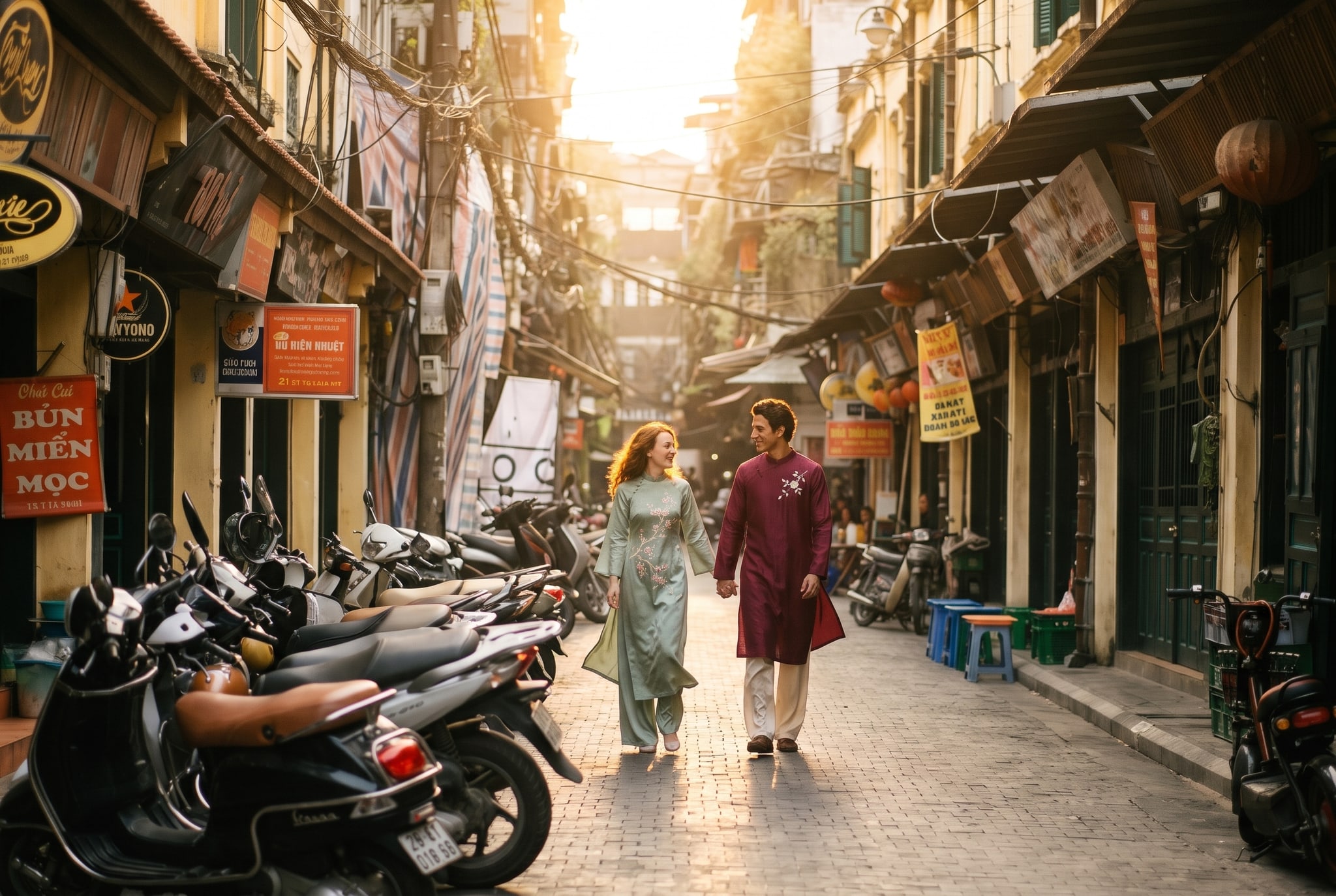
We shoot flying dress sessions at three core locations after dark: the tree-lined walkways near Hoan Kiem Lake's northwest corner (streetlight-lit, low traffic after 7 p.m.), select Old Quarter side streets with cafe ambient glow (scouted in advance for vehicle flow), and occasionally the small parks and architectural alcoves near central office buildings. Hoan Kiem Lake photo guide walks you through daytime access; after sunset, the vibe shifts—fewer tourists, softer neon reflections in the water, and calm foot traffic. We avoid Train Street photo guide for flying dress work because trains run unpredictably and the narrow alley offers no safe jump radius. Old Quarter photo guide includes night-viable pockets, but we check crowd density and vehicle schedules before confirming a time slot. Each spot gets a weather check at 3 p.m. the day of your shoot; if rain threatens, we pivot to an alternate location or reschedule. Night light consistency is fragile—a single streetlight failure or unexpected road closure can ruin a booked spot, so we build flexibility into every contract.
How does Hanoi's seasonal weather affect nighttime flying dress sessions?
October through March: temperatures 15–25°C, low humidity, clear skies, and crisp air—ideal for fast motion and sharp fabric detail. Your dress flies faster in cool air; fabric doesn't cling. Flash recycles quicker; batteries last longer. April–May: humidity climbs to 80%+; silk becomes heavier and clings; flash recharge slows; mosquitoes arrive after sunset. June–September: heat remains above 30°C at night; storms erupt without warning; fabric absorbs sweat; tourists crowd every lit corner. We schedule 70% of flying dress shoots October–March and openly discourage bookings May–August unless you accept a rescheduling clause. Light duration is nearly equal year-round in Hanoi (latitude 21°N), but quality differs: winter night light is crisp, contrast is high, and motion reads cleanly; summer night light is diffused by haze, shadows soften, and fabric loses edge definition. Ask us for a quote on a specific date; we'll tell you the weather likelihood and whether we recommend rescheduling.
What should you wear, and can we provide the dress?
Flying dress shoots work best in full-skirted designs: A-line or ball gown silhouettes, midi or floor length, with 2–4 meters of skirt circumference. Fabric should weigh 120–200 grams per square meter—chiffon, silk crepe, cotton voile, or tulle blend. Avoid denim, leather, or heavy velvet; they won't catch air. Color choices: pastels and jewel tones photograph sharply under night flash; neons read flat. We offer makeup, hair & ao dai rental for many styles, including Western dresses, Vietnamese áo dài re-cuts, and flowing gowns. If you bring your own, we inspect fabric weight and structure; if it's too rigid or too heavy, we discuss a rental alternative. Undergarments matter: wear nude or matching shorts (visible undergarments ruin shots). Shoes: flat sandals, ballet flats, or go barefoot (ground conditions permitting); heels limit jump height and safety on uneven Hanoi pavement. Hair should be loose or softly pinned—tight buns defeat the airborne fabric narrative. We do all styling in-house; no outside services required. Hair and makeup take 45 minutes; outfit fitting takes 15; you arrive 60 minutes early.
What's the exact lighting setup, and why does it matter?
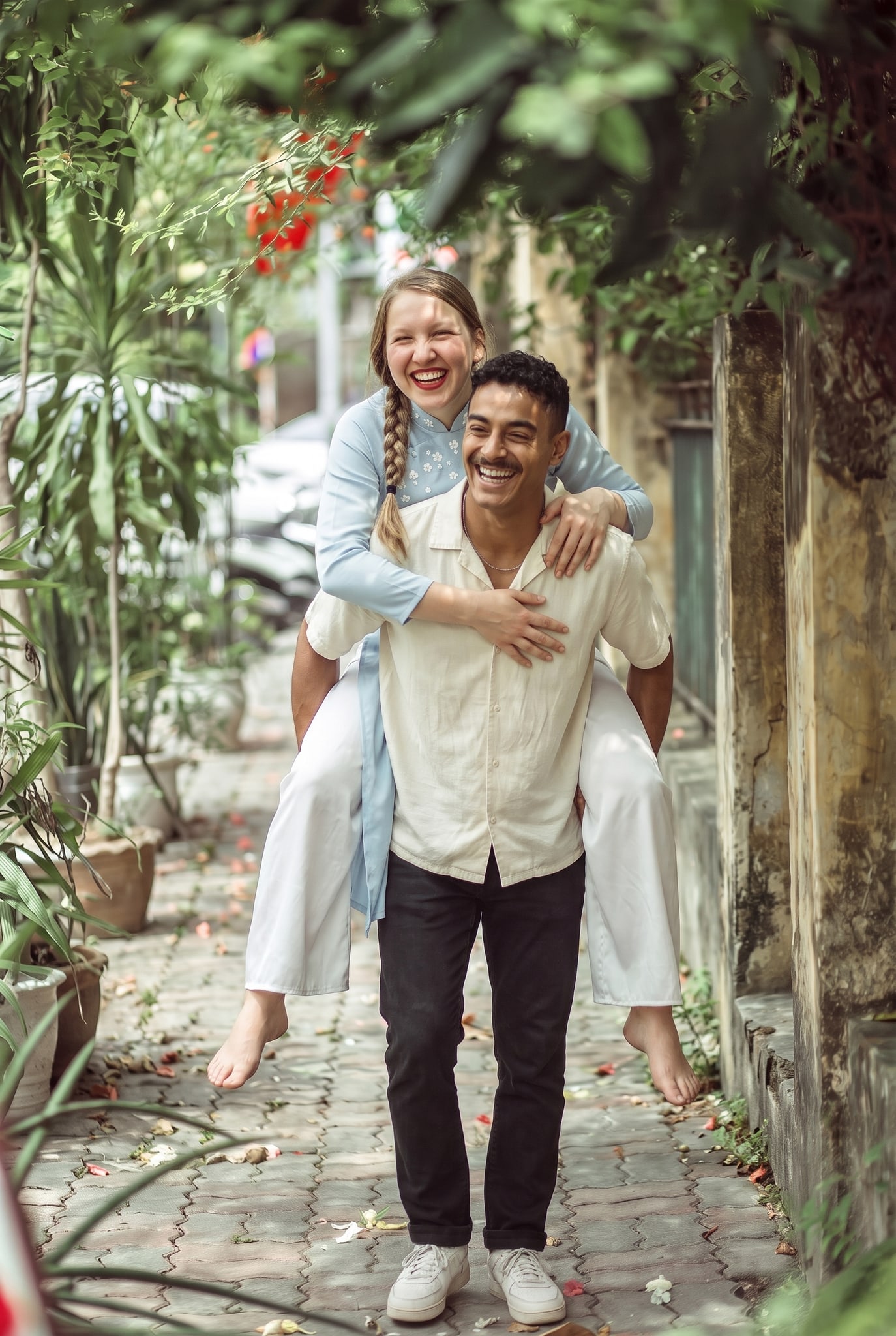
We use a Godox SL-60W or equivalent high-powered off-camera flash mounted on a light stand 2–3 meters to your left or behind you, angled 45° upward. High-speed sync mode (1/500–1/2000 second) lets us freeze motion without overexposure. A second smaller flash (key light) bounces fill light softly onto your face from the front, preventing silhouette. Ambient Hanoi night light contributes 10–20% of the final exposure; our flash contributes 80–90%. We meter for a base ISO of 400–800, f/4–f/5.6 aperture, and adjust shutter speed to balance the dark surroundings. If a location has bright neon signs or streetlights, we use ND filters to darken the background and keep the flash as the hero light. This is why night flying dress shoots require a second crew member: one to manage camera and composition, one to adjust flash angles and watch for vehicles or obstacles while you're in motion. Single-photographer night shoots are unsafe and produce softer results. Every setup takes 15–20 minutes per location; that's built into your 90-minute session.
Typical night location lighting hierarchy:
| Light Source | Brightness (lux approx.) | Role in Frame | Why It Matters |
|---|---|---|---|
| Hanoi streetlight (LED, modern) | 50–200 | Background separation | Rim light on dress fabric |
| Our off-camera main flash | 1000–3000 | Freeze motion, fabric pop | Makes dress airborne detail visible |
| Café or neon sign glow | 100–500 | Ambient color/texture | Adds warmth, reduces flat look |
| Ambient sky (post-sunset, pre-midnight) | 0–20 | Near-black background | Contrast boost for silhouette option |
Night flying dress work depends on this stacking: without the main flash, fabric reads as dark blur; without streetlight rim light, the dress melts into black. Daytime flying dress shoots use only sun and reflectors—simpler, but less sculptural.
What are the top mistakes people make, and how do we prevent them?
Mistake 1: Booking a summer date and expecting crystal-clear shots. Summer Hanoi air is hazy; night light scatters; fabric loses edge. Solution: we block May–August for new flying dress bookings unless you accept a 100% rescheduling clause. By October 1, we reopen night sessions.
Mistake 2: Choosing a dress too heavy or rigid. Thick brocade, stiff tulle, or padded garments don't catch air; they sag or fold awkwardly. Solution: we pre-approve any personal dress or steer you toward our rental collection; weight check happens at fitting.
Mistake 3: Booking without understanding motion. Flying dress photos require you to jump, spin, or pivot repeatedly for 10–15 takes per location. If you have mobility limits or joint issues, static posed shots work better. Solution: we discuss your physical comfort level on the pre-shoot call and propose alternatives (e.g., gentle twirls versus high jumps).
Mistake 4: Assuming night shoots work anywhere. Hanoi's narrow Old Quarter streets, while photogenic, may have parked motorbikes, electrical wires, or sudden foot traffic that creates hazards. We scout 48 hours prior and confirm or pivot. Solution: book with us, not a freelancer unfamiliar with Hanoi's night logistics.
Mistake 5: Not allowing enough time for styling and safety checks. Arriving 30 minutes before a night shoot means rushed hair, skipped safety walk-throughs, and poor lighting setup. Solution: we request 90 minutes total; first 60 is on-site setup and styling, last 30 is capture.
How does a flying dress night shoot fit into broader session types?
Our Instagram photoshoot packages often include flying dress as a secondary theme—typically 20–30 minutes within a larger session. Full flying dress-focused shoots (90 minutes) suit people who want editorial-quality fashion or bridal content. If you're pairing flying dress with couple photoshoot content, we usually do couple portraits in early evening (softer light, fewer crowds), then transition to flying dress solo work post-sunset when movement feels more intimate. We've also combined flying dress with pre-wedding photoshoot themes: the groom twirls the bride's dress as a playful second-outfit moment. For solo travel portraits visitors to Hanoi, flying dress offers a dramatic, statement-making option that photographs beautifully on social media and feels celebratory without needing a partner.
What to check before you book a flying dress night shoot
- Your physical ability: Can you jump or spin for 10+ consecutive takes? Mobility concerns? Tell us upfront; we adapt.
- Dress weight and fabric: Show us a photo or bring it to a pre-shoot consultation. If it's >250 g/m², we'll suggest alternatives.
- Date and season: October–March = crisp light and ideal conditions. May–September = haze, heat, rescheduling risk. Book off-season dates only if you accept flexibility.
- Traffic and safety walkthrough: We'll text you the exact spot address and send a short video of the location the evening prior. You confirm comfort; if not, we pivot.
- Backup indoor location: If rain hits, we move to a covered courtyard or ask you to reschedule. This is written into our contract.
- Editing style expectations: Night flash photography has a specific look—crisp, high contrast, cinematic. If you prefer soft, dreamy tones, tell us early; we'll adjust color grading or suggest daytime instead.
FAQ
Can I book a flying dress shoot in the rain at night?
No. Wet fabric becomes heavy, motion stalls, and our equipment risks water damage. We monitor the forecast and reschedule if rain is >30% likely. Ask us for a quote on WhatsApp and discuss your flexibility before paying a deposit.
Do I need to bring my own dress, or do you provide one?
We provide makeup, hair & ao dai rental dresses in multiple sizes and styles. If you bring your own, we inspect it beforehand for weight, durability, and photogenic appeal. Personal dresses must be pre-approved.
How many edited photos do I get from a 90-minute night shoot?
Typically 80–120 edited digital files, delivered in 2–3 weeks. We shoot RAW; editing includes color correction, light balance, and blemish cleanup. Cropping and major retouches are included; extensive reshaping is not.
What's the best time of night to shoot—immediately after sunset or later?
7–8:30 p.m. (October–March) offers the best balance: enough ambient sky light to read backgrounds, but dark enough for flash to dominate. Later than 9 p.m., city lights dim; earlier than 6:30 p.m., too much residual daylight causes overexposure if we're using flash.
Do I need to bring anything besides the dress?
Wear undergarments that match your skin tone or the dress color. Bring flat shoes or go barefoot. We provide all styling products, touch-up supplies, and props (fans, bouquets if relevant). Hydration is your responsibility; bring water.
Can I book a flying dress session as part of a larger photoshoot package?
Yes. Many clients combine flying dress (30–45 min) with couple photoshoot, solo travel portraits, or pre-wedding photoshoot themes in a single session. We design hybrid itineraries; ask us for a quote on WhatsApp and tell us your overall vision.
What happens if I'm unhappy with the photos?
We offer a rescheduling option: if conditions were poor (unexpected crowd, equipment malfunction, safety hazard) and we couldn't capture your vision, we book a second session at no extra session fee (only styling/rental if different). Client satisfaction is our priority; we're honest about when a location or moment didn't work.
Check dates
Send your dates, how many people and the style you like. We reply on WhatsApp in English with spots, timing and a quote.
FAQ
Can I book a flying dress shoot in the rain at night?
No. Wet fabric becomes heavy, motion stalls, and our equipment risks water damage. We monitor the forecast and reschedule if rain is >30% likely. Ask us for a quote on WhatsApp and discuss your flexibility before paying a deposit.
Do I need to bring my own dress, or do you provide one?
We provide [makeup, hair & ao dai rental](/makeup-and-styling) dresses in multiple sizes and styles. If you bring your own, we inspect it beforehand for weight, durability, and photogenic appeal. Personal dresses must be pre-approved.
How many edited photos do I get from a 90-minute night shoot?
Typically 80–120 edited digital files, delivered in 2–3 weeks. We shoot RAW; editing includes color correction, light balance, and blemish cleanup. Cropping and major retouches are included; extensive reshaping is not.
What's the best time of night to shoot—immediately after sunset or later?
7–8:30 p.m. (October–March) offers the best balance: enough ambient sky light to read backgrounds, but dark enough for flash to dominate. Later than 9 p.m., city lights dim; earlier than 6:30 p.m., too much residual daylight causes overexposure if we're using flash.
Do I need to bring anything besides the dress?
Wear undergarments that match your skin tone or the dress color. Bring flat shoes or go barefoot. We provide all styling products, touch-up supplies, and props (fans, bouquets if relevant). Hydration is your responsibility; bring water.
Can I book a flying dress session as part of a larger photoshoot package?
Yes. Many clients combine flying dress (30–45 min) with [couple photoshoot](/couple-photoshoot), [solo travel portraits](/solo-portrait), or [pre-wedding photoshoot](/pre-wedding) themes in a single session. We design hybrid itineraries; ask us for a quote on WhatsApp and tell us your overall vision.
What happens if I'm unhappy with the photos?
We offer a rescheduling option: if conditions were poor (unexpected crowd, equipment malfunction, safety hazard) and we couldn't capture your vision, we book a second session at no extra session fee (only styling/rental if different). Client satisfaction is our priority; we're honest about when a location or moment didn't work.
More like this
Instagram photoshoot
Travel Influencer Photographer Hanoi Winter Guide
Winter (November–February) transforms Hanoi into a soft-light haven for travel influencers. We guide you through timing, locations, styling and working with our in-house team to build your feed.
Instagram photoshoot
Travel Influencer Photographer Hanoi at Sunrise: Golden Hour Guide
Sunrise shoots in Hanoi demand exact timing, temple access permits and posing confidence non-models struggle with. We guide influencers through golden hour logistics, safe spots and real constraints.
Instagram photoshoot
St Joseph's Cathedral Instagram photoshoot: light, crowds & ao dai tips
St Joseph's Cathedral is Hanoi's most Instagrammed heritage site, but timing, crowds and ao dai fit matter hugely. We share real logistics—light by hour, when to arrive, what outfit choices work—so you get gallery-ready frames, not tourist snapshots.