
Home › Blog › Couple photoshoot
Couple Photoshoot French Quarter Hanoi: Light, Crowds & Posing Tips
By the Hanoi Photoshoot team · 2026-11-06
The French Quarter (Hoàn Kiếm District) offers couple photoshoots best between 3–5 p.m. April–September, when low-angle sunlight casts warm shadows on yellow ochre villas and tree-lined lanes. You'll shoot 2–3 hours, typically 15–25 frames per couple, combining posed portraits and candid walks. No permit is required for handheld camera work on public streets, but temples within the quarter demand shoe removal and modest dress. Crowds peak weekends and holidays; weekday mornings see fewer tourists. Hanoi Photoshoot by Cáo Studio coordinates outfits (jeans and neutral tops work; avoid patterns that clash with architecture), hair and makeup in-house before sessions. Budget light loss after 5:30 p.m. October–March; choose indoor villa shots instead. Expect 20–40% reshoot requests if posing feels stiff—we coach non-models through natural walking, hand placement and eye contact to avoid looking at the lens. Check dates on WhatsApp
Which season gives the best light in the French Quarter?
April to September delivers the richest light: golden hour stretches 3–5 p.m., casting long shadows on colonial walls and green shutters without overexposure. October–March mornings are clearer but sunlight arrives lower and faster; afternoon sessions risk flat, harsh noon glare by 1 p.m. May–August brings monsoon risk (sudden showers darken skies in minutes), so we scout backup indoor spots—historic villas with tall windows or roofed courtyards. Humidity is high year-round, affecting makeup stability; our in-house team uses setting spray and applies makeup 30 minutes before shooting to ensure it holds through 2+ hours outdoors. Winter (December–February) offers crisp air and fewer insects, but couples need cardigans or lightweight jackets to stay warm in shade. Spring (March–April) combines mild temperature, lower tourist volume, and predictable afternoon light—our most-booked season for French Quarter couple shoots.
How do you pose naturally when you're not a model?
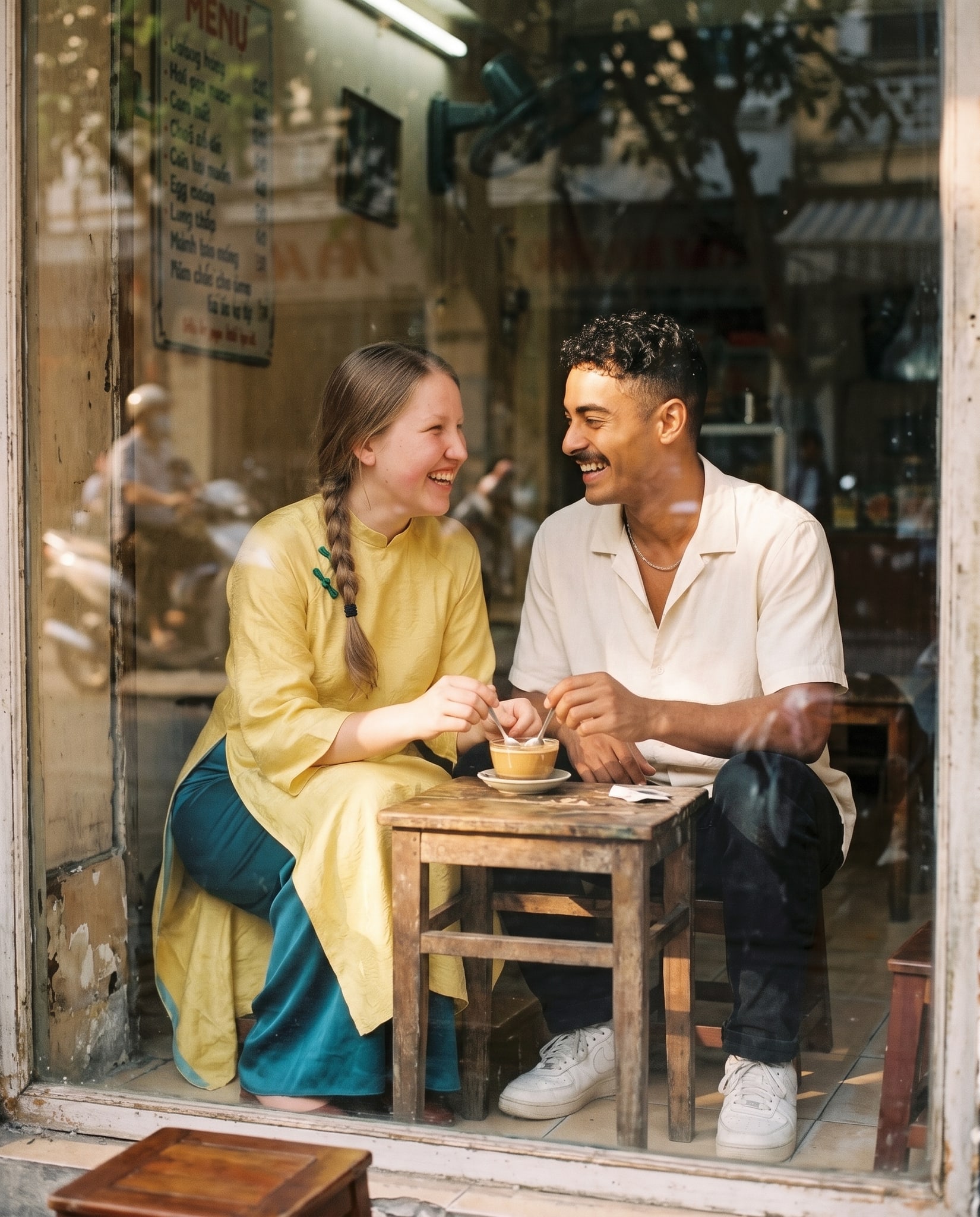
Most couples freeze when facing a camera; we use movement and genuine interaction to bypass stiffness. Start with walking toward or alongside each other—not static hand-holding—and capture frames mid-stride when expressions relax. Ask the man to place his hand on the woman's lower back or hold her hand while walking, then look down or at each other rather than the lens. For seated shots (on villa steps or benches), sit close, lean slightly inward, and have one person whisper something to the other to trigger real smiles. Avoid symmetrical poses (both facing dead-center); rotate one body 45 degrees and have the other angle toward them. If posing stiffness returns, we use prompts: "What's the most annoying thing he/she does that makes you laugh?" Authentic reactions beat forced smiles in post-processing. We shoot 40–60 frames per setup (motion, blinks, light shift), so you're never locked into one "perfect" take.
Why does timing matter more than location in the French Quarter?
Light quality and crowd density are the two variables you cannot control post-shoot. The French Quarter is geometrically narrow; streets like Tạ Hiến and Hàng Ngang are 4–6 meters wide, so direct sun overhead (10 a.m.–2 p.m.) fills shadows with glare and bleaches skin tone. Shooting 3–5 p.m. places the sun at 45 degrees, creating dimension: yellow building facades glow, skin looks warm, and shadows define cheekbones and jawlines. Crowds peak 9 a.m.–12 p.m. (tour groups), noon–2 p.m. (lunch hour foot traffic), and 4–6 p.m. (evening strollers). A 3:15 p.m. start on Tuesday–Thursday cuts background traffic by 60–70% compared to Saturday—we avoid the 3-hour weekend crush. Season also shifts timing: May heat forces us to start 3 p.m. (before the worst afternoon glare), while February's shorter daylight requires 2:30 p.m. starts. Poor timing can mean no usable frames; perfect location at 12 p.m. produces flat, overexposed images with photobombers. We plan every session around ephemeris (sun angle) and local event calendars, not just Instagram aesthetics.
What rules apply at temples and historic villas in the Quarter?
Temples within the French Quarter—including Chùa Lầu (Hang Trong Ward)—prohibit footwear; couples must remove shoes before entering and dress modestly (shoulders and knees covered). Posing inside is allowed for non-commercial personal use, but flash and tripods are forbidden. Historic villas open to walk-through tours sometimes permit shooting; always ask the attendant or guard before framing shots on private property. Many villas now restrict photography to scheduled times (usually 9 a.m.–11 a.m.) to reduce crowd disruption. Hanoi's Old Quarter heritage zone (which overlaps the French Quarter) has no blanket camera ban, but military sites or government buildings should be avoided entirely. Never shoot directly into people's homes (windows, balconies) without permission. Most temple and villa managers accept a polite greeting in English; we always confirm access 24 hours prior and scout alternative doorways, courtyards and street corners as backups if access is denied on the day.
What's the outfit strategy for colonial architecture backgrounds?
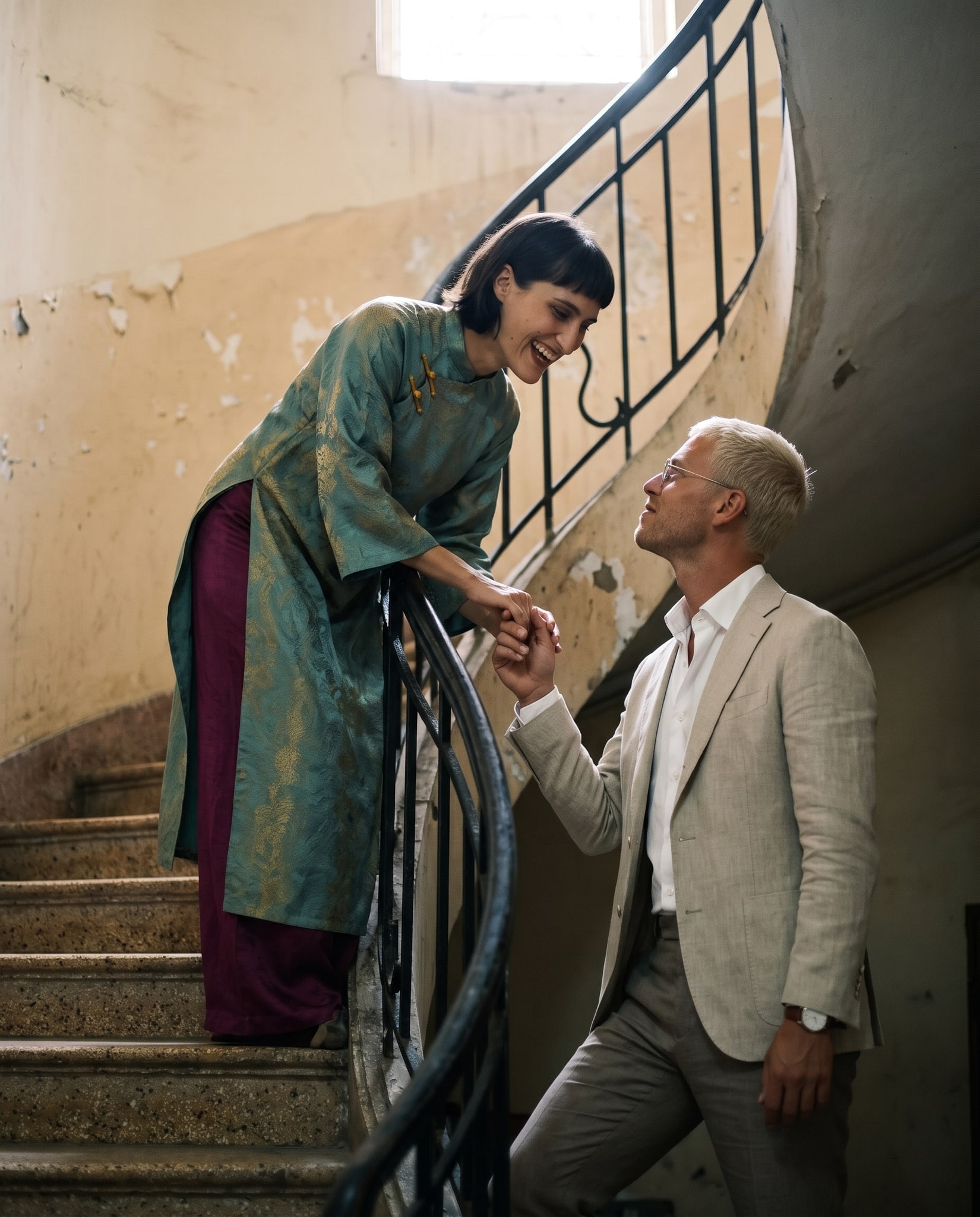
Wear neutral, fitted clothing that doesn't compete with yellow ochre walls and green colonial details. Men: dark or light solid jeans, white or cream linen shirt (rolls up sleeves for warmth and visual lightness), or a neutral polo—avoid logos or busy patterns. Women: fitted white, cream, pastel blue or blush dresses (knee-length or midi); dark jeans with a fitted cream or white top; or a simple slip dress—avoid florals or large prints that visually fight the architecture. Avoid neon, metallic shine, or anything that pulls the eye away from the couple's faces and connection. Accessories matter: delicate jewelry (small earrings, simple rings) work; chunky bags or hats should be left at your accommodation. Shoes are visible in many shots; neutral sneakers, simple flats or sandals blend better than statement footwear. If wearing an áo dài (Vietnamese traditional dress), choose solid colors (navy, burgundy, cream) over brocade patterns—the gown's lines are intricate enough. We check outfit photos 48 hours before the shoot and suggest swaps if clashes arise. Hair should be styled (half-up, loose waves, or a low bun); wind and humidity will shift it, so securing it prevents constant restyling during the 2–3 hour session.
| Outfit element | Works best | Why | Avoid |
|---|---|---|---|
| Top (men) | Cream or white linen shirt | Breathes, reflects afternoon warmth, complements yellow walls | Busy logos, tight black (absorbs heat, high contrast reads harsh) |
| Bottom (both) | Dark or medium-wash jeans | Slimming, neutral, hides dirt from street sitting | Rips, distressing, or overly loose fit |
| Dress (women) | Solid white, cream, or pastel slip | Simple elegance, doesn't distract, flatters against colonial hues | Busy florals, metallics, or anything shorter than knee |
| Shoes | Neutral flats, sneakers, sandals | Visible in many frames; simple shoes let architecture + couple stand out | Statement heels, neon, ankle weights that restrict movement |
| Hair | Loose waves or secured half-up | Wind and humidity shift unstyled hair constantly; styled = fewer on-set fixes | Fully down in monsoon season (tangles, sweat visibility) |
| Jewelry | Delicate earrings, thin rings | Catches light, adds detail without clutter | Chunky necklaces, dangling bracelets (distract in close-ups, catch wind) |
How do you manage photobombers and stay in frame on narrow streets?
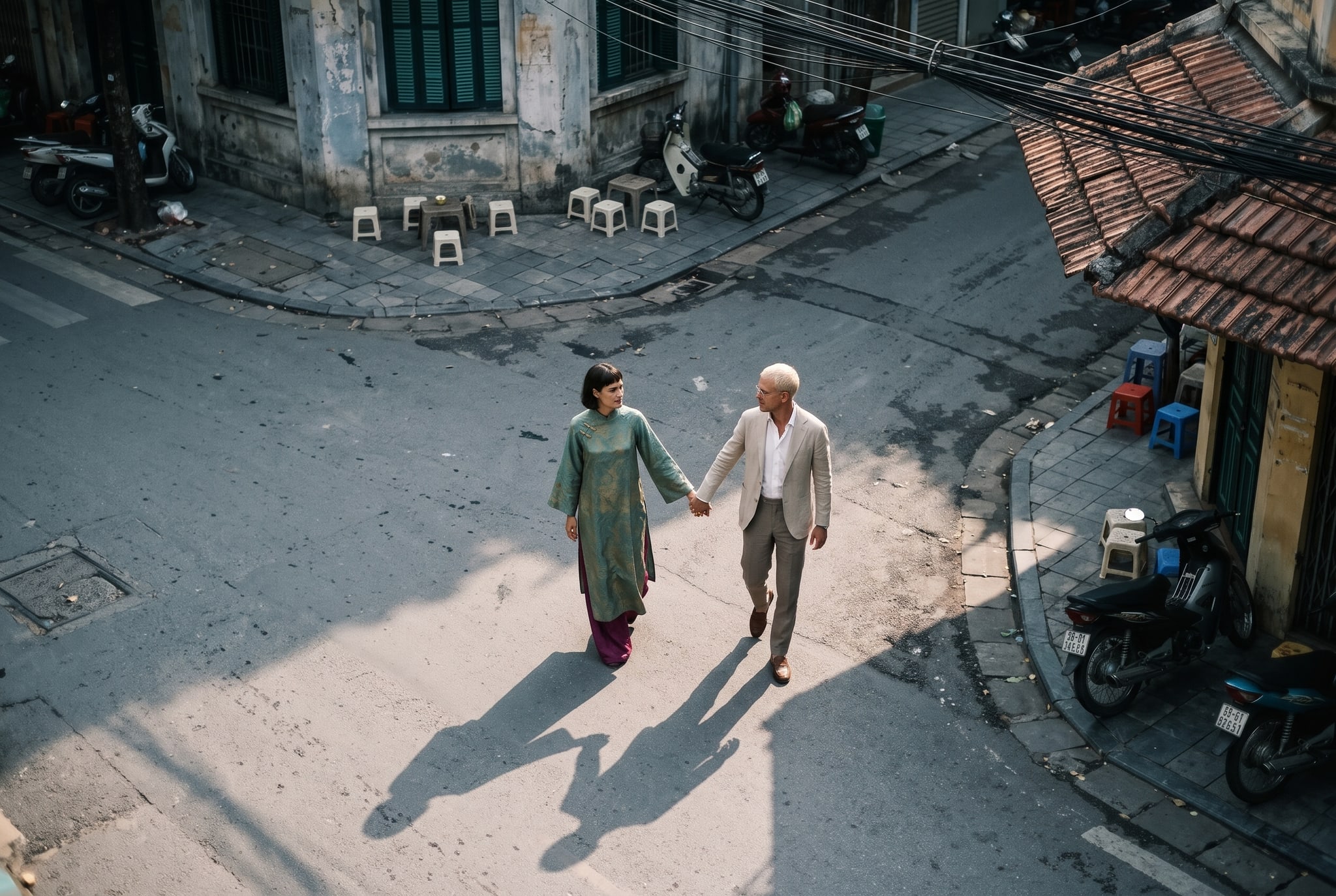
Narrow French Quarter lanes (3–5 meters wide) are two-way pedestrian highways; you cannot avoid background foot traffic entirely. We scout 48 hours before the shoot, noting dead-end alleys (fewer walkers), side lanes with fewer tour operators, and narrow passages where one strategically placed guide blocks sightlines. Scout spots include quiet morning corners of Hàng Ngang, Tạ Hiến's quieter southern section, and passages between Hoàn Kiếm and Chùa Lầu where residential foot traffic is lighter. During the session, we use an assistant (part of our standard team) to politely ask passersby for 30–60 second pauses—most locals and tourists comply when asked with a smile. If that fails, we shoot tighter framing (close-ups on faces, hands, jackets) that crop out background entirely, or move to a side entrance or doorway alcove where we're partially sheltered. We also shift timing: a 3:15 p.m. Tuesday start sees 40% fewer walkers than 4 p.m. Saturday. Post-processing (clone removal) can fix 1–2 small photobombers, but if 30%+ of frames have distracting background figures, the session was poorly timed—we reschedule rather than deliver substandard work.
Should you hire a professional or shoot on your own?
Professional couple photography in the French Quarter requires scouting light angles by season, managing crowds and timing, coaching non-models through posing, and delivering 50–100 polished edited frames—skills that take years to develop. Handheld smartphone shots capture memory but rarely achieve the warm skin tone, sharp focus, and compositional depth of a proper camera. Lighting at 2 p.m. (flat, overexposed) versus 3:30 p.m. (dimensional, warm) produces a 70% quality difference; most people don't know to wait. Posing coaching alone prevents the stiff, awkward expressions that plague DIY couple photos. If you value heirloom-quality images for anniversaries, social media, or framing, professional work is worth the investment; if you want casual memories, a high-end smartphone in portrait mode suffices. Professional sessions include editing (color correction, light balancing, background cleanup), styling advice, and on-set direction—DIY requires you to handle all three. Many couples hire us for the French Quarter session and skip the editing learning curve entirely.
What to check before you book your French Quarter couple shoot
- Verify your date 2–3 weeks ahead. We book on WhatsApp and confirm based on weather forecast and sunset time—monsoon season (May–August) may shift timing or suggest indoor backups.
- Choose your outfits and share photos with us 48 hours prior. We flag clashes with architecture and suggest swaps, saving on-set time.
- Confirm you're comfortable with non-pose coaching. Some couples prefer static, formal posing; we default to natural walking and interaction—let us know your preference early.
- Ask about backup locations before the session starts. If crowds are unexpectedly heavy or weather shifts, we pivot to a roofed villa or indoor courtyard—know the plan.
- Clarify your final output format. Digital files only, or printed album? Unedited RAW files or edited JPEGs? Confirm before booking to avoid disappointment.
- Check cancellation and rescheduling terms on WhatsApp. Monsoon downpours or personal emergencies may force a move; understand the policy upfront.
- Bring a phone charger and water bottle. The shoot runs 2–3 hours on outdoor streets with little shade; staying hydrated keeps energy and expressions fresh.
Other couple shoot styles and locations we offer
The French Quarter suits intimate, architectural storytelling; other couples prefer the natural landscape of Hoan Kiem Lake photo guide for reflections and open sky, or the raw industrial aesthetic of Train Street photo guide. We also shoot pre-wedding photoshoot multi-location sessions (combining French Quarter mornings with lakeside afternoons) and couple photoshoot packages tailored to your narrative. If you're considering other cities in Vietnam, our sister site vietnamphotoshoot.com covers alternative regions—ask us if Ho Chi Minh City or Da Nang suits your timeline better.
Plan your Hanoi shoot
FAQ
Can we do a couple shoot in the French Quarter if it's raining?
Light rain adds atmosphere (reflections on cobblestones, moody sky), but heavy downpour requires pivoting to indoor villa shots or rescheduling. We monitor forecasts 48 hours prior and confirm timing with you. Monsoon season (May–August) carries higher rain risk; we build backup indoor locations into those bookings.
What time should we arrive before the 3 p.m. shoot start?
Arrive 30 minutes early (2:30 p.m.) for final hair, makeup touch-ups and outfit checks. We handle all styling in-house, so no rush—but buffer time prevents on-set scrambling and lets you feel camera-ready.
Do we need to book the French Quarter location separately, or is it included?
No booking required; the French Quarter is public streets. We include location scouting, timing strategy, crowd management and posing coaching in our session. You show up; we handle logistics and direction.
How many edited images do we receive?
That varies by package; ask us for a quote on WhatsApp. Standard couple sessions yield 50–100 edited digital files (typically 10–15 per outfit change or location shift).
Can we bring a friend to watch or help during the shoot?
Yes, but extra people slow pacing and distract focus. We recommend one trusted friend as an emotional anchor if you're nervous about posing; anyone else should meet us afterward.
What if we hate the photos we got—can we reshoot?
If images are severely underexposed, blurry, or compromised by crowd chaos due to poor timing on our end, we offer a rescheduled session at no additional cost. If you're simply unhappy with poses or styling choices, we discuss edits first (cropping, color shifts, expression swaps across similar frames) before committing to a full reshoot.
Is the French Quarter accessible by motorbike, or do we need to walk?
Motorbikes are banned in many French Quarter lanes (Hàng Ngang, Tạ Hiến, Chùa Lầu) during peak hours. We recommend dropping you at the quarter's edge and walking in; shoot area is compact, so 5–10 minute walk from a main road suffices.
Can we incorporate an áo dài (traditional dress) into our French Quarter shoot?
Absolutely. Áo dài pairs beautifully with colonial architecture, especially solid colors (navy, burgundy, cream). We have makeup, hair & ao dai rental in-house; solid colors prevent visual clutter against ornate backgrounds. Plan an extra 30 minutes for áo dài styling if you're changing outfits mid-session.
Check dates
Send your dates, how many people and the style you like. We reply on WhatsApp in English with spots, timing and a quote.
FAQ
Can we do a couple shoot in the French Quarter if it's raining?
Light rain adds atmosphere (reflections on cobblestones, moody sky), but heavy downpour requires pivoting to indoor villa shots or rescheduling. We monitor forecasts 48 hours prior and confirm timing with you. Monsoon season (May–August) carries higher rain risk; we build backup indoor locations into those bookings.
What time should we arrive before the 3 p.m. shoot start?
Arrive 30 minutes early (2:30 p.m.) for final hair, makeup touch-ups and outfit checks. We handle all styling in-house, so no rush—but buffer time prevents on-set scrambling and lets you feel camera-ready.
Do we need to book the French Quarter location separately, or is it included?
No booking required; the French Quarter is public streets. We include location scouting, timing strategy, crowd management and posing coaching in our session. You show up; we handle logistics and direction.
How many edited images do we receive?
That varies by package; ask us for a quote on WhatsApp. Standard couple sessions yield 50–100 edited digital files (typically 10–15 per outfit change or location shift).
Can we bring a friend to watch or help during the shoot?
Yes, but extra people slow pacing and distract focus. We recommend one trusted friend as an emotional anchor if you're nervous about posing; anyone else should meet us afterward.
What if we hate the photos we got—can we reshoot?
If images are severely underexposed, blurry, or compromised by crowd chaos due to poor timing on our end, we offer a rescheduled session at no additional cost. If you're simply unhappy with poses or styling choices, we discuss edits first (cropping, color shifts, expression swaps across similar frames) before committing to a full reshoot.
Is the French Quarter accessible by motorbike, or do we need to walk?
Motorbikes are banned in many French Quarter lanes (Hàng Ngang, Tạ Hiến, Chùa Lầu) during peak hours. We recommend dropping you at the quarter's edge and walking in; shoot area is compact, so 5–10 minute walk from a main road suffices.
Can we incorporate an áo dài (traditional dress) into our French Quarter shoot?
Absolutely. Áo dài pairs beautifully with colonial architecture, especially solid colors (navy, burgundy, cream). We have [makeup, hair & ao dai rental](/makeup-and-styling) in-house; solid colors prevent visual clutter against ornate backgrounds. Plan an extra 30 minutes for áo dài styling if you're changing outfits mid-session.
More like this
Couple photoshoot
Couple Photoshoot Phung Hung Mural Street Sunrise Hanoi
Phung Hung Street's pastel murals are prime for couple shoots at dawn, but light, crowds and mural colors shift by season. We guide you through the best hour, what to wear, and how to avoid blurry or washed-out frames.
Couple photoshoot
Couple Photographer at Thang Long Imperial Citadel Sunrise in Hanoi
Capturing couples at Thang Long Imperial Citadel at sunrise delivers dramatic golden light, UNESCO heritage framing, and near-empty grounds—but requires 4 a.m. arrival, permit coordination, and seasonal weather timing to succeed.
Couple photoshoot
Couple Photographer Hanoi Duong Lam: Best Time to Shoot
Duong Lam Ancient Village, 45 km west of central Hanoi, offers stone-walled lanes, tiled roofs and rice terraces perfect for couple shoots. The best time is October to November (dry, soft light) or early morning May–August before heat peaks.