
Home › Blog › Ao dai photoshoot in Hanoi
Ao Dai Rooftop Sunrise Photoshoot in Hanoi: Light, Spots, Timing
By the Hanoi Photoshoot team · 2026-11-06
Rooftop sunrise ao dai photography in Hanoi means shooting between 5:30–7:00 a.m., when golden light floods east-facing rooftops and the city is quiet. We work with heritage buildings in the Old Quarter and French-colonial zones where permission and access are secured beforehand—no guessing. A typical session lasts 2–3 hours, includes in-house makeup, hair, and ao dai rental, and captures 100+ edited images. October–April offers the clearest skies and most flattering cool light; May–September brings humidity and haze. Success depends on arriving before crowds (temples fill by 8 a.m.), choosing a rooftop with clear east or south exposure, and understanding that non-models need posing cues: jaw angle, hand placement, breathing rhythm. Ask us for a quote on WhatsApp to confirm date, ao dai style, and rooftop availability—supply is limited, and morning slots book fast. Check dates on WhatsApp
Why sunrise light beats noon for ao dai portraits?
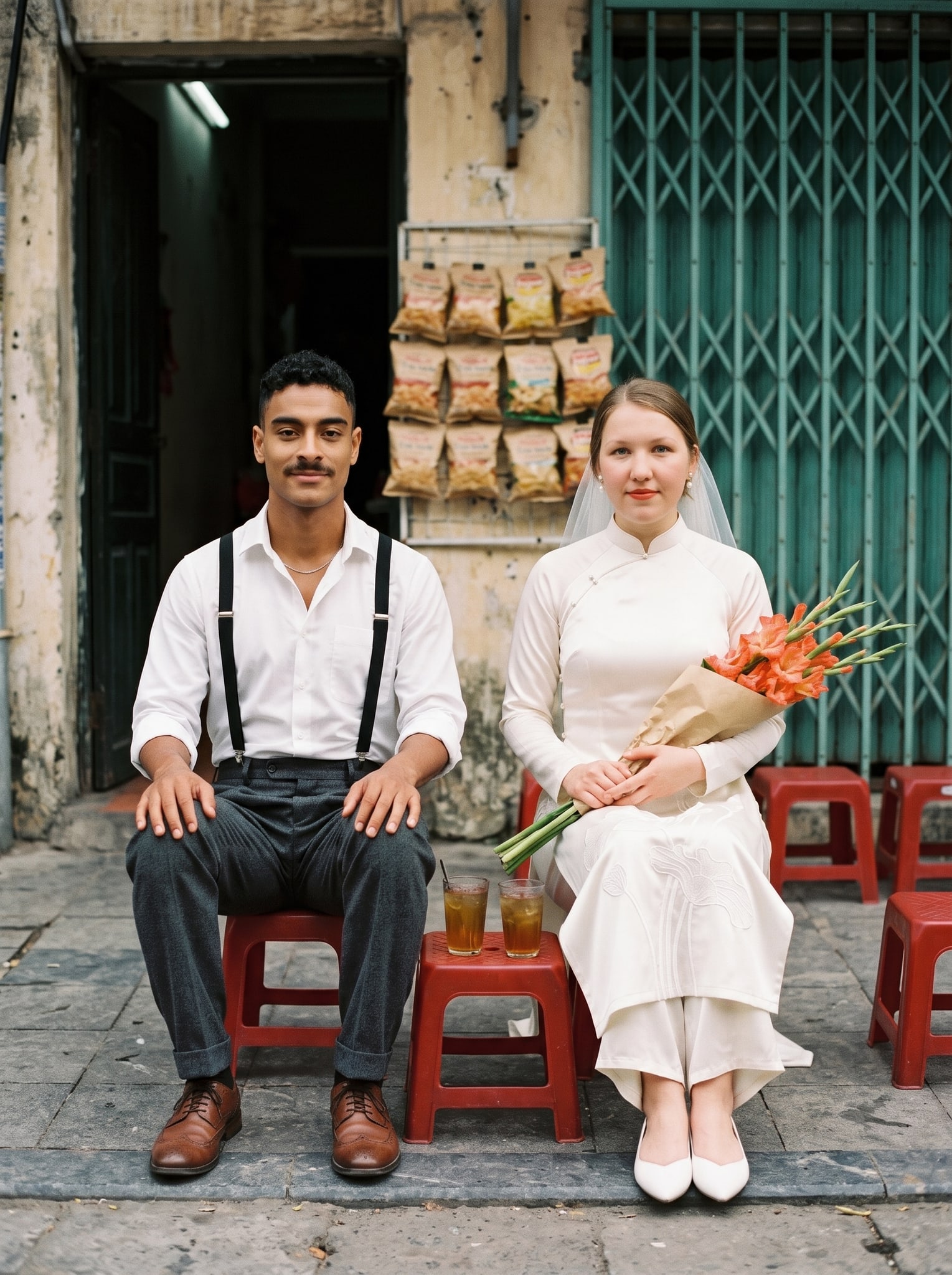
Golden hour—the first 60 minutes after dawn—produces soft, directional light that flatters skin tone, makes silk fabric glow, and creates natural shadows that sculpt the face without harsh contrast. Noon light is flat and blue-shifted; sunset is crowded. At 6:00 a.m. on a clear October morning, east-facing rooftops receive light at a 20–30° angle, wrapping around the subject. This angle minimizes flyaway hair, defines cheekbones, and makes embroidered ao dai details (gold thread, beading) catch fire. By 7:30 a.m., light hardens and the Old Quarter fills with tour groups. We position you so the sun is 45° behind your left or right shoulder—never directly in your eyes. This technique works equally well for solo travel portraits and couple photoshoots, though rooftop couple poses demand more space and balance.
Which Hanoi rooftops offer the best sunrise exposure?
We work with three rooftop types in Hanoi: heritage French-colonial buildings (Old Quarter, Hanoi French Quarter), modern mid-rise hotels with terraces (Lake Tây Hồ area), and restored shophouse roofs (Trần Nhân Tông, Nguyễn Huệ). East-facing rooftops are priority for sunrise; south-facing are secondary. Access depends on owner permission—we secure this in advance, not on-the-day. A rooftop's usability also depends on electrical lines, railings (safety first), and ground-level noise (motorbike traffic peaks 7:00–8:00 a.m.). The best rooftops have clear sight-lines to the horizon and no overhead obstructions. Our team scouts each location week-of-shoot to check for new construction, maintenance, or access changes. You won't waste time searching or negotiating at dawn; we arrive with keys, permits, or a confirmed contact. Avoid tourist-trap temple rooftops where photography is banned or charged; we stick to private and semi-private roofs where light and safety are guaranteed.
How does season change rooftop sunrise conditions?
Dry season (October–April) = clear skies, 10–20° humidity, consistent 5:45 a.m. sunrise, cool 15–18°C air. Golden hour light is direct and warm-toned. Wet season (May–September) = cloud cover on 70% of days, 70–90% humidity, 5:00 a.m. sunrise, warm 25–28°C air. Light scatters through haze; skin tones shift cooler and duller. Our editing restores warmth, but the in-camera result is softer and less punchy. Winter (December–February) offers the latest sunrise (6:15 a.m.) and coldest air—wear layers. Spring (March–April) is ideal: clear, warm, sunrise at 5:50 a.m., ao dai silk photographs richly. If your travel date lands in wet season, we book rooftops facing west (capture late-afternoon warm light instead) or schedule a Hoan Kiem Lake session where reflective water compensates for overcast skies. Hoan Kiem Lake photo guide details seasonal light there. Summer humidity can cause makeup fade and hair frizz; we use long-wear formulas and protective spray. Ask us for a quote tied to your exact travel month so we can lock the optimal time-slot.
What outfit and styling choices matter for rooftop sunrise?
Ao dai selection: Traditional silk (heavy, warm, flows beautifully in still morning air) vs. modern cotton-blend (cooler, less wrinkle-prone, faster dry if you sweat). Both photograph the same; choose by comfort. Embroidered or solid? Embroidery catches light like jewelry; solid colors let your face dominate. Pastels (blush, cream, pale blue) and jewel tones (emerald, burgundy, navy) photograph best in golden light; neon and white wash out. We offer ao dai rental in our styling package—sizes XS–XL, traditional cuts, modern fits—or you can bring your own (allow 2 hours for fitting adjustments).
Hair & makeup: Rooftop wind is unpredictable even at dawn. We use braids, pins, and gentle spray to secure styles; loose waves work if we hairspray them. Makeup must be long-wear foundation (12+ hours) because humidity and body heat will test it over 3 hours. Blush goes slightly heavy—golden light washes warmth away. Eyeliner is matte (no glossy shadows that catch the sun and disappear in photos). Our in-house makeup team applies products suited to your skin type and Hanoi's October–April or May–September environment.
Jewelry & props: Metal jewelry (gold, silver) bounces sunrise light; keep pieces simple so they don't compete with the ao dai. Avoid white metal on pale skin—it flattens. Rings, bracelets, and earrings are fine; necklaces can distract unless they're heirloom pieces. Props (fans, mirrors, silk scarves) work if held loosely and moved naturally; static props look staged. We guide you on-set.
How should a non-model pose for rooftop sunrise ao dai shots?
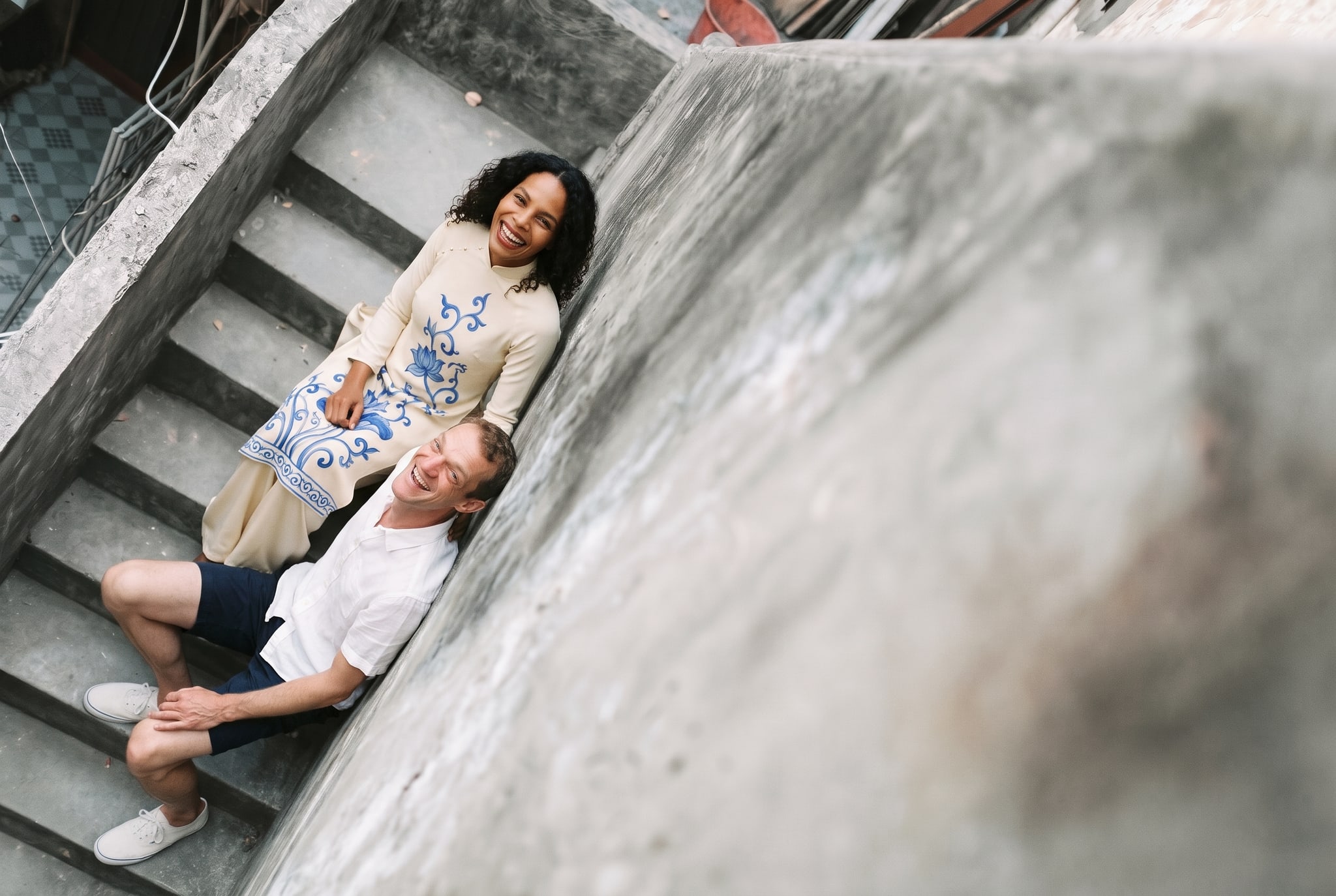
Non-models often freeze in front of the camera. We use a step-by-step posing method: (1) Stance: stand at a 45° angle to the camera, one foot forward, weight on the back leg—this lengthens your silhouette. (2) Shoulders: drop them away from your ears, then roll them back once; hold. (3) Chin: tilt slightly downward and forward; no double-chin, no strained neck. (4) Eyes: look 2 inches above the camera lens, blink on the count of three (pre-blink calm is natural). (5) Hands: place one hand on your thigh or in your ao dai's sash; the other hand can rest on the railing or hold your skirt. Avoid crossed arms—ao dai is the star, not you hiding. (6) Breathing: exhale slowly as we shoot; held breath tenses your face. We take 10–15 frames per pose, so you'll have options. Between takes, we chat, joke, move you to catch shifting light. The goal is candid joy, not a mannequin freeze. First-time clients are always surprised at how relaxed they look in the final images. We also shoot couple photoshoots and family sessions on rooftops—couples benefit from the same posing framework, just with interaction (hand-holding, looking at each other) layered in.
What to check before you book a rooftop sunrise session
| Factor | What to confirm | Why it matters | Timing |
|---|---|---|---|
| Rooftop access | We have secured permission or key | No delays at dawn; safe entry | 1 week before |
| Light forecast | Cloud cover % for your date | Affects golden-hour intensity | 3 days before |
| Ao dai fit | Size, style, neckline, hem | Wrong size wastes 30 min; photos look sloppy | 1 week before |
| Makeup formula | Long-wear, sweat-resistant | Fade mid-session = re-touching delays | At booking |
| Sunrise time | Exact time for your month | Late sunrise = later golden hour; affects schedule | At booking |
| Crowd traffic | Motorbike noise, foot traffic below | Audio can ruin video; distracts during shoots | 1 week before |
| Backup location | Assigned if rooftop is inaccessible | Rain, construction, locked gates happen | At booking |
Seasonal rooftop sunrise ao dai guide
October–November: Ideal. Clear skies, 15–18°C, sunrise at 6:00–6:15 a.m., zero humidity frizz. Book early—these months fill fast.
December–February: Cold mornings (12–16°C); wear a thin shawl or robe over your ao dai until 6:45 a.m., then remove for shooting. Clear light, late sunrise (6:15–6:30 a.m.).
March–April: Perfect blend: warm, clear, sunrise at 5:50–6:00 a.m. Ao dai silk glows. High demand—confirm dates 2+ weeks out.
May–September: 70% cloud cover, high humidity, 5:00 a.m. sunrise. Light is soft but dull. We pivot to lakeside shoots (Hoan Kiem Lake photo guide) where reflective water and shaded archways compensate. Makeup fades faster; plan touch-ups.
Real barriers: what goes wrong, and how we prevent it
Barrier 1: Rooftop locked or owner unavailable. Solution: We confirm access 48 hours prior and have backup rooftops scouted.
Barrier 2: Unexpected cloud cover at sunrise. Solution: We monitor weather hourly; if heavy cloud persists, we shoot golden-hour reflection shots at Tây Hồ (west-facing, later light) or reschedule with no penalty.
Barrier 3: Ao dai doesn't fit. Solution: Our in-house wardrobe has alterations on-site (hem, seam adjustments); fitting is 7 days before, not the morning of.
Barrier 4: Makeup fade from sweat or humidity. Solution: Long-wear formulas + setting spray applied 15 min before sunrise; we bring touch-up kits and reapply if needed between outfit changes.
Barrier 5: Jet lag = slurred eyes at 5:45 a.m. Solution: We schedule a 20-min coffee + stretching warm-up before first frame; caffeine + movement restores focus.
Plan your Hanoi shoot
We also offer couple photoshoots, pre-wedding sessions, family portraits, and solo travel portraits—all available on rooftops or at Hoan Kiem Lake, Train Street, or the Old Quarter. Ask us for a quote on WhatsApp to lock your sunrise date and time. We'll handle permits, makeup, hair, ao dai, and posing—you just show up and breathe.
FAQ
What time do we actually start shooting on a rooftop?
We meet at 5:30 a.m., do makeup and hair for 30 min, then shoot from 6:00–7:30 a.m. while golden light lasts. By 7:45 a.m., light hardens and crowds arrive. We finish strong before the city wakes.
Can we do rooftop sunrise in September (monsoon season)?
Possible but risky—70% of mornings have cloud cover or light rain. We offer it if you're flexible on rescheduling or accepting softer, less dramatic light. Wet-season shoots are discounted. Dry season (Oct–Apr) is safer for guaranteed golden-hour drama.
Do we need to bring our own ao dai, or do you rent?
We rent in-house or you bring your own. Rental includes pressing, fitting, and return laundry. If you bring your own, allow 7 days for fit checks and any tailoring needed. Both options photograph identically.
How many outfit changes fit in a 3-hour rooftop session?
Typically 2–3 ao dai, plus pants + blouse combo if desired. Changing on a rooftop takes 10–15 min per outfit (privacy, buttons, shoe swap). We allocate time so light quality stays high—rushing dilutes photos.
What if the rooftop is too windy or slippery on the day?
We monitor weather hourly and move indoors or to a sheltered alcove if needed. If the rooftop is unsafe, we shift to our backup location (usually lakeside or Old Quarter sheltered courtyard) with no extra charge and same light quality via reflectors and positioning.
Can we add a family member or partner to the rooftop session?
Yes. Rooftops fit 2–4 people comfortably for couple photoshoots or family portraits. Group posing follows the same framework—staggered heights, angled bodies, natural hand contact. Ask us for a quote that includes group ao dai rental and extended session time (we recommend 4 hours for 3+ people).
Check dates
Send your dates, how many people and the style you like. We reply on WhatsApp in English with spots, timing and a quote.
FAQ
What time do we actually start shooting on a rooftop?
We meet at 5:30 a.m., do makeup and hair for 30 min, then shoot from 6:00–7:30 a.m. while golden light lasts. By 7:45 a.m., light hardens and crowds arrive. We finish strong before the city wakes.
Can we do rooftop sunrise in September (monsoon season)?
Possible but risky—70% of mornings have cloud cover or light rain. We offer it if you're flexible on rescheduling or accepting softer, less dramatic light. Wet-season shoots are discounted. Dry season (Oct–Apr) is safer for guaranteed golden-hour drama.
Do we need to bring our own ao dai, or do you rent?
We rent in-house or you bring your own. Rental includes pressing, fitting, and return laundry. If you bring your own, allow 7 days for fit checks and any tailoring needed. Both options photograph identically.
How many outfit changes fit in a 3-hour rooftop session?
Typically 2–3 ao dai, plus pants + blouse combo if desired. Changing on a rooftop takes 10–15 min per outfit (privacy, buttons, shoe swap). We allocate time so light quality stays high—rushing dilutes photos.
What if the rooftop is too windy or slippery on the day?
We monitor weather hourly and move indoors or to a sheltered alcove if needed. If the rooftop is unsafe, we shift to our backup location (usually lakeside or Old Quarter sheltered courtyard) with no extra charge and same light quality via reflectors and positioning.
Can we add a family member or partner to the rooftop session?
Yes. Rooftops fit 2–4 people comfortably for [couple photoshoots](/couple-photoshoot) or [family portraits](/family-photoshoot). Group posing follows the same framework—staggered heights, angled bodies, natural hand contact. Ask us for a quote that includes group ao dai rental and extended session time (we recommend 4 hours for 3+ people).
More like this
Ao dai photoshoot in Hanoi
Ao Dai Photoshoot at Ho Chi Minh Mausoleum: Best Time & Tips
Ho Chi Minh Mausoleum area offers dramatic colonial architecture and red flags perfect for ao dai portraits, but timing and permit rules are critical.
Ao dai photoshoot in Hanoi
Ao Dai Photoshoot at Lotus Pond Sunrise in Hanoi
Lotus ponds offer Hanoi's most serene ao dai backdrop at dawn, but timing and location scouting are critical for empty frames and soft light. We share exact hours, seasonal water levels and how to avoid tourist crowds.
Ao dai photoshoot in Hanoi
Ao Dai Photoshoot Duong Lam Ancient Village: Best Time & Hanoi Guide
Duong Lam Ancient Village—45 minutes northwest of central Hanoi—offers weathered brick lanes, lotus ponds and colonial-era storefronts perfect for ao dai portraits. Best light and crowd conditions occur October–November and February–March mornings.