
Home › Blog › Ao dai photoshoot in Hanoi
Ao Dai Photoshoot Hanoi Train Street: Light, Crowds & Pose Tips
By the Hanoi Photoshoot team · 2026-11-06
Train Street (Phố Ga) runs a 2.6 km railway through the Old Quarter where freight trains pass 1–3 times daily; the best ao dai shots happen in the 90 minutes after dawn (5:45–7:15 am in summer, 6:30–8:00 am in winter) when soft golden light hits the tracks and crowds are minimal. We book sessions in the early morning slot, arrive 30 minutes early to scout, position you for the train's approach (never on the rails), and brief you on hand placement and walking rhythm—non-models often look stiff because they forget to breathe. Expect 60–90 minutes on location; wear layers (mornings are cool) and sturdy shoes (cobblestones are uneven). Train Street has no rental fee, but local authorities enforce a "no standing on tracks" rule, especially after 7:30 am when foot traffic and police checks increase. Book through Cáo Studio's WhatsApp to confirm the train schedule 48 hours ahead—service is unpredictable and sometimes shifts seasonally. Check dates on WhatsApp
What time of day gives the softest light on Train Street?
Dawn light (5:45–7:15 am April–September; 6:30–8:00 am October–March) is softest because the sun is low and passes through more atmosphere, diffusing hard shadows. By 8:00 am, direct overhead sun creates harsh contrasts that flatten ao dai fabric. Winter mornings are often misty, adding romantic diffusion but requiring 1–2 stop higher exposure. We avoid midday (11 am–3 pm) entirely; the light is clinical and pedestrian foot traffic peaks. Late afternoon (4:30–6:00 pm) can work in winter if sky is clear, but Train Street's narrow walls block direct rays, making frames dimmer and requiring slower shutter speeds.
Why do crowds ruin Train Street ao dai shots, and when are they smallest?
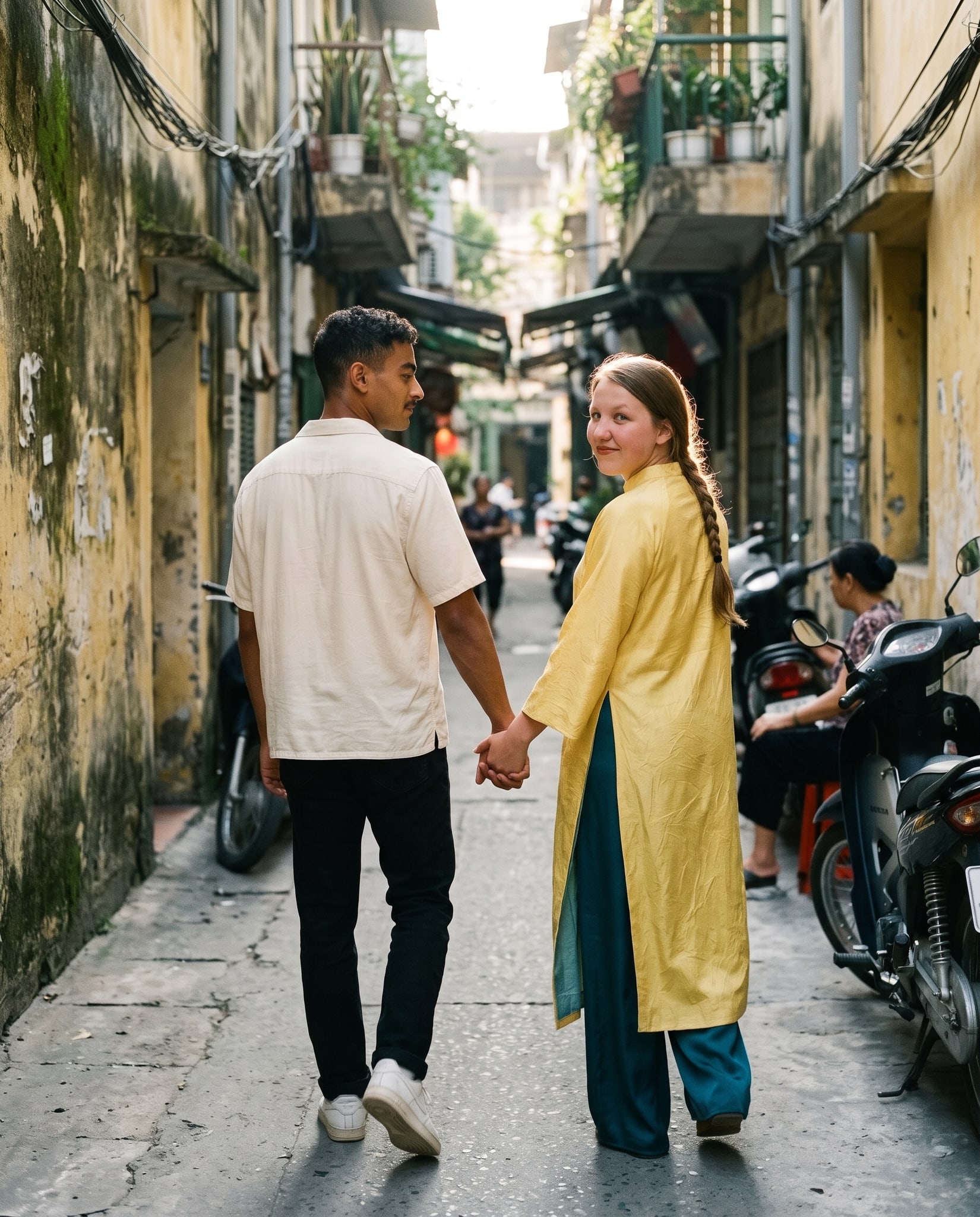
Peak tourist foot traffic arrives 7:30 am–11:00 am and 2:00 pm–5:00 pm; during these windows, 30–80 people are visible in background frames, and police presence increases to manage congestion. We shoot 5:45–7:00 am to ensure fewer than 5 bystanders per 20-meter stretch and zero police interaction. Late autumn and winter (November–January) drop weekday morning foot traffic 40–50% compared to summer. Rain mornings see almost no tourists; if you're willing to wear a water-resistant ao dai and accept wet ground reflections, dawn after rain offers unmatched clarity and emptiness.
How should a non-model pose naturally on Train Street without looking stiff?
Non-models freeze because they're aware of the camera and the unusual setting. We use a three-step sequence: first, walk toward or away from the camera in your natural pace (not slowed for drama), breathing steadily—this anchors your shoulders. Second, pause mid-stride with one foot slightly forward, then glance back over your shoulder as if noticing the light. Third, sit on the rails (never stand on them) and let your ao dai settle naturally; avoid symmetrical arm placement—one hand rests on your lap, the other on the rail behind you. We never ask for "smiles"; instead, we ask you to think of a specific memory (a good meal, a person you love, a place you want to return to), which creates a soft, present expression rather than a forced grin.
What outfit details help ao dai stand out on Train Street's gray backdrop?
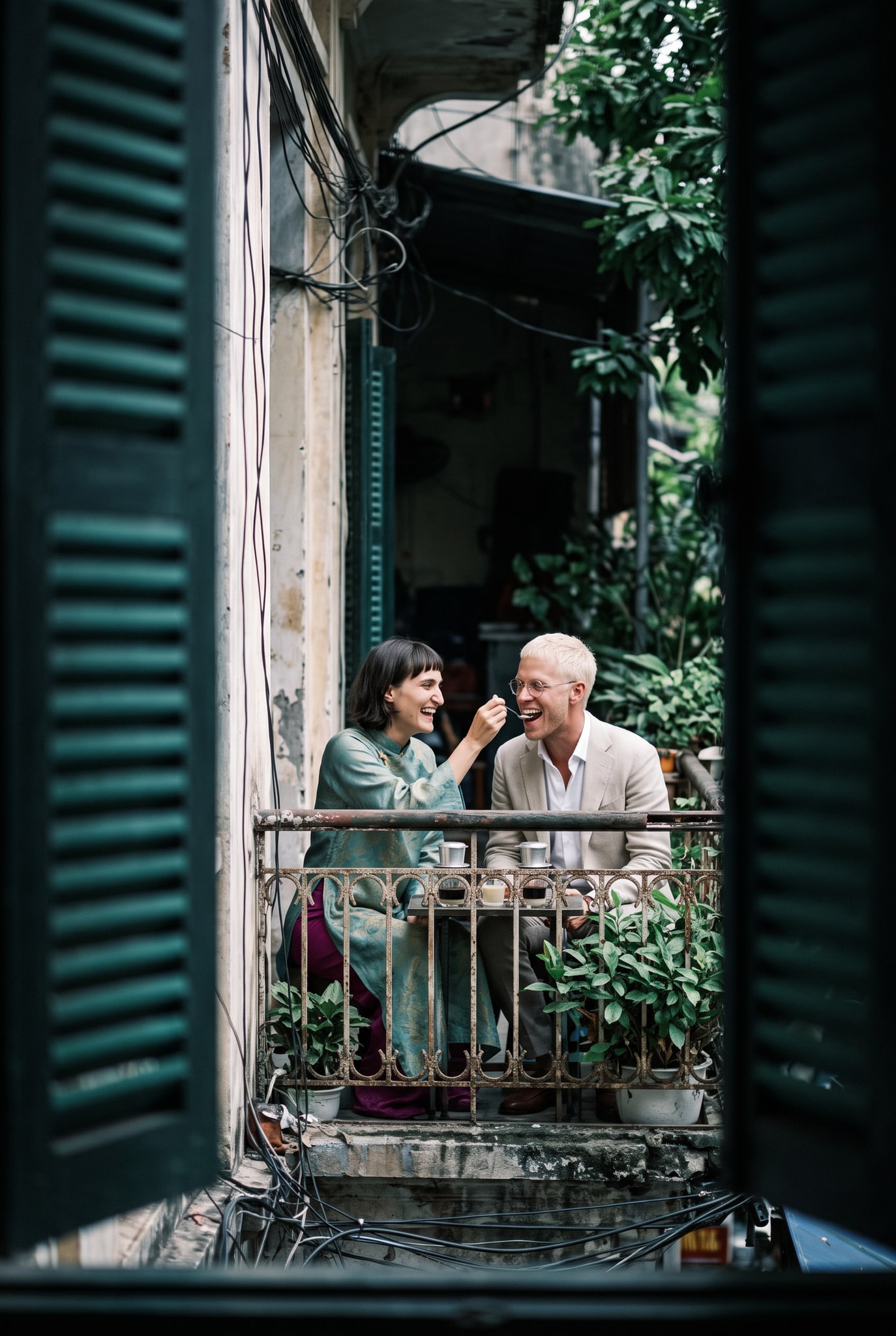
Train Street's palette is charcoal rails, rust stains, terracotta brick and green mold—jewel tones, pastels and metallics read cleanest. Deep emerald, sapphire, burgundy and gold-threaded ao dai cut through the muted background; white and cream wash out against overcast skies unless the sun is directly behind you (rim lighting). Avoid patterns that compete with the herringbone cobblestone or rust texture; solid colors or subtle brocade work. Jewelry should be minimal; long necklaces catch morning light unpredictably, and dangling earrings draw attention away from your face. Many clients pair an ao dai with a shawl or light outer layer in a contrasting tone to add depth and motion. We advise against sandals—Train Street cobblestones are slippery when wet, and shoes ground the frame visually.
What are the hard rules about Train Street photography that tourists ignore, and what happens if you break them?
Train Street's tracks are an active railway; standing or sitting on rails is technically illegal and increases danger if a train arrives unexpectedly (they are quiet and often ahead of schedule). Local police enforce a "no photography on the tracks" rule loosely but will ask you to move if congestion is high (usually after 8:00 am). Tour groups and solo tourists often ignore this, resulting in blocked shots and police contact. We always position you between the rails or on the cobblestone shoulder to stay compliant and safe. A second rule: avoid blocking residents' access—Train Street runs through a living neighborhood; early morning residents use the passage to commute. We schedule shoots with this traffic pattern in mind and never block a doorway or passage for more than 5 minutes. Finally, do not trespass into private courtyards or residential buildings visible from the track; a few have asked photographers to pay "permission fees," which is a scam.
How does seasonal weather affect Train Street ao dai composition and timing?
| Season | Light Quality | Crowd Level | Best Times | What to Adjust |
|---|---|---|---|---|
| Apr–Sep (hot/humid) | Harsh, golden early; hazy by 7:30 am | Very high on weekends, moderate on weekdays | 5:45–6:45 am | Lighter fabrics, water bottle, shoot before humidity peaks |
| Oct–Mar (cool/dry) | Softest morning light; blue sky noon–3 pm | Low (locals + fewer tourists) | 6:30–8:00 am or 4:00–5:30 pm | Layering, longer exposure time if overcast |
| Oct–Nov (transitional) | Golden + mist; 40–60% smaller shadows | Lowest annual foot traffic | 6:00–7:30 am any weekday | Mist adds romance; light flare unpredictable |
| Dec–Jan (cold/misty) | Low-angle sun, diffuse; 20–30% darker frames | Minimal; occasional frost hazard | 6:45–8:00 am | Slower shutter (ISO 400–800), white-balance toward warm to offset blue mist |
We always scout 2–3 weeks ahead to catch the seasonal light pattern and warn clients if recent construction, street maintenance or religious festivals have shifted local schedules.
What to check before you book a Train Street ao dai session.
Confirm the train schedule 48 hours prior—Cáo Studio sources this from the rail authority, but seasonal shifts happen. Check the weather forecast the night before; if rain is forecast, ask whether you prefer to reschedule or shoot in wet conditions (we offer both). Wear layers: mornings are 18–22°C year-round, warming by 8:00 am. Bring a small towel to wipe moisture from the rails if you'll sit. If you've never worn an ao dai, practice walking and sitting in it at least once before the shoot; Train Street's uneven ground is unforgiving if you're unbalanced. Finally, confirm your ao dai rental, hair and makeup is booked 72 hours ahead—this ensures your outfit is pressed, tailored to fit and coordinated with the light forecast.
Further Reading
Our Train Street photo guide covers location history, transport rules and gear needs in depth. If you're combining Train Street with other Old Quarter landmarks, see our Old Quarter photo guide for layout and timing. For ao dai photoshoot sessions elsewhere in Hanoi, we also offer Hoan Kiem Lake and lakeside temple options with different light and crowd patterns. Many clients add a second location in the same session; ask us about half-day or full-day couple photoshoot or family photoshoot options that blend Train Street with a secondary spot.
FAQ
What if the train doesn't show up on the morning of my shoot?
Train schedules shift seasonally and are sometimes 30–90 minutes late. We confirm arrival status via local contacts 30 minutes before your session. If no train arrives in your window, we pivot to static frames on the tracks (legally safer in low-traffic hours) or offer a rescheduled date at no additional cost. Many clients prefer static poses anyway—the train is a bonus, not the core shot.
Can we do a Train Street shoot in the afternoon or evening instead of dawn?
Afternoon light (3:00–5:30 pm) is possible in winter when sun angle is lower, but foot traffic is heavy (30–50 people visible), and police checks are more frequent. Evening (after 5:30 pm) is risky—light fades fast, crowds linger, and the railway is busier. We do not recommend either; if you must, we charge a coordination fee to manage permissions. Early morning remains the only professional choice.
Do we need insurance or a permit to shoot on Train Street?
Train Street is a public right-of-way, so formal permits are not required for personal (non-commercial) shoots. However, standing on the rails is technically illegal, and authorities do spot-check, especially 8:00 am–noon. We position you off-rails to avoid any issue. Commercial work (brand campaigns, ad shoots) requires explicit railway authority permission, which we do not broker; you would contact the rail authority directly months in advance.
What's the difference between Train Street and Cau Ong Nhan (the other famous Hanoi railway track)?
Cau Ong Nhan (Bridge One) is a second, quieter railway in the Old Quarter, running under a covered archway with tighter crowds and dimmer light. Train Street is longer, more scenic and has softer dawn light. We recommend Train Street for ao dai; Cau Ong Nhan for moody, dramatic frames if you prefer enclosed settings or have time for a second location.
How long does a Train Street shoot typically take?
60–90 minutes on-site, including 15 minutes of scouting and setup, 30–45 minutes of active shooting, and 15 minutes of buffer for train arrival or crowd management. We recommend booking a morning slot (5:45–8:00 am) to maximize light and minimize variables. If you're combining Train Street with a second location, a half-day (4–5 hours total) is ideal.
Is it safe to wear an ao dai on Train Street's wet, uneven ground?
Yes, with precautions. Train Street cobblestones are slippery when wet or mossy; wear closed-toe shoes with grip (not sandals). The ao dai itself is designed for movement and will not catch on the rails if you step carefully. We brief all clients on safe placement and never ask you to balance or pose awkwardly. In over 50 early morning sessions, we've had zero falls or injuries; the key is slow, intentional movement and sturdy footwear.
Check dates
Send your dates, how many people and the style you like. We reply on WhatsApp in English with spots, timing and a quote.
FAQ
What if the train doesn't show up on the morning of my shoot?
Train schedules shift seasonally and are sometimes 30–90 minutes late. We confirm arrival status via local contacts 30 minutes before your session. If no train arrives in your window, we pivot to static frames on the tracks (legally safer in low-traffic hours) or offer a rescheduled date at no additional cost. Many clients prefer static poses anyway—the train is a bonus, not the core shot.
Can we do a Train Street shoot in the afternoon or evening instead of dawn?
Afternoon light (3:00–5:30 pm) is possible in winter when sun angle is lower, but foot traffic is heavy (30–50 people visible), and police checks are more frequent. Evening (after 5:30 pm) is risky—light fades fast, crowds linger, and the railway is busier. We do not recommend either; if you must, we charge a coordination fee to manage permissions. Early morning remains the only professional choice.
Do we need insurance or a permit to shoot on Train Street?
Train Street is a public right-of-way, so formal permits are not required for personal (non-commercial) shoots. However, standing on the rails is technically illegal, and authorities do spot-check, especially 8:00 am–noon. We position you off-rails to avoid any issue. Commercial work (brand campaigns, ad shoots) requires explicit railway authority permission, which we do not broker; you would contact the rail authority directly months in advance.
What's the difference between Train Street and Cau Ong Nhan (the other famous Hanoi railway track)?
Cau Ong Nhan (Bridge One) is a second, quieter railway in the Old Quarter, running under a covered archway with tighter crowds and dimmer light. Train Street is longer, more scenic and has softer dawn light. We recommend Train Street for ao dai; Cau Ong Nhan for moody, dramatic frames if you prefer enclosed settings or have time for a second location.
How long does a Train Street shoot typically take?
60–90 minutes on-site, including 15 minutes of scouting and setup, 30–45 minutes of active shooting, and 15 minutes of buffer for train arrival or crowd management. We recommend booking a morning slot (5:45–8:00 am) to maximize light and minimize variables. If you're combining Train Street with a second location, a half-day (4–5 hours total) is ideal.
Is it safe to wear an ao dai on Train Street's wet, uneven ground?
Yes, with precautions. Train Street cobblestones are slippery when wet or mossy; wear closed-toe shoes with grip (not sandals). The ao dai itself is designed for movement and will not catch on the rails if you step carefully. We brief all clients on safe placement and never ask you to balance or pose awkwardly. In over 50 early morning sessions, we've had zero falls or injuries; the key is slow, intentional movement and sturdy footwear.
More like this
Ao dai photoshoot in Hanoi
Ao Dai Photoshoot at Ho Chi Minh Mausoleum: Best Time & Tips
Ho Chi Minh Mausoleum area offers dramatic colonial architecture and red flags perfect for ao dai portraits, but timing and permit rules are critical.
Ao dai photoshoot in Hanoi
Ao Dai Photoshoot at Lotus Pond Sunrise in Hanoi
Lotus ponds offer Hanoi's most serene ao dai backdrop at dawn, but timing and location scouting are critical for empty frames and soft light. We share exact hours, seasonal water levels and how to avoid tourist crowds.
Ao dai photoshoot in Hanoi
Ao Dai Photoshoot Duong Lam Ancient Village: Best Time & Hanoi Guide
Duong Lam Ancient Village—45 minutes northwest of central Hanoi—offers weathered brick lanes, lotus ponds and colonial-era storefronts perfect for ao dai portraits. Best light and crowd conditions occur October–November and February–March mornings.