
Home › Blog › Ao dai photoshoot in Hanoi
Ao Dai Photoshoot Hanoi Opera House: Best Times & Light Guide
By the Hanoi Photoshoot team · 2026-11-06
The Hanoi Opera House offers a grand colonnaded exterior perfect for ao dai portraits, but timing is critical: shoot 6–7 a.m. or after 5 p.m. to avoid harsh midday sun and peak tour groups (10 a.m.–3 p.m.). Golden hour (late afternoon, year-round 5–5:45 p.m. in winter, 6–6:45 p.m. in summer) gives warm, directional light that flatters traditional silk. Crowds thin significantly after 5 p.m., and late-morning light (8–9 a.m.) works well in winter when the sun is lower. You'll need a two-hour session to capture the façade, steps, and side gardens; the Opera House exterior is accessible to photographers without entry fees. Hanoi Photoshoot by Cáo Studio coordinates timing, handles permits for tripod use, and includes in-house ao dai rental and hair/makeup—ask us for a quote on WhatsApp to confirm your preferred time slot. Check dates on WhatsApp
Why is timing everything at the Opera House?
Light quality and crowd density determine whether your ao dai portraits feel timeless or cluttered. At midday, direct overhead sun creates harsh shadows across the face and washes out the silk's color. Early morning or late afternoon sun rakes across the façade, sculpting the classical architecture and warming the ao dai's fabric. Tour groups peak 10 a.m.–3 p.m., so booking before 8 a.m. or after 5 p.m. keeps backgrounds clean. In winter (November–February), the sun is lower and weaker, so 8–9 a.m. works almost as well as golden hour. Summer (May–September) requires earlier starts: 6–6:30 a.m., then a gap until 5:30 p.m., because mid-morning through late afternoon light becomes too harsh.
What does the Opera House offer photographers in each season?
Winter (November–February) delivers the best light stability and coolest temperatures. Sun is low all day, so 8 a.m.–4 p.m. avoids brutal shadows; humidity is lowest, so ao dai holds crisp silhouettes. Occasional morning mist adds mystery to formal portraits. Spring (March–April) brings 75–85°F mornings but intense sun by 10 a.m.; golden hour stretches from 5:15–6 p.m. Summer (May–September) is hot and humid—book 6–7 a.m. sessions before heat peaks—but late-afternoon light (6–6:45 p.m.) is still soft if you can wait. Autumn (October) repeats spring: cool mornings, strong sun by mid-morning, excellent 5–5:45 p.m. window. Crowds are lightest in July–August and November–January, when school holidays and holiday seasons keep tourists away.
How do we navigate permits and security for tripod work?
The Opera House exterior (forecourt, steps, columns) permits hand-held photography freely, but tripods require informal coordination with security. We arrive 15–20 minutes early, identify ourselves as photographers, and position tripods near the building's sides, away from main pathways. Security rarely objects to still photography when we're respectful and keep sessions under two hours. Do NOT attempt to shoot inside the lobby or theatre—that requires formal booking and commercial permits. Do NOT block pedestrian walkways or prop people against the doors. We always scout the exact angle with available light before setting up, meaning we waste zero time adjusting once the session begins. If you're self-booking, introduce yourself to the guards; if refused, we pivot to the side gardens or the neighbouring Hanoi Old Quarter colonial streets, which offer similar grandeur.
What ao dai styles photograph best against the Opera House's classical lines?
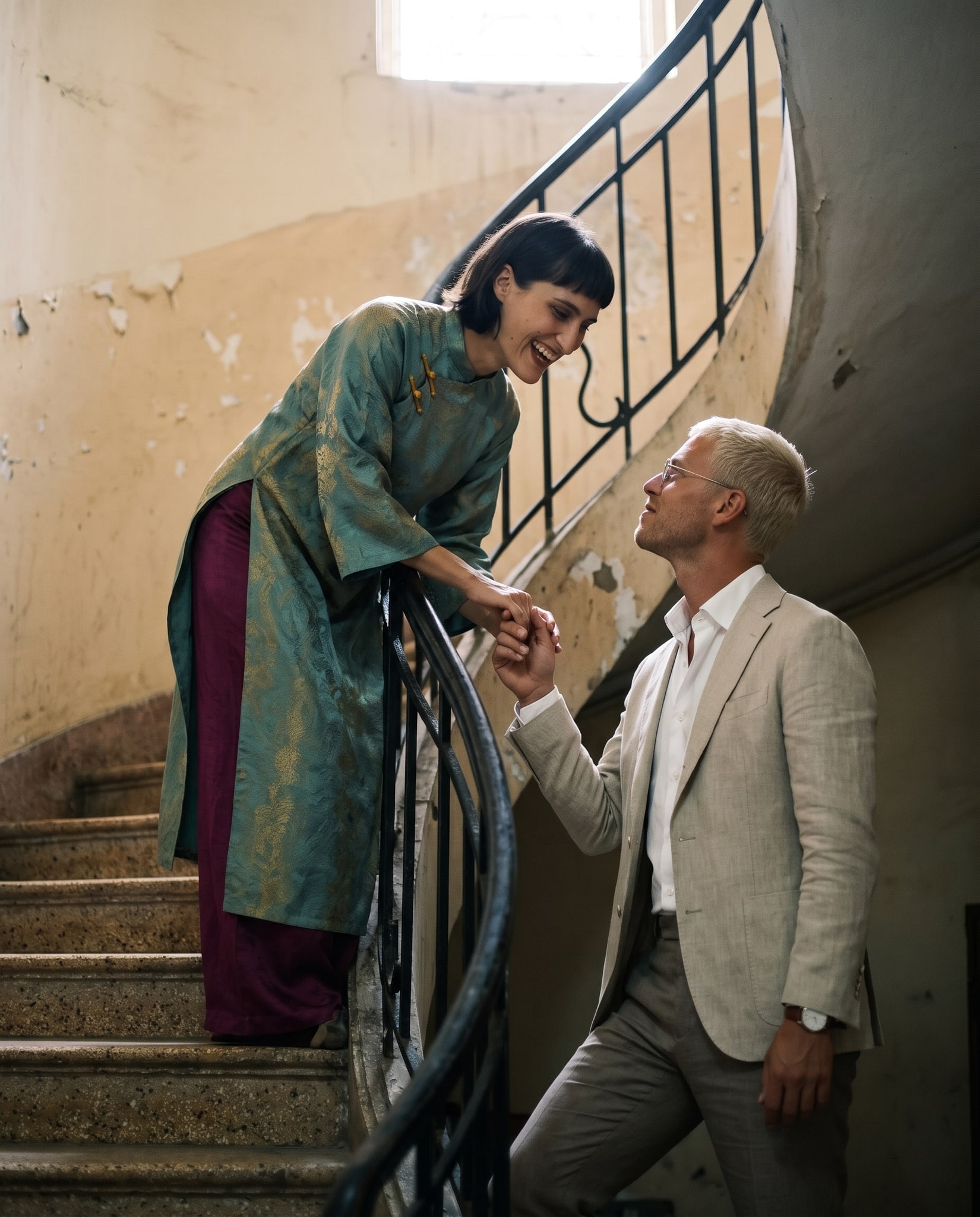
Solid colours and minimal patterns respect the architecture without competing visually. Deep jewel tones (emerald, sapphire, burgundy) and rich neutrals (black, cream, champagne) photograph with maximum depth and elegance against pale stone. Embroidered hems and collar details catch soft morning light beautifully; fine brocade or silk damask reads well even in afternoon shadow. Avoid busy prints or metallic sheens, which flatten under harsh sun. We offer ao dai rental in-house with a curated selection of formal and semi-formal cuts—ask us for a quote on WhatsApp to see the current collection and reserve a style that suits your vision and body frame. Many clients choose a fitted classical cut (traditional "ao dai ôm") for solo shots and a looser "ao dai thụng" for movement and group portraits. Hair and makeup are coordinated by our team to emphasize the ao dai's drape without competing for attention.
How do light and positioning differ for solo versus group ao dai sessions?
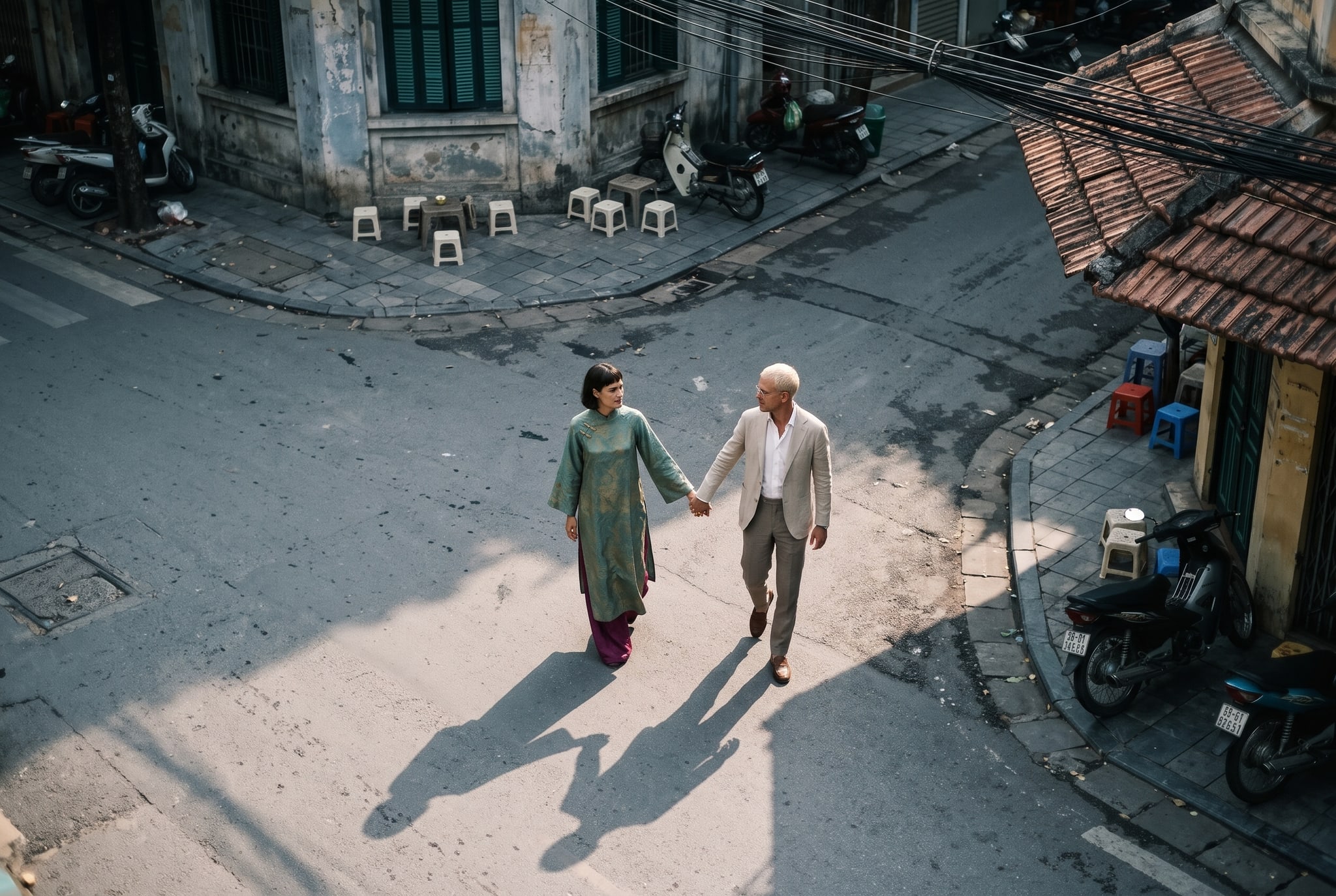
Solo portraits rely on single-direction light to sculpt the face and drape. Position yourself perpendicular to the sun's direction (e.g., sun to your right at 5 p.m.); the light rakes across cheekbones, softens the jaw, and creates a thin shadow that adds dimension. For group ao dai family photoshoots, we use the entire façade—positioning subjects at intervals along the steps so each person catches directional light without blocking others. Three people fit naturally on the main stairs without crowding; for larger families, we use the side portico or front plaza to space everyone evenly. Couple sessions benefit from the iconic wide shot (both on the central steps, framed by columns) plus close-up detail work on the lace, embroidery, and fabric texture. Metering is trickier in groups because stone reflects light unevenly; we take 3–5 test frames to lock exposure before the session starts.
| Scenario | Light Window | Positioning | Typical Duration | Best For |
|---|---|---|---|---|
| Solo portrait | 5–5:45 p.m. (winter); 6–6:45 p.m. (summer) | Perpendicular to sun, stairs or plaza | 60–90 min. | Professional, personal keepsake |
| Couple shoot | 6–6:30 p.m. all year | Central steps, framed by columns | 90–120 min. | Pre-wedding, anniversary, engagement |
| Small family (3–5) | 6–6:45 p.m. or 8–9 a.m. (winter only) | Spread on stairs and side portico | 120–150 min. | Multi-generational memories |
| Group (6+) | 8–9 a.m. (winter); 6:30–7 p.m. (warm months) | Staggered on plaza and side gardens | 150+ min. | Family reunion, corporate portrait |
What do we check before locking in an Opera House booking?
First, confirm your preferred date and time slot—afternoon windows (5–7 p.m.) fill fastest in winter and autumn. Second, specify ao dai rental style and colour; if you bring your own, inform us in advance so we can assess fit and potential damage risk (outdoor stone can snag delicate fabric). Third, discuss whether you want makeup and hair touch-ups on-site; humidity and heat require a powder compact and bobby pins. Fourth, clarify whether you'll bring a partner, family members, or solo—group dynamics affect timing and framing. Fifth, ask about weather backup: if rain is forecast, we offer a rescheduled date or pivot to the Old Quarter's covered shophouse arcades for a different aesthetic. Sixth, confirm that you understand the Opera House is an exterior-only shoot; lobby and theatre access is not available for photo sessions. Seventh, provide your camera preferences (phone, compact, or DSLR) so we can adjust composition to your device's sensor; some phones struggle with high-contrast stone-and-shadow scenes. Finally, ask us for a quote on WhatsApp—we'll confirm availability, io dai selection, and exact timing based on the season and your vision.
What can go wrong, and how do we prevent it?
Harsh shadows: Midday sun creates black pools under eyes and nose. Solution: never shoot 11 a.m.–4 p.m.
Blown-out stone: Pale limestone reflects so much light that subjects' faces underexpose. Solution: expose for the face, let the building go slightly bright—it reads better in prints.
Crowd interference: Tour groups cluster on the same stairs. Solution: schedule before 8 a.m. or after 5 p.m.; we confirm this during booking.
Humidity and makeup breakdown: Summer heat wilts foundation and causes frizz. Solution: arrive early enough to settle into the environment; we use long-wear makeup products and bring touch-up powder.
Ao dai wrinkles: Long periods sitting or standing crease the silk. Solution: bring a garment steamer (available at nearby hotels) or contact us to arrange pressing 30 minutes before the session.
Tripod knockover: Stone forecourt is uneven; legs can slip. Solution: we use sandbags and scout the exact spot beforehand.
#
FAQ
Can we shoot inside the Opera House?
The theatre interior requires a formal rental permit and commercial license—outside our scope. We stick to the exterior façade, steps, and forecourt, which is freely accessible for still photography and requires no permit for hand-held work.
Is there a fee to photograph at the Opera House?
No entry fee for the exterior public areas. We handle any informal coordination with security; ask us for a quote on WhatsApp to confirm session length and logistics.
What if we want an ao dai shoot but prefer a different Hanoi landmark?
We offer couple photoshoots and solo travel portraits at Hoan Kiem Lake, the Old Quarter, and other spots. WhatsApp us to explore alternatives based on your style and schedule.
How far in advance should we book?
High-demand times (golden hour in December–February, weekends year-round) book 2–3 weeks ahead. Off-peak mornings (July–August, rainy season) can accommodate bookings with 3–5 days' notice.
Do we need to bring our own ao dai, or can we rent?
We provide rental ao dai with hair, makeup, and styling. Bring your own if you prefer—we'll assess fit and advise on any touch-ups. Ask us for a quote on WhatsApp to compare options.
What if weather ruins our session?
We reschedule to your next available window at no extra charge, or pivot to an indoor-friendly location like a colonnaded shophouse or hotel lobby. Confirm our rescheduling policy when you book. Check dates on WhatsApp
Check dates
Send your dates, how many people and the style you like. We reply on WhatsApp in English with spots, timing and a quote.
FAQ
Can we shoot inside the Opera House?
The theatre interior requires a formal rental permit and commercial license—outside our scope. We stick to the exterior façade, steps, and forecourt, which is freely accessible for still photography and requires no permit for hand-held work.
Is there a fee to photograph at the Opera House?
No entry fee for the exterior public areas. We handle any informal coordination with security; ask us for a quote on WhatsApp to confirm session length and logistics.
What if we want an ao dai shoot but prefer a different Hanoi landmark?
We offer [couple photoshoots](/couple-photoshoot) and [solo travel portraits](/solo-portrait) at [Hoan Kiem Lake](/spots/hoan-kiem-lake), the [Old Quarter](/spots/hanoi-old-quarter), and other spots. WhatsApp us to explore alternatives based on your style and schedule.
How far in advance should we book?
High-demand times (golden hour in December–February, weekends year-round) book 2–3 weeks ahead. Off-peak mornings (July–August, rainy season) can accommodate bookings with 3–5 days' notice.
Do we need to bring our own ao dai, or can we rent?
We provide [rental ao dai with hair, makeup, and styling](/makeup-and-styling). Bring your own if you prefer—we'll assess fit and advise on any touch-ups. Ask us for a quote on WhatsApp to compare options.
What if weather ruins our session?
We reschedule to your next available window at no extra charge, or pivot to an indoor-friendly location like a colonnaded shophouse or hotel lobby. Confirm our rescheduling policy when you book. [📸 Check dates on WhatsApp](https://wa.me/84338762340)
More like this
Ao dai photoshoot in Hanoi
Ao Dai Photoshoot at Ho Chi Minh Mausoleum: Best Time & Tips
Ho Chi Minh Mausoleum area offers dramatic colonial architecture and red flags perfect for ao dai portraits, but timing and permit rules are critical.
Ao dai photoshoot in Hanoi
Ao Dai Photoshoot at Lotus Pond Sunrise in Hanoi
Lotus ponds offer Hanoi's most serene ao dai backdrop at dawn, but timing and location scouting are critical for empty frames and soft light. We share exact hours, seasonal water levels and how to avoid tourist crowds.
Ao dai photoshoot in Hanoi
Ao Dai Photoshoot Duong Lam Ancient Village: Best Time & Hanoi Guide
Duong Lam Ancient Village—45 minutes northwest of central Hanoi—offers weathered brick lanes, lotus ponds and colonial-era storefronts perfect for ao dai portraits. Best light and crowd conditions occur October–November and February–March mornings.