
Home › Blog › Ao dai photoshoot in Hanoi
Ao Dai Photoshoot French Quarter Hanoi Sunrise: Light, Timing & Crowds
By the Hanoi Photoshoot team · 2026-11-06
Sunrise ao dai shoots in Hanoi's French Quarter work best 06:30–07:30, when northeast-facing colonial buildings catch soft golden light and streets stay uncrowded. The shoot lasts 90–120 minutes and includes in-house ao dai rental, makeup, hair and two outfit changes at our Hanoi Photoshoot by Cáo Studio base (or your chosen tailored ao dai). You'll work with our lead photographer in tree-lined avenues near the Opera, Hoan Kiem Lake's northeast shore, and heritage stone passageways. Cost varies by package; ask us for a quote on WhatsApp. Avoid midweek rain (May–September) and 08:30+ arrival—crowds swell, light flattens, and ao dai silk gets damp. Suits travelers, couples and solo portraits seeking timeless colonial framing without tourist congestion. Check dates on WhatsApp
Why does sunrise light work best for ao dai in the French Quarter?
The French Quarter's stone buildings face northeast and southwest; sunrise rays hit east-facing facades at a shallow angle, wrapping ao dai silks in warm diffused gold without harsh shadows at 06:45–07:15. By 08:00, light becomes directional and hot; by 11:00, it flattens and washes out the deep reds, golds and blues ao dai fabric demands. Morning light also softens porcelain skin tones and adds a subtle rim glow to hair and embroidered trim—impossible in noon glare. Morning shoots feel quieter, more intimate, and let fabric drape naturally before humidity peaks. The trade-off: you start early, weather must be clear, and rain in summer months (May–September) happens 3–4 days per week, so confirm 24 hours ahead.
Which streets and landmarks photograph best for ao dai before crowds arrive?
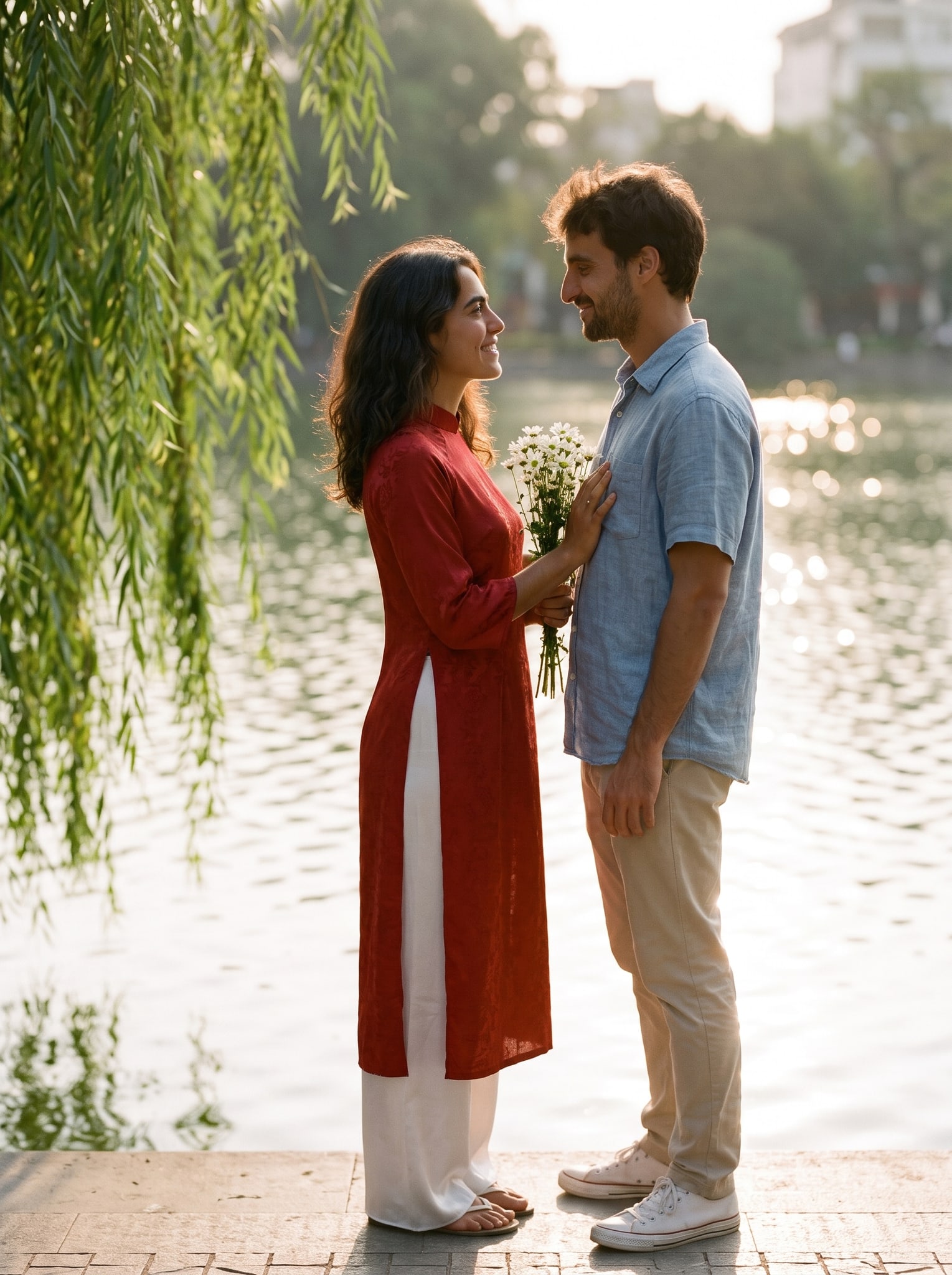
The Opera House (Nhà Hát Lớn) courtyard and colonnaded approaches open to foot traffic from 07:00; we book 06:45–07:45 shoots here before tour groups arrive. Trang Tien Street, a tree-lined pedestrian lane linking the Opera to Hoan Kiem Lake, stays nearly empty until 08:15 on weekdays and 08:00 on weekends—its dappled shade suits close-up ao dai detail shots (embroidery, cuff, collar) without blown-out backgrounds. The northeast shore of Hoan Kiem Lake, near the old restored French pier area, offers stone railings and morning mist reflecting ao dai colors—best at 06:50–07:20 when light rakes across water. Avoid the Turtle Tower island itself; no official ao dai shoots permitted there. Small heritage alleyways (like those near Nha Tho Street) feature weathered yellow-ochre walls and narrow stone archways—ideal for single-outfit, high-contrast shots—but scouting these requires local knowledge; we handle location scouting and permits as part of our ao dai photoshoot service.
How do season and weather affect sunrise ao dai timing in Hanoi?
Sunrise times shift from 06:00 (December) to 05:15 (June), so "golden hour" window shrinks in summer and expands in winter. Winter (November–February) brings clear skies but chilly mornings; ao dai silk feels crisp and drapes sharply, though makeup requires longer setting. Spring (March–April) is ideal: sunrise at 05:45–06:15, humidity low, light stable. Summer (May–September) means sunrise at 05:15–05:30, but 50–70% chance of morning drizzle; wet stone and fabric require extra makeup prep and fast shooting. Autumn (September–November) returns clarity; sunrise at 06:15–06:45, no rain. Rain during a 06:45 shoot isn't always a kill—we've shot in light drizzle with waterproof makeup, and wet streets photograph beautifully—but confirm 12 hours before. Humidity peaks July–August; dehydration and makeup breakdown happen faster, so we adjust pacing and offer extra touch-ups mid-shoot.
| Season | Sunrise time | Best for ao dai | Rain risk | Humidity | What to prepare |
|---|---|---|---|---|---|
| Nov–Feb (Winter) | 06:00–06:45 | Crisp drape, stable light | 10–20% | Low | Warm layers, extra makeup set time |
| Mar–Apr (Spring) | 05:45–06:15 | Ideal: clear, cool, soft light | 15–25% | Low–med | Standard kit, bring sunscreen |
| May–Sep (Summer) | 05:15–05:45 | Golden light early, brief | 50–70% | High (70–85%) | Waterproof makeup, fast shooting, hydration |
| Sep–Nov (Autumn) | 06:15–06:45 | Clear, stable, warm gold | 10–15% | Medium | Sunscreen, afternoon coolness |
What do non-models need to know about posing ao dai at heritage colonial sites?
Most travelers aren't used to standing still for 90 seconds while light and wind shift ao dai folds—here's what we see go wrong. First, holding the áo (tunic) front loose causes wrinkles; we show you to pinch fabric at hip-height and let the skirt (quần) sit flat on your legs, not bunched at the knee. Second, walking while shooting—avoid stopping mid-stride; pause, breathe, relax shoulders, then we shoot 8–12 frames in 5 seconds while you stay still. Third, the arms: tucked behind the back looks stiff; instead, let them hang at sides or rest one hand on a railing behind you, fingers loose. Fourth, the face: the French Quarter's stone walls are bright; squinting kills the shot. We position you with back-light or shade, or ask you to look slightly past the camera at a tree or building, not directly into sun. Fifth, cold-morning stiffness is real; we do a 10-minute warm-up walk before the first shot. Finally, ao dai rental—we size you correctly (measure waist, bust, height before arrival) so tunic drapes, not clings or sags. New-to-ao-dai clients often undershoot (6–8 usable frames) when they tense up; relaxed poses yield 20+. We frame the colonial setting to do the work—you just stand, breathe, and turn slightly when we ask.
How do permits, temple rules and street closures affect early-morning shoots?
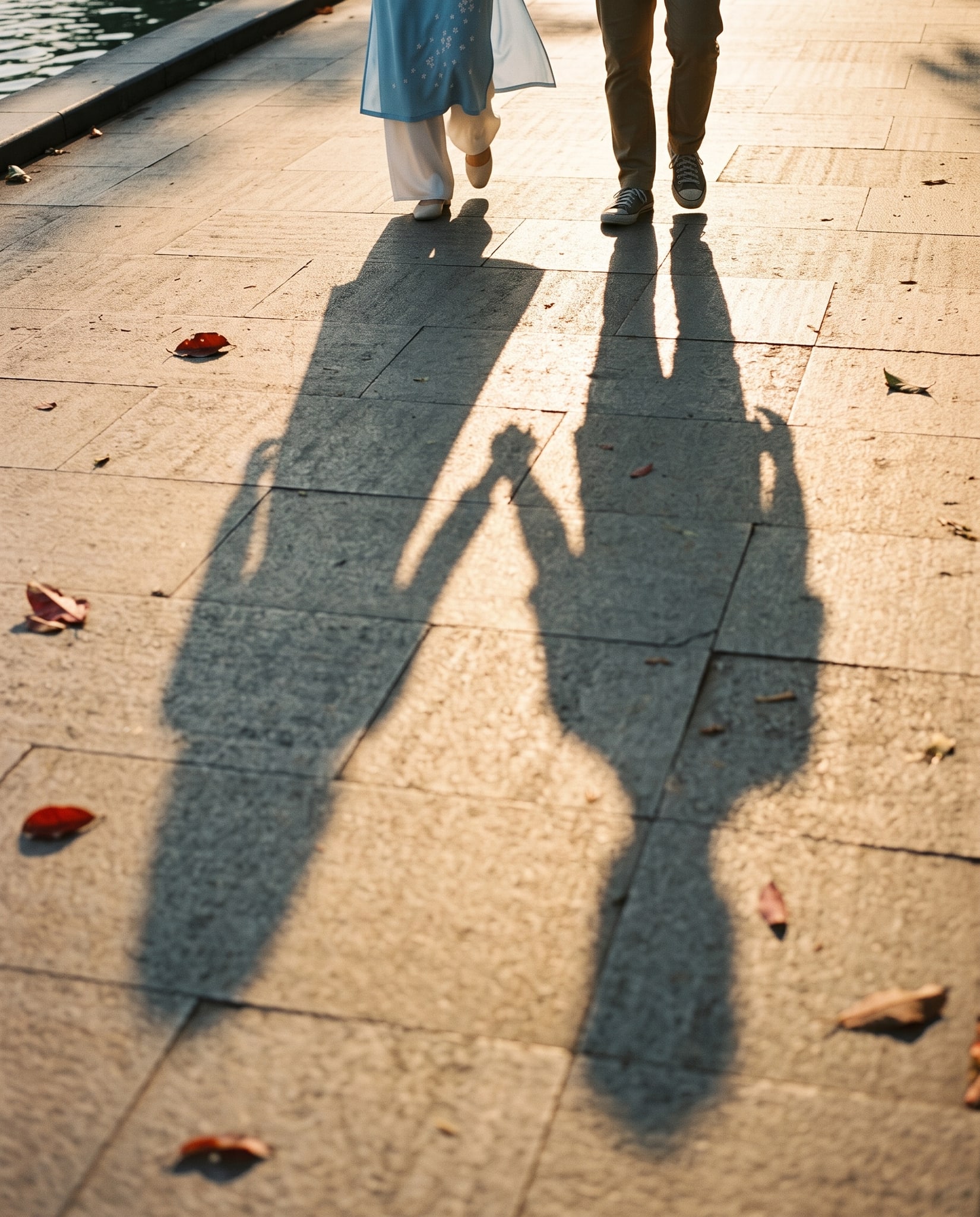
Hanoi's French Quarter isn't a free-access film zone; we hold proper photography permits for Old Quarter heritage sites and coordinate with local authorities for Street shoots near government buildings (rare, but the Finance Ministry building on Ngo Quyen Street restricts tripod use). The Opera House allows photography from its perimeter and courtyard before 07:00 without fees; after, tour groups own the space. Trang Tien pedestrian street is public; no booking needed, though we scout morning foot traffic and alert you if events block access. Hoan Kiem Lake's northeast shore is public park space; photography allowed dawn to dusk, but don't cross into the restricted island interior. Small temple alleyways (like those near Nha Tho Street's Cathedral) permit respectful ao dai photography outside active worship hours (before 07:00 or after 17:00), but no posed shrine shots or climbing on sacred structures. If we include a heritage site needing permits, we obtain them 7–10 days before; you simply arrive, and we handle logistics. Street closures happen rarely in the French Quarter; we confirm 24 hours ahead. One risk: occasional early-morning police checks—extremely rare for photography, but we carry ID and can explain the shoot in Vietnamese. Worst case: officer asks us to move 50 meters; we adapt without fuss. This never cancels a shoot, just shifts framing.
What to check before you book an ao dai French Quarter sunrise shoot
- Sunrise time and light window: Confirm exact sunrise time for your shoot date on a weather app; our 06:45 shoot means golden light until 07:20. If you arrive late (07:00+), we lose 20 minutes of premium light.
- Weather and rain backup: Check Hanoi's 5-day forecast 48 hours before; May–September requires a rain plan. Ask us if we reschedule or shoot in light drizzle; we have waterproof makeup and lighting backup.
- Ao dai fit and sizing: Measure yourself (waist, bust, height, shoe size) and email before booking; ill-fitting ao dai photographs stiffly and requires mid-shoot adjustments, costing 15–20 minutes.
- Your physical comfort: Early morning is cold (16–22°C in winter, 22–25°C in summer); bring a light jacket or shawl to wear between shots. Breakfast before 06:00; low blood sugar makes you slouch and stiff.
- Arrival and transit: Plan 20 minutes extra travel; Hanoi streets are quieter at 06:30, but a missed taxi or late start eats your golden hour. Meet us 10 minutes early for makeup touch-up.
- Outfit changes and accessories: If you bring your own ao dai, ensure it's tailored (not rental—loose fabric looks sloppy at sunrise). Ask if we include two outfits in your package; if you bring a second ao dai, confirm fabric weight and color so we plan light and background positioning.
- Post-processing and delivery: Confirm turnaround time (typically 5–10 business days) and delivery format (JPEGs, cloud link, or USB); sunrise shots need careful white-balance matching to colonial stone—we handle this.
Why choose Cáo Studio for French Quarter ao dai sunrise photography?
We're based in Hanoi; we scout these streets weekly and know the exact 15-minute window when both light and street traffic align. We own ao dai rental (so no external delays), in-house makeup and hair (no separate vendor fussing), and work with one lead photographer per session (no turnover, consistent vision). Our solo travel portraits and couple photoshoots here repeat the same sunrise principle—we've refined timing and posing over hundreds of sessions. For first-time ao dai wearers or non-models, our posing cues are gentle and practical; you won't feel like a runway model, but you'll look natural and confident in 120 minutes. We also offer makeup, hair and ao dai rental as standalone services if you already have a photographer.
Pages from our team you may need
- ao dai photoshoot in Hanoi
- couple photoshoot
- family photoshoot
- solo travel portraits
FAQ
Is a French Quarter sunrise ao dai shoot better than midday or afternoon in the same location?
Sunrise (06:30–07:30) wins: warm golden light on stone, ao dai colors pop, no crowds, and silk drapes crisply in cool air. Midday (11:00–14:00) has harsh shadows, washed-out fabric colors, and 40+ tourists per frame. Afternoon (15:00–17:00) rescues light angle but brings heat-wilted makeup and packed streets. Sunrise is peak choice.
Can I wear my own tailored ao dai, or should I use your rental?
Yes to both. If your ao dai is tailored and fits perfectly, bring it—we know how to light and pose custom fabric. Rental ao dai from us means zero sizing risk and two outfit changes included; we've pre-selected colors that photograph well in colonial sunrise light. Ask for rental options on WhatsApp.
What if it rains on the morning of our shoot? Do we reschedule?
Light rain (drizzle, <2mm/hour) is shootable; we have waterproof makeup and the wet stone photographs beautifully. Heavy rain (>5mm/hour) or thunderstorms: we offer a 100% reschedule or refund. Confirm 6 hours before arrival; we text with a go/no-go call.
How many usable photos do I get from a 90-minute French Quarter sunrise shoot?
Expect 40–60 edited JPEGs per outfit (80–120 total from two outfits), delivered in 5–10 business days. Every frame is curated—no filler. Raw count is 150–200 frames; we deliver only gallery-ready shots with color and light corrected for stone architecture.
Do I need a model or dance background to pose convincingly in ao dai?
No. We've shot travelers wearing ao dai for the first time. The key is standing still, breathing, and letting the fabric and light do the work. We guide your posture and head angle; you simply relax and trust the process. 120 minutes typically yields 20+ natural, confident frames.
Check dates
Send your dates, how many people and the style you like. We reply on WhatsApp in English with spots, timing and a quote.
FAQ
Is a French Quarter sunrise ao dai shoot better than midday or afternoon in the same location?
Sunrise (06:30–07:30) wins: warm golden light on stone, ao dai colors pop, no crowds, and silk drapes crisply in cool air. Midday (11:00–14:00) has harsh shadows, washed-out fabric colors, and 40+ tourists per frame. Afternoon (15:00–17:00) rescues light angle but brings heat-wilted makeup and packed streets. Sunrise is peak choice.
Can I wear my own tailored ao dai, or should I use your rental?
Yes to both. If your ao dai is tailored and fits perfectly, bring it—we know how to light and pose custom fabric. Rental ao dai from us means zero sizing risk and two outfit changes included; we've pre-selected colors that photograph well in colonial sunrise light. Ask for rental options on WhatsApp.
What if it rains on the morning of our shoot? Do we reschedule?
Light rain (drizzle, <2mm/hour) is shootable; we have waterproof makeup and the wet stone photographs beautifully. Heavy rain (>5mm/hour) or thunderstorms: we offer a 100% reschedule or refund. Confirm 6 hours before arrival; we text with a go/no-go call.
How many usable photos do I get from a 90-minute French Quarter sunrise shoot?
Expect 40–60 edited JPEGs per outfit (80–120 total from two outfits), delivered in 5–10 business days. Every frame is curated—no filler. Raw count is 150–200 frames; we deliver only gallery-ready shots with color and light corrected for stone architecture.
Do I need a model or dance background to pose convincingly in ao dai?
No. We've shot travelers wearing ao dai for the first time. The key is standing still, breathing, and letting the fabric and light do the work. We guide your posture and head angle; you simply relax and trust the process. 120 minutes typically yields 20+ natural, confident frames.
More like this
Ao dai photoshoot in Hanoi
Ao Dai Photoshoot at Ho Chi Minh Mausoleum: Best Time & Tips
Ho Chi Minh Mausoleum area offers dramatic colonial architecture and red flags perfect for ao dai portraits, but timing and permit rules are critical.
Ao dai photoshoot in Hanoi
Ao Dai Photoshoot at Lotus Pond Sunrise in Hanoi
Lotus ponds offer Hanoi's most serene ao dai backdrop at dawn, but timing and location scouting are critical for empty frames and soft light. We share exact hours, seasonal water levels and how to avoid tourist crowds.
Ao dai photoshoot in Hanoi
Ao Dai Photoshoot Duong Lam Ancient Village: Best Time & Hanoi Guide
Duong Lam Ancient Village—45 minutes northwest of central Hanoi—offers weathered brick lanes, lotus ponds and colonial-era storefronts perfect for ao dai portraits. Best light and crowd conditions occur October–November and February–March mornings.