
Home › Blog › Ao dai photoshoot in Hanoi
Ao Dai Photo Shoot Hanoi Old Quarter: Tips for Stunning Shots
By the Hanoi Photoshoot team · 2026-11-06
An ao dai photo shoot in Hanoi Old Quarter is a session capturing the traditional Vietnamese gown against narrow streets, colonial doorways, and silk-shop colors—ideally booked with Cáo Studio's Hanoi team who coordinate in English via WhatsApp. Sessions run 1–2 hours; we handle in-house ao dai rental, makeup and hair. Early morning (6–8 a.m.) offers soft light and fewer tourists; avoid 11 a.m.–2 p.m. midday glare. Expect crowds at popular corners (Silk Street, Tea House Lane) especially weekends and October–March. Non-models need posing cues: walking shots, hand-on-hip stances, and looking away from camera work best. Temples allow photography but respect interior shrine rules—ask our team before booking. Old Quarter's tight alleys limit crew size; dress comfortably under the ao dai for quick changes. Check dates on WhatsApp
What time of day gives the best light in Old Quarter?
Early morning (6–8 a.m.) delivers soft, directional light from the east that skims Old Quarter's buildings without harsh shadows. Golden hour at 5–6 p.m. works if you arrive before vendor stalls close at 7 p.m., but October–March has earlier sunset (by 5:15 p.m.). Midday (11 a.m.–2 p.m.) creates blown-out skies and underlit faces in narrow lanes. Overcast days are safer for even skin tone but less atmospheric. We scout locations the week before to confirm light angles by season and position reflectors accordingly.
Conclusion: Arrive by 7 a.m. for consistent, flattering light year-round.
Why do crowds spike on certain days and seasons?
Old Quarter fills with organized tour groups 9 a.m.–4 p.m. daily; weekends (Saturday–Sunday) draw double the locals and tourists. October–March (cool, dry season) sees 40% more foot traffic than April–September. School holidays (early May, mid-July, early September, January) flood the streets. Hanoi Photoshoot by Cáo Studio books early slots precisely to dodge this. Vietnamese public holidays (Tet mid-January through early February, Independence Day Sept. 2–3) shut many shops and pack the district. We advise weekday early bookings; if you must shoot midday, we use side alleys and private courtyards to avoid the crowds.
Conclusion: Book Tuesday–Thursday before 9 a.m. for minimal interruption.
Which temples and shrines allow photography during an ao dai shoot?
Ngoc Son Temple (on Hoan Kiem Lake's Jade Island, accessed via the Red Bridge) permits exterior and courtyard shots; interior shrines require respectful distance and no tripods. Tran Quoc Pagoda (on Red River dike, north Old Quarter) allows photos in grounds but not inside the reliquary. St. Joseph Cathedral (French colonial, Old Quarter edge) permits exterior photography; interiors need permission from staff. We confirm temple protocols before each session, carry no large equipment through shrines, and ask clients to remove hats and avoid pointing cameras at altar areas. Most temples close 11:30 a.m.–2 p.m. for prayer time.
Conclusion: Temple photography works best 8–11 a.m.; we coordinate access in advance.
How do you pose non-models in ao dai so they look natural and confident?
Non-models often stiffen in traditional dress. We use these tactics: walking shots (moving toward or away from camera, ao dai trailing) feel less posed than standing stares. Hand placement—one hand on hip, one resting on ao dai skirt, or both holding skirt edges—gives busy hands direction. Looking over shoulder or down at details (silk texture, embroidery) avoids the "smile for camera" trap. Sitting on low steps or leaning against shop doors removes the "where do I put my feet" anxiety. We demo each pose first, shoot 5–8 frames per setup, and show playback so clients relax into the next shot. Breathing cues ("exhale as I click") reduce tension.
Comparison Table: Posing Approaches for Non-Models
| Pose Type | Best For | Why It Works | Old Quarter Fit |
|---|---|---|---|
| Walking/moving | Active, restless clients | Movement hides stiffness | Narrow lanes ideal |
| Sitting (steps, stools) | Shy or uncertain clients | Removes body awareness | Many street alcoves available |
| Hands on skirt/folds | All clients | Gives purpose to hands | Shows ao dai detail |
| Over-shoulder glance | Close-ups, intimate shots | Softens direct stare | Works in tea shops |
| Leaning on structures | Confident clients | Casual, editorial feel | Doorways, railings abundant |
What outfit layers and adjustments prevent wardrobe fails during a shoot?
Ao dai consists of tunic (áo) and pants (quần); most slip easily over clothes for quick changes. Wear thin, tight-fitting undergarments—loose bras or slips add bulk under the fitted tunic. Our in-house rental stock includes sizes XS–XL in classic (white, pastels) and decorative (embroidered, silk blend) styles. The tunic should fall mid-calf without bunching at the waist; we safety-pin or tape if needed. Avoid heavy jewelry that catches the fabric or dominates the frame. Shoes matter: flat sandals or embroidered slippers suit shoots; heels work for couple or pre-wedding sessions but limit walking in alleys. Hair should be up or styled before donning the áo to prevent static and restyling delays. Bring a small pouch for phone and lipstick only; large bags compete visually. We provide a changing room at our studio or use private courtyards booked in advance.
Conclusion: Minimal underlayers and removable jewelry prevent reshoots and discomfort.
What are the key logistics before shooting in Old Quarter?
Book at least 2 weeks ahead; we confirm date, time, and ao dai size via WhatsApp, then send you a link to see our makeup, hair & ao dai rental options. Old Quarter has no parking for cars; our crew arrives on motorbikes or uses the nearby multi-level lot a 5-min. walk away. You'll meet us at a landmark (usually a café or temple gate) by 6:45 a.m. if you booked a 7 a.m. slot. Bring a copy of your ID (some temples ask), a light jacket for 5–7 a.m. cool air, and sunscreen for touch-ups at midday. Allergies? Tell us in advance so makeup artists stock hypoallergenic products. Phone battery matters—we encourage portrait-mode shots on your phone too, and you'll need charge for GPS navigation afterward. Weather delays (heavy rain) are rescheduled within 48 hours; we monitor forecasts daily.
Conclusion: Two-week lead time, early arrival, and light provisions ensure smooth execution.
What to check before you book an ao dai Old Quarter shoot
- Season & light angle: October–March has lower sun (better for faces); April–September has harsh overhead glare. Ask us which week of your travel suits your ao dai color.
- Crowd tolerance: Can you shift 30 min. earlier if tour groups arrive? Early bookings avoid this.
- Ao dai fit & rental: Measure your chest, waist, and inseam; our rental staff will confirm size fit via video if you're unsure.
- Temple access: Confirm with us if a specific temple is on your must-shoot list; some close Mondays or have renovation periods.
- Mobility: Old Quarter stairs and uneven stones challenge mobility. Let us know if you need gentler alley routes.
- Hair & makeup duration: Plan 45 min. for styling; if you prefer your own look, that's fine—we'll adjust timing accordingly.
Is Old Quarter suitable for couple or family shoots?
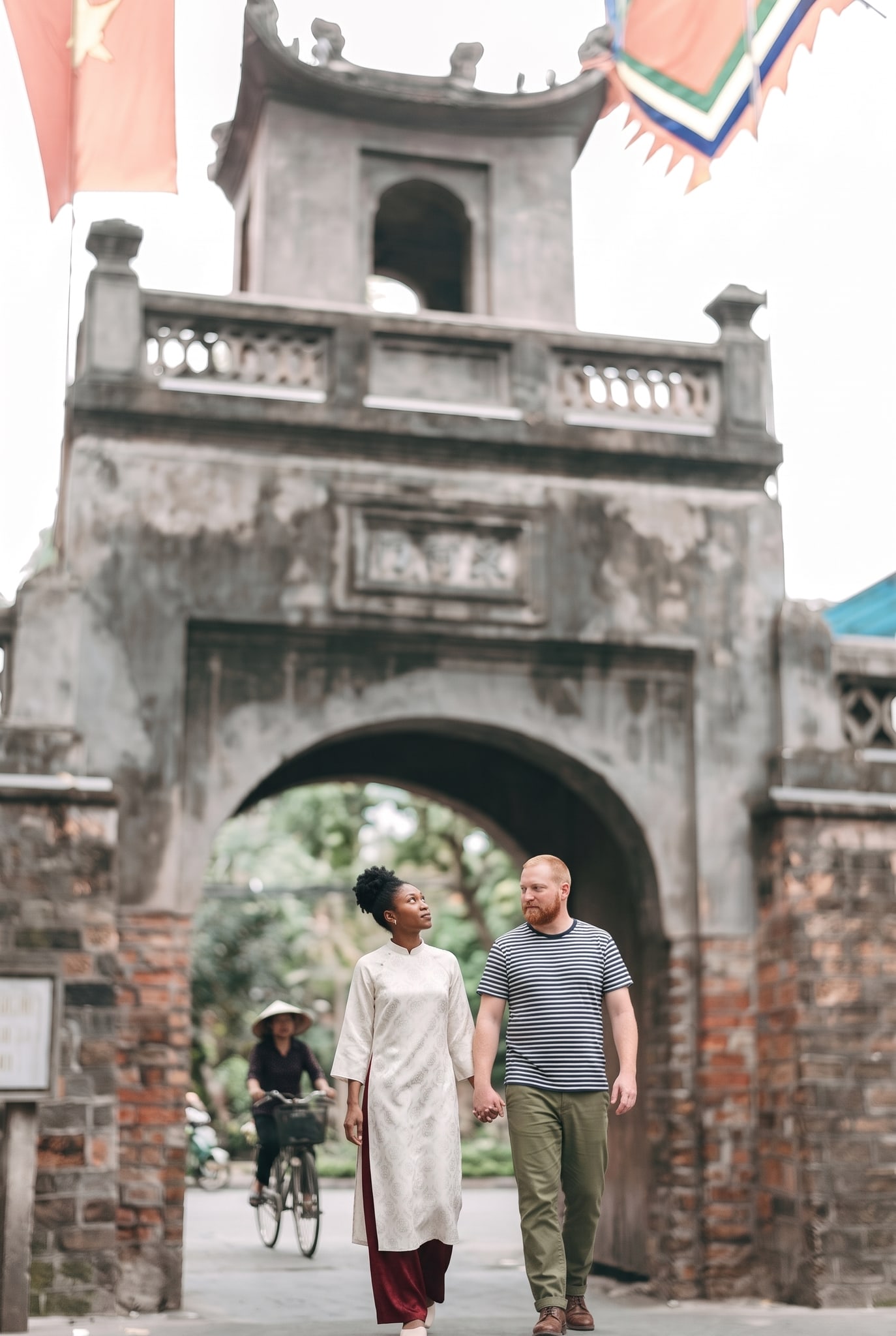
Yes, but with caveats. Couple shoots work beautifully in Old Quarter's narrow lanes and intimate tea shops, especially sunrise bookings. Family shoots require flexibility—young children may tire on uneven ground, and large groups can't fit all four people in the narrow alley frames we love. We recommend family shoots pair ao dai with a second location (like Hoan Kiem Lake) for variety and rest breaks. If you're doing a pre-wedding photoshoot, Old Quarter offers stunning detail shots but usually isn't the anchor location—it works best as a 1-hour addition to a Lake or French Quarter day.
Conclusion: Couples thrive; families and pre-wedding sessions benefit from a second venue.
How does weather affect Old Quarter ao dai shoots?
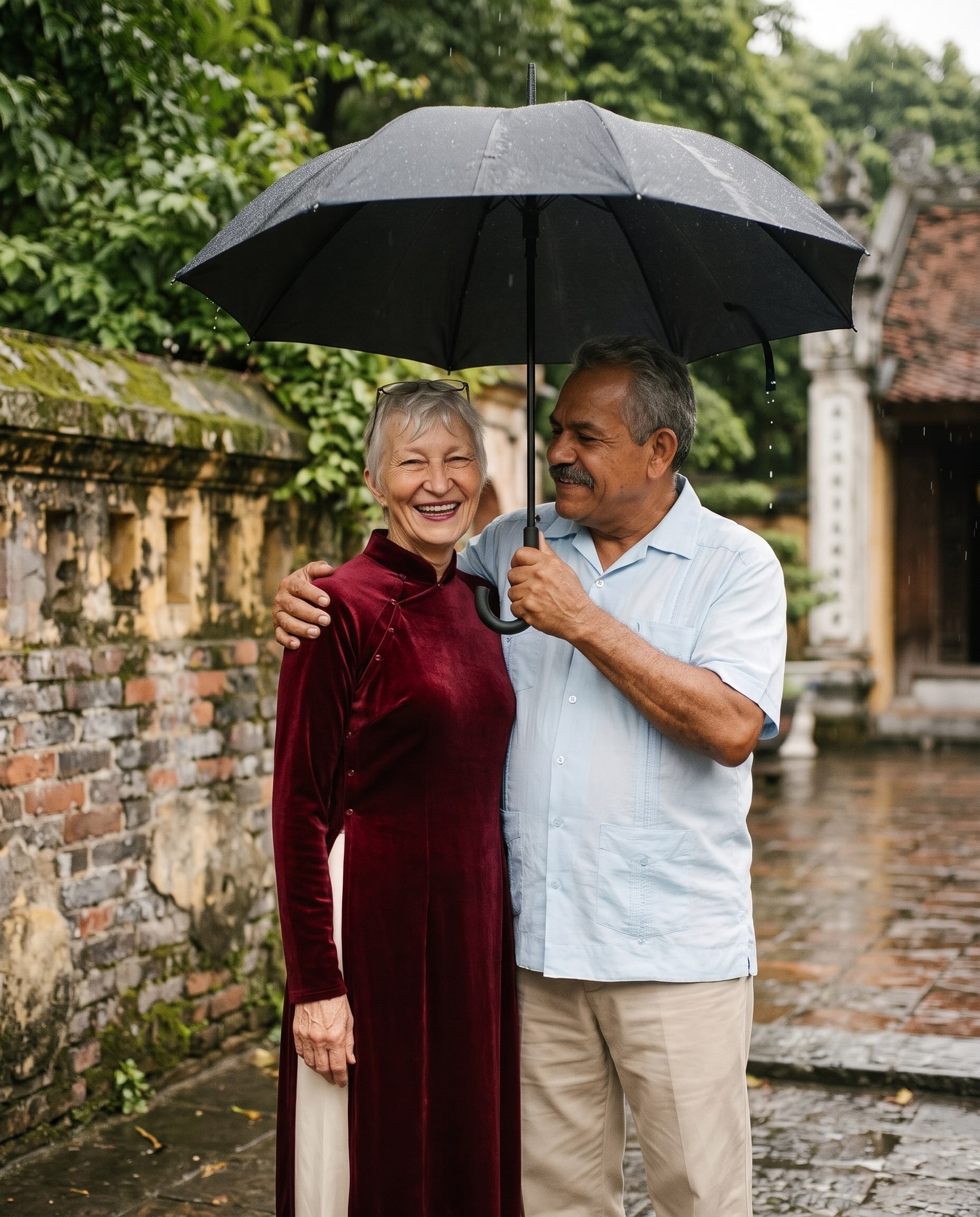
Light rain (drizzle) is actually flattering—it dampens dust, softens light, and makes wet-stone textures pop. Heavy downpour stops us; we reschedule within 48 hours. Humidity (May–September average 85%+) causes makeup to migrate and áo fabric to cling; we use setting spray and breathable, moisture-wicking underlayers. Fog (rare, cold season early mornings) creates moody atmosphere but requires reflectors to light faces. Extreme heat (April–May, >35°C/95°F) makes early morning even more critical—by 8:30 a.m., the narrow lanes turn into ovens. Wind (September–October monsoon edge) can whip the ao dai skirt (a feature, not a bug). We monitor hourly forecasts and advise clients to reschedule if conditions turn unsafe (lightning, flash flooding during typhoon season late August–September).
Conclusion: Rain and cool weather suit Old Quarter; heat and storms warrant rescheduling.
Pages from our team you may need
- ao dai photoshoot in Hanoi
- couple photoshoot
- family photoshoot
- solo travel portraits
FAQ
Can we shoot inside a shop or café in Old Quarter?
Yes, with owner permission. We coordinate this beforehand or ask on arrival (small cafés are usually friendly). Shop interiors have warm tungsten light that reads orange in photos—we compensate with white balance and occasional fill flash. Cramped quarters mean smaller crew (photographer + one stylist). Factor in 30 min. per location if the café is busy.
What happens if the ao dai doesn't fit when we arrive?
Our team brings 2–3 backup sizes and can safety-pin or tape a tunic to fit snugly. If a total mismatch, we reschedule and fit you properly in-studio before the session. Measure your chest, waist, and inseam when you book so we pre-stage correct sizes.
How many outfit changes can we do in a 2-hour slot?
Typically 2 ao dai (30 min. each, plus 10–15 min. travel between spots). Changing in narrow alley shopfronts takes longer than our studio. We recommend one primary áo plus one accent color or embroidery style for variety without time loss.
Is Train Street near Old Quarter and can we include it in one shoot?
Train Street is 2–3 km south; combining it with Old Quarter requires a full 3-hour session to avoid rushed frames. Train Street photo guide has its own permit and crowd windows. We usually book them separately for quality focus.
Do you offer retouching and when do we get the final images?
Yes, basic retouching (blemish removal, color grading) is included. You receive a preview gallery within 5 business days, edited full gallery within 10 days. We shoot RAW and deliver high-resolution JPEGs via a private cloud link. No printed albums are included; ask us for print or album options.
What's the difference between a morning Old Quarter shoot and an evening one?
Morning (6–8 a.m.) is cooler, emptier, and has directional golden light from the east—ideal for detail and ao dai texture shots. Evening (5–6:30 p.m.) has warm, amber light but bustling crowds, closed shop interiors, and the rush to finish before 7 p.m. closure. Morning suits first-time visitors; evening suits photographers who've done Old Quarter before and want moody street life.
Check dates
Send your dates, how many people and the style you like. We reply on WhatsApp in English with spots, timing and a quote.
FAQ
Can we shoot inside a shop or café in Old Quarter?
Yes, with owner permission. We coordinate this beforehand or ask on arrival (small cafés are usually friendly). Shop interiors have warm tungsten light that reads orange in photos—we compensate with white balance and occasional fill flash. Cramped quarters mean smaller crew (photographer + one stylist). Factor in 30 min. per location if the café is busy.
What happens if the ao dai doesn't fit when we arrive?
Our team brings 2–3 backup sizes and can safety-pin or tape a tunic to fit snugly. If a total mismatch, we reschedule and fit you properly in-studio before the session. Measure your chest, waist, and inseam when you book so we pre-stage correct sizes.
How many outfit changes can we do in a 2-hour slot?
Typically 2 ao dai (30 min. each, plus 10–15 min. travel between spots). Changing in narrow alley shopfronts takes longer than our studio. We recommend one primary áo plus one accent color or embroidery style for variety without time loss.
Is Train Street near Old Quarter and can we include it in one shoot?
Train Street is 2–3 km south; combining it with Old Quarter requires a full 3-hour session to avoid rushed frames. [Train Street photo guide](https://hanoiphotoshoot.com/spots/hanoi-train-street) has its own permit and crowd windows. We usually book them separately for quality focus.
Do you offer retouching and when do we get the final images?
Yes, basic retouching (blemish removal, color grading) is included. You receive a preview gallery within 5 business days, edited full gallery within 10 days. We shoot RAW and deliver high-resolution JPEGs via a private cloud link. No printed albums are included; ask us for print or album options.
What's the difference between a morning Old Quarter shoot and an evening one?
Morning (6–8 a.m.) is cooler, emptier, and has directional golden light from the east—ideal for detail and ao dai texture shots. Evening (5–6:30 p.m.) has warm, amber light but bustling crowds, closed shop interiors, and the rush to finish before 7 p.m. closure. Morning suits first-time visitors; evening suits photographers who've done Old Quarter before and want moody street life.
More like this
Ao dai photoshoot in Hanoi
Ao Dai Photoshoot at Ho Chi Minh Mausoleum: Best Time & Tips
Ho Chi Minh Mausoleum area offers dramatic colonial architecture and red flags perfect for ao dai portraits, but timing and permit rules are critical.
Ao dai photoshoot in Hanoi
Ao Dai Photoshoot at Lotus Pond Sunrise in Hanoi
Lotus ponds offer Hanoi's most serene ao dai backdrop at dawn, but timing and location scouting are critical for empty frames and soft light. We share exact hours, seasonal water levels and how to avoid tourist crowds.
Ao dai photoshoot in Hanoi
Ao Dai Photoshoot Duong Lam Ancient Village: Best Time & Hanoi Guide
Duong Lam Ancient Village—45 minutes northwest of central Hanoi—offers weathered brick lanes, lotus ponds and colonial-era storefronts perfect for ao dai portraits. Best light and crowd conditions occur October–November and February–March mornings.