
Home › Blog › Ao dai photoshoot in Hanoi
Ao Dai Photo Shoot Hanoi at Night: Light, Spots & Timing Guide
By the Hanoi Photoshoot team · 2026-11-06
A night ao dai photo shoot in Hanoi combines traditional Vietnamese dress with low-light urban drama—typically 2–3 hours starting 45 minutes before sunset and extending into early evening, when street lights, neon, and twilight create depth and mood. Hanoi Photoshoot by Cáo Studio shoots ao dai at Old Quarter laneways, Hoan Kiem Lake's lit edges, and select temples during permitted hours; we bring professional lighting, an in-house makeup artist, and ao dai rental to handle the technical and wardrobe demands of night work. Night shoots cost more than daytime because they require specialized equipment and shorter working windows. Avoid monsoon season (May–September) when humidity fogs lenses; book December–March for clear skies and cooler comfort in layers. Check dates on WhatsApp
Why night ao dai shoots need different planning than day portraits?
Night work changes every technical rule: aperture opens wider to gather scattered light, shutter speed slows unless you're using flash or strobes, and ISO rises—each pushes image quality unless your photographer masters the trade-offs. Hanoi's streetscape at night is also a moving target: neon signs shift color temperature every few blocks, car headlights create flare, and foot traffic unpredictably fills frames. We pre-scout locations by season and time to lock in the exact minute when ambient light balances with our strobes, so you're not standing in darkness hoping for magic. This means booking well ahead; we confirm light windows weeks before your session. Traditional ao dai fabric—silk, brocade, embroidered panels—reads beautifully under cool tungsten and sodium vapor light, revealing texture that midday sun flattens. Expect your session to feel slower and more intimate than daytime work: fewer poses, longer between frames, more stillness. That's by design; night portraits of depth beat rushed daylight crowds every time.
Which Hanoi neighborhoods photograph best after sunset?
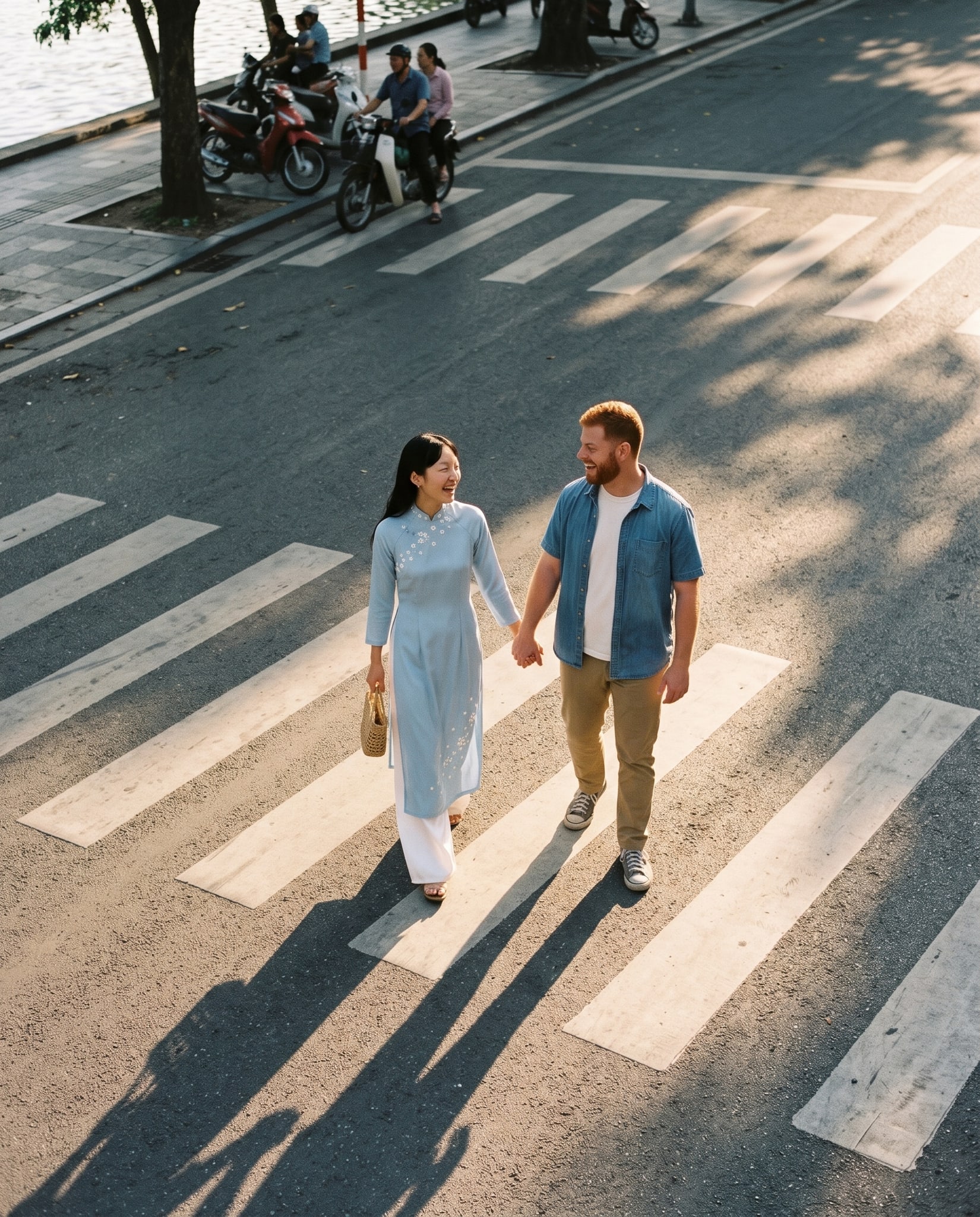
Hanoi's Old Quarter remains the top night choice: narrow laneways funnel warm neon and lantern glow onto subjects, and 11 p.m. crowds thin enough for posed work on side streets near Hoan Kiem Lake. The lake's eastern bank, lit by ambient streetlamps and reflections, works 6–8 p.m. before fishing crowds arrive; we shoot in the quieter north alcove near park benches. Train Street—the famous narrow alley with colonial shutters—is permit-only after 6 p.m. and too chaotic for ao dai work on nights when trains run; we avoid it for night shoots unless you're aiming for editorial chaos (and paying for security coordination). Select temples allow evening shoots if booked in advance; Quan Thanh Temple's waterfront courtyard has soft, diffused light 6–7 p.m. before closing. Avoid: high-traffic zones (Hoan Kiem's main south shore, Trang Tien Plaza approach) where lighting is harsh, unstable, and crowds unpredictable. Best neighborhoods overall—Old Quarter back streets, lake quieter edges, temple grounds—all reward patience and pre-scouting. We lock location 3–4 weeks ahead so we can confirm light quality that exact hour, that exact date.
How does Hanoi's seasonal light change your night shoot timeline?
Hanoi's sunset shifts 40+ minutes across the year: December peaks at 5:15 p.m., June bottoms at 6:45 p.m., turning the usable evening window into a moving target. Winter (December–March) gives you 2–3 hours of rich twilight; we often shoot 5:30–8 p.m., catching that deep-blue magic hour when street lights just click on and the sky still holds warmth. Summer (June–September) compresses that window: twilight fades fast 6:50–7:30 p.m., then flips to full dark; humidity also fogs lenses and exhausts you in silk ao dai. Spring (March–May) and autumn (September–November) are sweet spots—clear skies, comfortable temperature, and 2.5 hours of usable light. Monsoon (May–September) adds rain risk: 60–70% chance of afternoon showers that soak streets, create puddles, and reduce visibility; reschedule rather than gamble. We check Hanoi's seasonal light tables and weather patterns before confirming your date; this means booking 4–6 weeks ahead so we can pick the optimal week and hold your slot. Avoid May–June and September if you're risk-averse; December–February and October–November are our top-booked seasons.
What equipment and crew do we bring for night ao dai work?
Our Hanoi team deploys: two professional strobes on light stands (because ambient Hanoi light is too low and color-unstable), a diffuser kit to soften flash (essential for avoiding harsh, unnatural shadows on face and ao dai silk), a reflector for fill light on alternate side, tripod for stability at slower shutter speeds, and color-correction gels to match tungsten and neon inconsistencies. We bring a makeup and hair artist because night light reveals every line—retouching later is costly; fresh makeup and defined brows ensure you read well in shadow. Our ao dai rental includes alterations on-site if fit shifts between day consultation and evening shoot. We also carry backup batteries (night work draws power fast), extra memory cards, and a portable reflector stand for when terrain is uneven. Crew is typically 3–4 people: photographer, lighting tech, makeup/hair, and sometimes an assistant to manage crowd control and reflectors. This scale is non-negotiable for night work; solo photographers cutting costs often sacrifice light quality and your comfort. Ask us what's included in your quote on WhatsApp—we're transparent about crew and kit.
How do you pose and move in ao dai during low-light shoots?
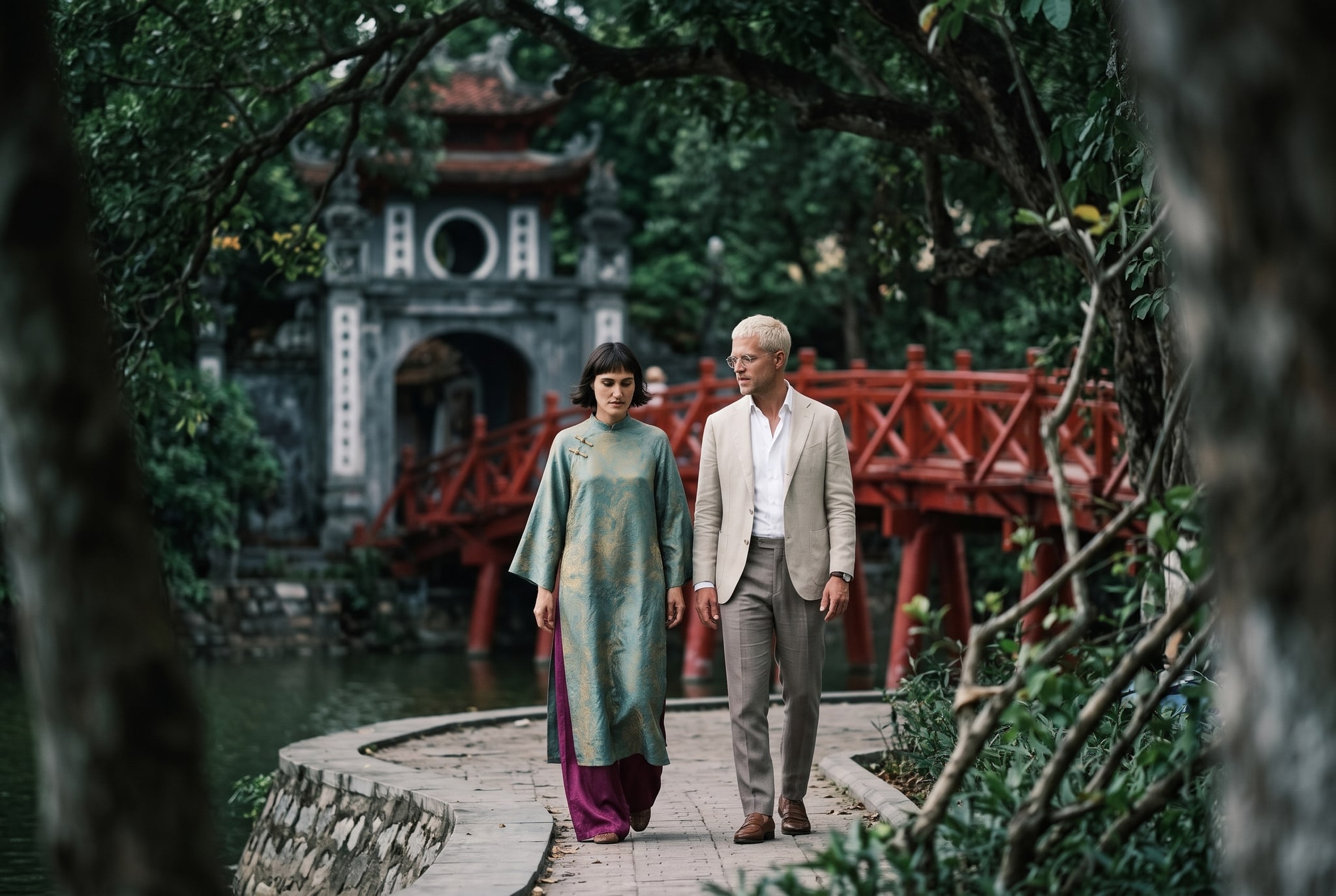
Posing at night is slower and more deliberate than day work: ambient light is unforgiving, so every shift in angle, head tilt, or fabric drape matters. We brief you beforehand on the 3–4 core poses that work best in the specific location's light (e.g., profile against a lantern, three-quarter turn under a neon sign, seated near water reflection). Avoid: looking directly into car headlights or camera flashes (blinking ruins frames), twisting too fast (motion blur at 1/30th shutter speed), and standing with ao dai folds bunched (night light clings to folds and reads as clutter). We move you incrementally—6 inches left, down a half-step, chin micro-drop—rather than asking for big repositions. Hair and ao dai fabric flow differently under tungsten light; what looks sleek in daylight looks dull at night, so we often ask you to move more dynamically—walk slowly, turn the ao dai panels to catch neon reflections, or stand near water so reflections double the light on your face. Between 5–10 frame shots we pause, adjust light, and let you breathe; night work is mentally taxing. Expect 60–100 frames total per 2-hour session (vs. 150–200 in daylight). The keepers are often more striking because low light compresses depth and isolates you from background clutter. If you're not a natural model, night shoots actually suit you better: slower pace, fewer poses, time to settle in. Learn more about posing for non-models.
| Scenario | Best Time | Light Source | Ao Dai Color | Why It Works |
|---|---|---|---|---|
| Old Quarter laneway | 6:30–7:30 p.m. (Dec–Feb) | Neon + streetlamp | Jewel tones, reds, golds | Warm light flatters silk; neon pops against fabric |
| Lake reflection shoot | 6:00–6:45 p.m. (year-round) | Twilight + ambient | Pastels, whites, silvers | Water doubles light; soft, diffused |
| Temple courtyard | 5:15–6:15 p.m. (permit-dependent) | Setting sun + lanterns | Embroidered, traditional | Backlighting reveals brocade detail |
| Street portrait (side-lit) | 7:00–7:45 p.m. (Oct–Mar) | Storefront neon + strobe fill | Deep colors, metallics | Neon separates you from gray walls |
When should you book, and what to check before locking a night session?
Reserve 4–6 weeks ahead so we can confirm the exact light window for your chosen date, month, and time. Confirm with us on WhatsApp:
- Location: Which Hanoi neighborhood appeals? (Old Quarter, lake, temple, or a hybrid.) We'll vet permits, access times, and light quality.
- Date & season: Winter (Dec–Mar) or shoulder (Oct–Nov, Mar–May) is ideal; monsoon risk rises June–September.
- Ao dai: Do you own one, or will you rent? Our rental includes in-house styling, sizing, and alterations.
- Duration: 2 hours is standard; 3 hours for extensive outfit changes or multiple locations.
- Crew transparency: Ask if strobes, diffuser, makeup/hair, and assistant are included. (They are at our studio; others may cut corners.)
- Weather backup: Night shoots are harder to reschedule than day; confirm the reschedule policy upfront.
- Lighting test: Ask for a sample shot (via WhatsApp) from your chosen location and time before final booking. We'll send one; it costs nothing and prevents disappointment.
What could go wrong on a night ao dai shoot, and how do we prevent it?
Underexposure: Ambient Hanoi light at 7 p.m. is roughly 1/10th the brightness of noon; without strobes, faces vanish into murk. Fix: We meter light on-site and bring backup strobes.
Color cast mess: Neon (RGB-chaotic), sodium vapor (orange), and tungsten (yellow) clash across a single frame. Fix: We use color gels and white-balance custom presets; we also shoot in RAW so post-processing corrections are lossless.
Monsoon downpour: May–September 60–70% evening shower risk; wet ao dai, ruined hair, slippery ground. Fix: Book Dec–Mar; if monsoon date is unavoidable, we scout covered locations (temple alcoves, shop porticos). Rescheduling is easier than damage control.
Crowd chaos: Night streets fill with scooters, vendors, and drunk revelers after 8 p.m. Fix: We shoot 5:30–7:30 p.m. window; Old Quarter is manageable then. We also use a light stand to cordon space and brief you on when to hold a pose vs. pause for foot traffic.
Ao dai slipping or wrinkles: Night photoshoots are 2+ hours of repeated posing; ao dai panels shift and fabric creases show under tungsten light. Fix: Our stylist fits the ao dai pre-shoot and carries a steamer on-site. We also shoot close-ups and wide shots so wrinkles vanish in frame context.
Flare from headlights or phone lights: Passing vehicles or curious onlookers' phones throw light directly into lens. Fix: We position you with your back to the main traffic line, use a lens hood, and politely ask nearby people to put phones away during key frames.
Is a night ao dai shoot right for you—or should you book daytime instead?
Choose night if: you love moody, intimate portraits; you're comfortable moving slowly and refining poses; you want to stand out (night ao dai work is less common than day, so frames feel editorial); or you're visiting Hanoi in peak season and daytime slots fill fast. Choose daytime if: you prefer bright, energetic imagery; you're new to photo shoots and want fast-paced, lower-pressure work; or you're traveling December–January and daylight hours give you more usable time. Hybrid works too: 2-hour daytime session + 1-hour night add-on lets you capture both drama and clarity. Learn what else we offer for ao dai shoots. Ask us for a quote on WhatsApp; night sessions cost more than day because they require specialized lighting and a tighter crew, but the investment pays in frames that feel like they're yours alone.
FAQ
Can we shoot ao dai at night on Train Street?
Train Street is permit-only after 6 p.m. and congested on train nights; we avoid it for night ao dai work unless you want editorial chaos. See our Train Street guide for daytime options instead.
What if it rains during our booked night session?
Monsoon season (May–Sept) has 60–70% evening shower risk. We scout covered locations (temple alcoves, shop porticos) pre-shoot. If rain is heavy, we reschedule to the next clear window within 14 days at no extra cost.
Do we need to wear heels or special shoes with ao dai at night?
Nighttime Hanoi streets are uneven and wet; flat sandals or embroidered evening slippers are safer. We advise on footwear during WhatsApp consultation; avoid heels on cobblestone or Train Street approaches.
How many edited photos do we receive from a 2-hour night session?
Typically 40–60 edited images (vs. 80–120 from a daytime shoot, due to slower pacing and longer light adjustments). Ask for the exact count when you request a quote on WhatsApp.
Can we combine a night ao dai shoot with other session types (couples, family)?
Yes. Our couple shoots and family shoots work at night with extended booking; ask us to customize a hybrid package on WhatsApp.
What months have the best night light and weather in Hanoi?
December–March and October–November: clear skies, comfortable temperatures, and 2–3 hours of usable twilight. May–September has 60% rain risk and humidity that fogs lenses; book these months only if flexible on reschedule.
Check dates
Send your dates, how many people and the style you like. We reply on WhatsApp in English with spots, timing and a quote.
FAQ
Can we shoot ao dai at night on Train Street?
Train Street is permit-only after 6 p.m. and congested on train nights; we avoid it for night ao dai work unless you want editorial chaos. [See our Train Street guide](/spots/hanoi-train-street) for daytime options instead.
What if it rains during our booked night session?
Monsoon season (May–Sept) has 60–70% evening shower risk. We scout covered locations (temple alcoves, shop porticos) pre-shoot. If rain is heavy, we reschedule to the next clear window within 14 days at no extra cost.
Do we need to wear heels or special shoes with ao dai at night?
Nighttime Hanoi streets are uneven and wet; flat sandals or embroidered evening slippers are safer. We advise on footwear during WhatsApp consultation; avoid heels on cobblestone or Train Street approaches.
How many edited photos do we receive from a 2-hour night session?
Typically 40–60 edited images (vs. 80–120 from a daytime shoot, due to slower pacing and longer light adjustments). Ask for the exact count when you request a quote on WhatsApp.
Can we combine a night ao dai shoot with other session types (couples, family)?
Yes. [Our couple shoots](/couple-photoshoot) and [family shoots](/family-photoshoot) work at night with extended booking; ask us to customize a hybrid package on WhatsApp.
What months have the best night light and weather in Hanoi?
December–March and October–November: clear skies, comfortable temperatures, and 2–3 hours of usable twilight. May–September has 60% rain risk and humidity that fogs lenses; book these months only if flexible on reschedule.
More like this
Ao dai photoshoot in Hanoi
Ao Dai Photoshoot at Ho Chi Minh Mausoleum: Best Time & Tips
Ho Chi Minh Mausoleum area offers dramatic colonial architecture and red flags perfect for ao dai portraits, but timing and permit rules are critical.
Ao dai photoshoot in Hanoi
Ao Dai Photoshoot at Lotus Pond Sunrise in Hanoi
Lotus ponds offer Hanoi's most serene ao dai backdrop at dawn, but timing and location scouting are critical for empty frames and soft light. We share exact hours, seasonal water levels and how to avoid tourist crowds.
Ao dai photoshoot in Hanoi
Ao Dai Photoshoot Duong Lam Ancient Village: Best Time & Hanoi Guide
Duong Lam Ancient Village—45 minutes northwest of central Hanoi—offers weathered brick lanes, lotus ponds and colonial-era storefronts perfect for ao dai portraits. Best light and crowd conditions occur October–November and February–March mornings.