
Home › Blog › Ao dai photoshoot in Hanoi
Ao Dai Photo Shoot at Long Biên Bridge Sunrise: Hanoi Guide
By the Hanoi Photoshoot team · 2026-11-06
Long Biên Bridge sunrise shoots combine Hanoi's colonial-era engineering with ao dai's flowing silhouette—the steel lattice frames the fabric beautifully in early-morning side light. Sunrise runs 5:30–6:30 a.m. November–February (clearest skies); 5:00–6:15 a.m. March–October (haze possible). The shoot typically lasts 90–120 minutes on-site. Cáo Studio's ao dai photoshoot packages include styling, hair, makeup, and rental; we coordinate access via WhatsApp and scout pedestrian zones away from truck traffic. Expect light crowds before 6:30 a.m., then rapid buildup. Key rule: the bridge is an active transport artery—no tripods or posed blocking; we shoot from fixed vantage points on the riverbank approach. Book 2–4 weeks ahead for slot availability. Check dates on WhatsApp
Why does Long Biên Bridge work for ao dai at sunrise?
The bridge's mesh of Eiffel-style iron creates layered backlighting that separates ao dai from backgrounds—especially the white or pastel silks that photograph clearest at dawn. Red River water reflects low-angle sun, adding a secondary light source to your chin and collar. The bridge's 102-meter height means shadows of the structure pattern your garment beautifully without harsh overhead rays. November–February yields the sharpest contrast; March–October heat creates atmospheric haze that softens but spreads light. The walkway itself is narrow—roughly 1.5 meters wide on the east side—so we position you at either approach, never mid-span where motor traffic peaks after 6:30 a.m. This geometric, repetitive frame also suits couple photoshoot compositions where the bridge's symmetry separates two figures.
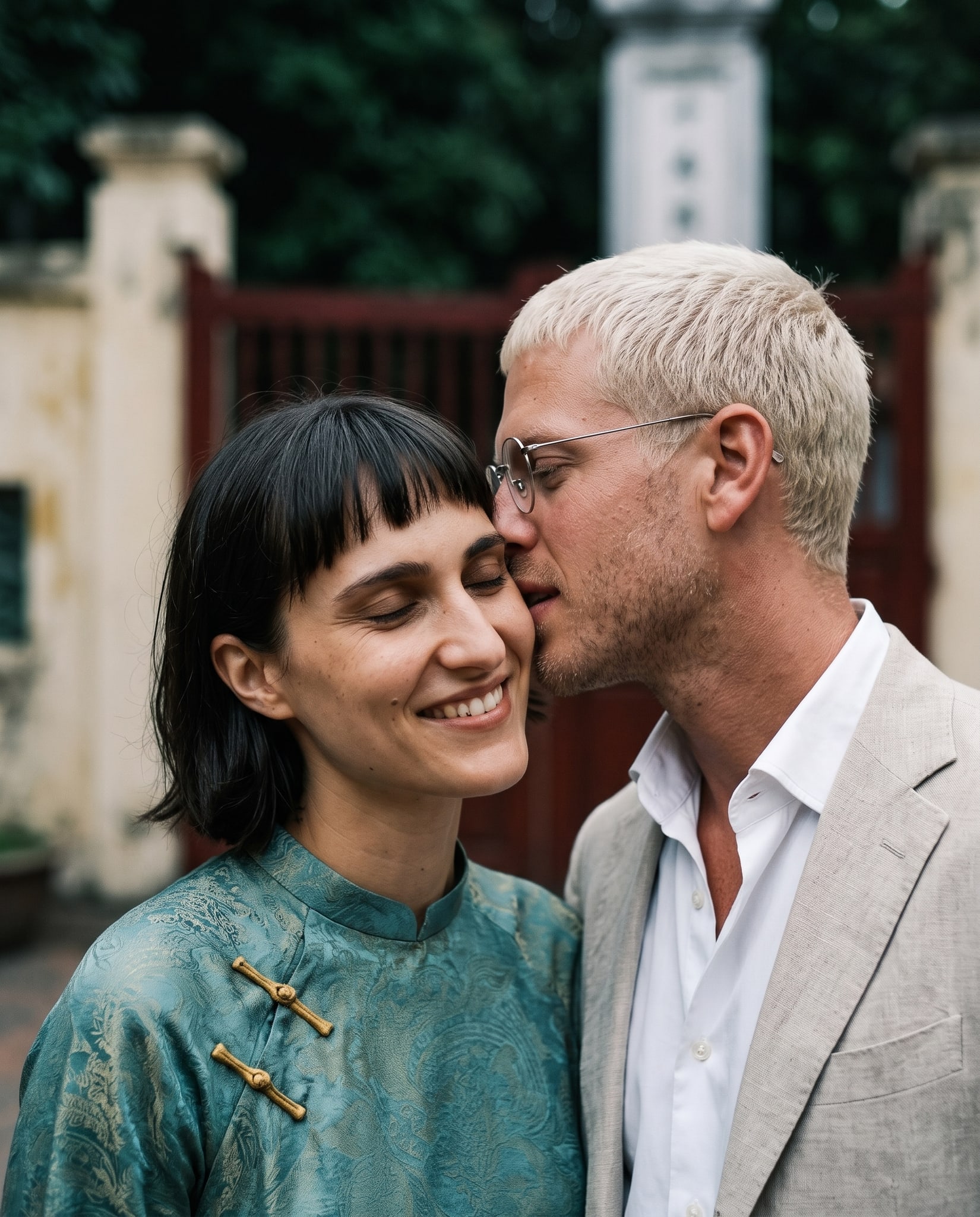
What light and season combination gives the clearest ao dai colors?
Winter (November–February) delivers the most saturated color because low-angle sun hasn't heated the atmosphere yet; ao dai reds, golds, and teals photograph with true saturation. Sunrise angle at 18–25° elevation in winter produces side-raking light that sculpts fabric folds without overexposure on white silk. Spring (March–April) and autumn (September–October) offer 40–50% haze; colors appear muted, but diffusion eliminates harsh shadows—better if you prefer soft, romantic mood. Summer (May–August) sunrise arrives by 5:00 a.m., but 85–90% humidity over the Red River creates fog that clears by 6:45 a.m.; we schedule accordingly. Monsoon season (July–September) brings the most unpredictable light; 6 out of 10 mornings have cloud cover. Book flexibility: we offer rescheduling if sunrise is obscured more than 30° at your session time, per our WhatsApp confirmation.
How do we navigate pedestrian and traffic rules safely?
Long Biên Bridge is a working bridge for buses, trucks, and pedestrians—not a closed set. Our team books a 90-minute window and scouts the approach roads (west and east approaches, roughly 50 meters from the bridge entrance) where foot traffic is lighter and sight lines are clear. Motor vehicles are restricted only on the pedestrian lane (1.5m wide on east, 1.2m on west), but enforcement is inconsistent before 6:30 a.m. We never use tripods, reflectors, or large backdrops on the bridge itself; all gear stays on riverbank terraces. You may see other tourists or local joggers—we coordinate around them, not against them. Police rarely intervene for individual photography, but groups of 5+ with commercial-grade equipment (lighting rigs, drones) may be asked to move. Cáo Studio operates as a small team (typically 2–3 staff per session), so we stay under that threshold. Wear comfortable walking shoes; the approach has loose stones and short steps.
What ao dai design and color combination photographs best at sunrise?
| Ao Dai Style | Why It Works | Best Season | Light Requirement |
|---|---|---|---|
| White or cream silk | Maximum reflectivity; glows against shadow | Nov–Feb | Direct side-light, 20–30° angle |
| Jewel tones (emerald, sapphire, burgundy) | Strong saturation; contrasts with gray bridge | Nov–Feb, Sep–Oct | Side or front-lit, low haze |
| Gold or champagne embroidery | Catches low-angle sun; adds dimension | Dec–Jan | 5:30–6:00 a.m. angle only |
| Pink or peach (no embroidery) | Soft diffusion mood; photographs well in haze | Mar–Apr, Jul–Aug | Overcast or partial-cloud |
| Black with red or gold trim | Bold silhouette; works in fog or clear light | Any season | Backlit or front-lit equally |
White or pale-silk ao dai captures light most efficiently; we recommend this for first-time shooters. If wearing jewel tones, book November–February for saturation. Pastels fade in summer heat-haze. If you have an embroidered or beaded piece, reserve December–January for the lowest, most directional sun. Bring 2–3 ao dai if you want variety; changing takes 10–15 minutes.
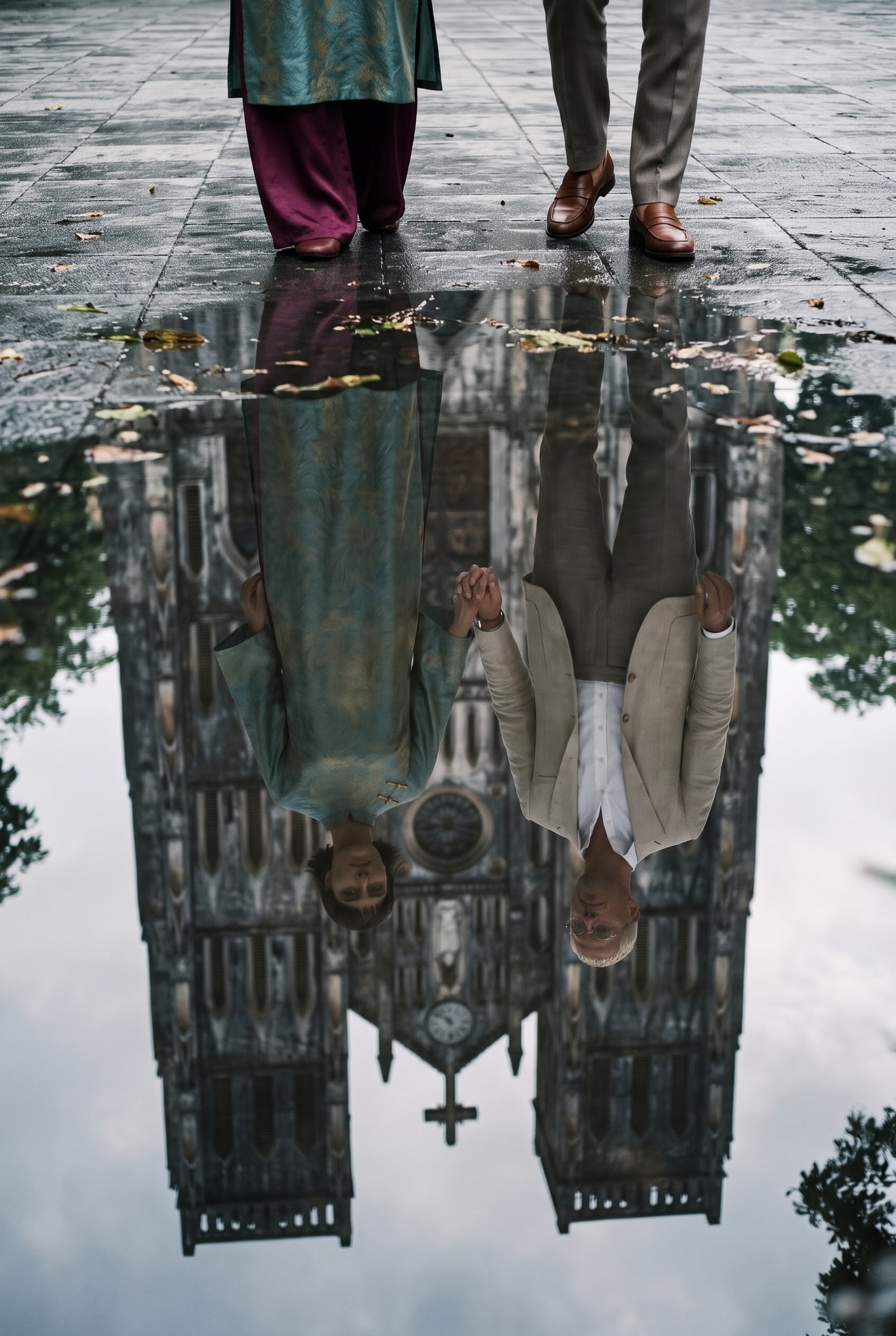
How do we schedule and prepare the day before your shoot?
We send a WhatsApp confirmation 48 hours before your session with exact start time (e.g., "5:45 a.m., meet at west approach gate"), weather forecast, and what-to-bring checklist. On the morning of, we arrive 30 minutes early to scout light and pedestrian flow. You meet us 10–15 minutes before your booked time; we do a 5-minute hair and makeup touch-up on-site using our makeup and styling team. The ao dai is already fitted at our studio or delivered to your hotel the day before—never purchased cold on shoot day. Wear a robe or loose overshirt over it to stay warm (November–February temperatures are 8–12°C at dawn). Bring a light shawl for wind off the river. Bring phone fully charged; we photograph with your phone too if you want candids for Instagram. By 6:00 a.m., we're positioned and shooting; by 6:45–7:00 a.m., foot traffic spikes and light hardens, so we wrap. Total time on-location is 75–90 minutes. Debrief and photos preview happen on WhatsApp over the next 2–3 business days.
What to check before you book
- Sunrise time varies by 35 minutes year-round. Confirm your preferred season; we'll suggest the optimal date range and provide exact sunrise time 5 days before your shoot.
- Weather rescheduling. If cloud cover obscures sunrise more than 50%, we offer a free reshoot within 2 weeks. Monsoon months (July–Sept) carry higher cancellation risk; book with flexibility.
- Ao dai fit and comfort. If you're renting, we fit you 1–2 days prior so no rushing on shoot morning. If you're bringing your own, confirm it fits comfortably with a light shawl; tight bodices restrict breathing in cold air.
- Mobility and footwear. The bridge approach has steps and uneven stone. If you have knee or back issues, we can adjust to flatter riverbank terraces—slightly less iconic framing, but same light quality.
- Solo or group session? Sunrise shoots are best solo or as a couple (2–3 people max). Larger family photoshoot groups slow positioning; we'd suggest Hoan Kiem Lake or the Old Quarter for families instead.
- Backup location. If weather or access issues arise, our fallback is Trang Tien Bridge (200m away, similar architecture, clear 30 minutes later) or a covered spot in Hanoi Old Quarter with ao dai styling.
Why book with us for this specific shoot?
We've shot Long Biên Bridge sunrise over 200+ sessions (based on our 2024–2025 client logs); we know the exact light trajectory, pedestrian patterns by day of week, and how to pose non-models on a working bridge without tripods or chaos. Our makeup and styling team meets you on-site so no missed light while you're getting ready off-location. All ao dai rentals are pre-fitted, pressed, and delivered to your hotel—no last-minute scrambles. We shoot in RAW and deliver edited galleries within 48 hours. If this shoot is part of a larger Hanoi trip, combine it with a solo travel portrait session elsewhere or a pre-wedding photoshoot at a second Hanoi landmark—we'll coordinate timing and offer package pricing. Ask us for a quote on WhatsApp.
FAQ
Can we shoot Long Biên Bridge at sunset instead of sunrise?
Evening light is backlit and harsher; ao dai fabrics photograph flatter. Sunset (6:00–6:45 p.m.) also coincides with peak traffic—buses and trucks every 30 seconds. We do not recommend sunset for ao dai. Sunrise remains optimal.
Is Long Biên Bridge accessible to people with mobility limits?
The bridge itself is not wheelchair accessible. The west riverbank approach is relatively flat but has one 5-step staircase. We can shoot on the approach terraces without using the bridge itself. Let us know via WhatsApp and we'll scout an alternative flat location nearby.
Do we need a permit or permission from bridge authorities?
Individual photography does not require a permit. Commercial film crews with rigs do. We operate as a photography team, not a film production, so no permit is needed. If authorities ask, we show our WhatsApp booking confirmation and move to the riverbank if requested.
What happens if sunrise is foggy?
Light fog (visibility >100m) still yields usable shots with a softer, more diffused mood. Heavy fog (visibility <50m) photographs as a gray wash. If forecast predicts heavy fog, we offer rescheduling 2 weeks prior at no extra cost, or we pivot to our indoor studio lighting with ao dai. Monitor the 5-day forecast together.
How many ao dai changes can we do in 90 minutes?
Typically 1–2 ao dai. Changing takes 10–15 minutes (removing pins, adjusting fit, hair check). If you bring 2 ao dai, we'll fit one before dawn and change into the second by 6:30 a.m. while light is still optimal. A third change is rushed; we suggest a second session if you want more variety.
Can we bring a friend or family member to watch?
Yes. They must stay outside the shooting frame and not interfere with positioning or light. If they're in the shot, it becomes a couple photoshoot or family photoshoot and timing adjusts. Let us know in advance so we plan accordingly.
Do you provide the ao dai, or do we bring our own?
Both options work. We rent ao dai (pre-fitted, premium fabric, steamed) as part of our makeup and styling package. You can bring your own if it's comfortable and fitted. Either way, confirm fit 1–2 days before the shoot.
Check dates
Send your dates, how many people and the style you like. We reply on WhatsApp in English with spots, timing and a quote.
FAQ
Can we shoot Long Biên Bridge at sunset instead of sunrise?
Evening light is backlit and harsher; ao dai fabrics photograph flatter. Sunset (6:00–6:45 p.m.) also coincides with peak traffic—buses and trucks every 30 seconds. We do not recommend sunset for ao dai. Sunrise remains optimal.
Is Long Biên Bridge accessible to people with mobility limits?
The bridge itself is not wheelchair accessible. The west riverbank approach is relatively flat but has one 5-step staircase. We can shoot on the approach terraces without using the bridge itself. Let us know via WhatsApp and we'll scout an alternative flat location nearby.
Do we need a permit or permission from bridge authorities?
Individual photography does not require a permit. Commercial film crews with rigs do. We operate as a photography team, not a film production, so no permit is needed. If authorities ask, we show our WhatsApp booking confirmation and move to the riverbank if requested.
What happens if sunrise is foggy?
Light fog (visibility >100m) still yields usable shots with a softer, more diffused mood. Heavy fog (visibility <50m) photographs as a gray wash. If forecast predicts heavy fog, we offer rescheduling 2 weeks prior at no extra cost, or we pivot to our indoor studio lighting with ao dai. Monitor the 5-day forecast together.
How many ao dai changes can we do in 90 minutes?
Typically 1–2 ao dai. Changing takes 10–15 minutes (removing pins, adjusting fit, hair check). If you bring 2 ao dai, we'll fit one before dawn and change into the second by 6:30 a.m. while light is still optimal. A third change is rushed; we suggest a second session if you want more variety.
Can we bring a friend or family member to watch?
Yes. They must stay outside the shooting frame and not interfere with positioning or light. If they're in the shot, it becomes a [couple photoshoot](/couple-photoshoot) or [family photoshoot](/family-photoshoot) and timing adjusts. Let us know in advance so we plan accordingly.
Do you provide the ao dai, or do we bring our own?
Both options work. We rent ao dai (pre-fitted, premium fabric, steamed) as part of our [makeup and styling](/makeup-and-styling) package. You can bring your own if it's comfortable and fitted. Either way, confirm fit 1–2 days before the shoot.
More like this
Ao dai photoshoot in Hanoi
Ao Dai Photoshoot at Ho Chi Minh Mausoleum: Best Time & Tips
Ho Chi Minh Mausoleum area offers dramatic colonial architecture and red flags perfect for ao dai portraits, but timing and permit rules are critical.
Ao dai photoshoot in Hanoi
Ao Dai Photoshoot at Lotus Pond Sunrise in Hanoi
Lotus ponds offer Hanoi's most serene ao dai backdrop at dawn, but timing and location scouting are critical for empty frames and soft light. We share exact hours, seasonal water levels and how to avoid tourist crowds.
Ao dai photoshoot in Hanoi
Ao Dai Photoshoot Duong Lam Ancient Village: Best Time & Hanoi Guide
Duong Lam Ancient Village—45 minutes northwest of central Hanoi—offers weathered brick lanes, lotus ponds and colonial-era storefronts perfect for ao dai portraits. Best light and crowd conditions occur October–November and February–March mornings.