
Home › Blog › Ao dai photoshoot in Hanoi
Ao Dai Photo Shoot at Hanoi Flower Market: Light, Crowds & Timing
By the Hanoi Photoshoot team · 2026-11-06
The flower market works best for ao dai shoots between 6–8am in spring (February–April) or early autumn (August–September), when soft side-light flatters colors and crowds stay light. The market sits near Hoan Kiem Lake's north edge; vendors allow photography if you're respectful and avoid blocking stalls. Shoots here run 60–90 minutes. We handle hair, makeup and ao dai rental on-site, plus we guide you on flower arrangements, posing and walking angles that work in tight aisles. Avoid midday (11am–2pm) when sun is harsh and vendor frustration peaks. Book at Hanoi Photoshoot by Cáo Studio via WhatsApp for exact date availability, lighting forecasts and a detailed briefing on which aisles stay guest-friendly year-round. Check dates on WhatsApp
What makes the flower market unique for ao dai?
The market's flower stalls create natural color contrast—purple orchids, orange chrysanthemums, pink roses—against traditional red, gold and white ao dai. Organic backdrops beat studio walls for travel and couple shoots. Light bounces off wet flower buckets and tile floors in ways that enhance fabric sheen and embroidery detail. The environment feels alive, not posed. You're also shooting a real Hanoi labor scene, not a tourist trap, which adds cultural authenticity. Our ao dai photoshoot guide covers this alongside Old Quarter and pagoda options so you can compare settings beforehand.
Which season and time deliver the best light?
Spring (February–April) offers warm, diffused morning light; humidity is low, and market crowds peak early but thin by 7:30am. Early autumn (August–September) brings similar soft-focus light but heavier crowds. Winter (November–January) light is harsher and sideways—useful for shadow drama but demanding for faces. Summer (May–July) is too hot and humid; you'll sweat through makeup.
Peak light window: 6–8am, 365 days. After 9am, direct sun washes out reds and golds, and vendors become protective of stall access. Evening (5–6:30pm) is cooler but crowds return, and flower arrangements get picked over by end of day. Based on daily market cycles at Quảng An, morning is non-negotiable for quality.
How do crowds and vendor rules affect your shoot?
| Factor | 6–8am | 9am–12pm | 1–5pm |
|---|---|---|---|
| Vendor willingness | High (calm) | Medium (busy) | Low (restocking) |
| Tourist count | Few | 20–40 | 5–15 |
| Light quality | Soft, directional | Hard, overhead | Sidelight (uneven) |
| Photo interruptions | ≤2 | 5–10 | 3–7 |
Early morning means vendors are setting up, not selling; they're used to photographers. By 9am, they're managing queues and resent posed sessions blocking their front. We ask permission stall-by-stall and move quickly. Avoid walking directly behind customers; use side alleys and flower walls as backdrops instead. Never photograph a vendor's face without asking. If a stall owner says no, we pivot to the next cluster within 20 steps—this is why local knowledge matters. Our makeup and styling team times arrival to coordinate hair and touch-ups in a quiet corner so you're camera-ready the moment light peaks.
What should your ao dai and styling look like at the market?
Jewel tones—emerald, sapphire, burgundy—pop against flower colors; pastels (cream, pale pink) risk blending with morning mist and floral softness. Solid colors photograph cleaner than busy embroidery in narrow aisles; geometric or floral patterns work, but avoid stripes that flicker in tight framing. Loose ao dai (traditional, not fitted modern cuts) move better through stalls and feel more authentic in this working setting.
Hair should be half-up or fully up; loose hair gets tangled in flower stems and looks windblown in narrow passages. Makeup needs to be matte or powder-set because humidity hits 70–80% by 7:30am. Heavy blush and bronzer photograph fake under flat market light. We use minimal, cool-toned makeup that reads well in soft directional sun. Avoid large jewelry—chains catch on flower baskets, and bangles clink in otherwise quiet footage. Footwear: flat sandals or soft shoes; heels sink into wet tile and slow you down, killing momentum in a 90-minute window.
How do you pose naturally without blocking vendors?
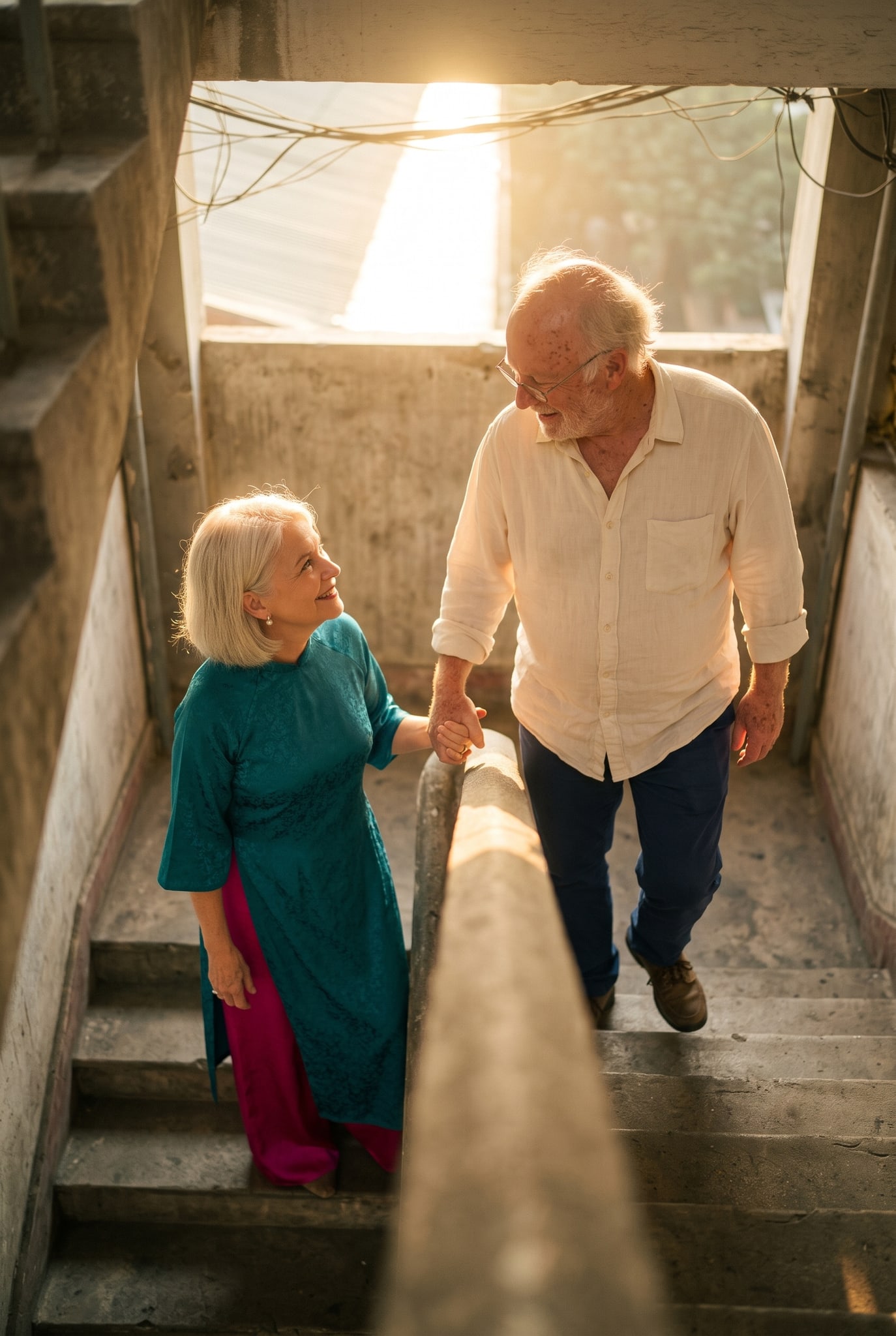
Posing rules here differ from pagodas or lakes. Vendors are working, not just decorating, so standing still for 10+ shots feels rude. Instead, we use walking-and-turning angles: stepping between stalls, looking down at flowers, adjusting your ao dai as you move. This captures natural motion, avoids stationary blocking, and feels candid—ideal for travel and couple storytelling.
Walking shots demand 2–3 takes per angle; you'll likely look stiff on take one, natural on take two or three. Stand at a stall for 15–20 seconds max; compose quickly and move. For sitting, perch on a low flower crate (ask first) rather than kneeling—easier to stand, less time wasted. Use flower walls as lean-and-turn backdrops: one hand touches the flowers (avoid crushing), gaze toward light, turn your head. These feel less "posed" and more "a moment at the market." Solo travel or couple shoots thrive here because the environment dictates movement; static fashion poses feel out of place.
What are common mistakes, and how do we avoid them?
Arriving too late (8:30am+): Light flattens, vendors are stressed, tourists cluster. Book early morning and plan travel time from your hotel. Hanoi traffic is unpredictable; we suggest 45 minutes from central districts.
Forgetting the "no flash" rule: Many vendors prohibit flash; it disturbs flowers and startles customers. We use natural light only—if conditions are too dim, we reschedule. Shooting RAW and lifting shadows in post is better than fighting vendors.
Overdressing for the season: You'll be moving constantly; bring a thin shawl or cardigan you can remove. Heat exhaustion kills energy by hour two.
Expecting picture-perfect flowers: Some blooms wilt by mid-morning; some are already in decline. Part of the market's charm is imperfection. We work with what's there and pivot to less-picked sections.
Wearing heavy makeup: It melts and migrates. We reapply minimally and often—our team carries powder, lip tint and a hand-held fan.
We coordinate all of this via WhatsApp beforehand: weather forecast, flower availability (seasonal blooms shift), exact entry point and backup dates if light fails.
What to check before you book
- Confirm the specific date 2–3 weeks ahead. Market flooding, vendor holidays or municipal events can close sections.
- Share any ao dai color preference. Certain blooms align with certain seasons; we match timing to your vision.
- Clarify if you want couple, solo or family framing. Crowd and stall logistics differ; we adjust the shoot route.
- Ask about makeup and hair trial beforehand. Humidity affects longevity; we discuss touch-up strategies.
- Check if you need rental ao dai or are bringing your own. Rental takes 15 minutes on-site; owned ao dai needs steaming beforehand.
Related shoots at other iconic Hanoi spots
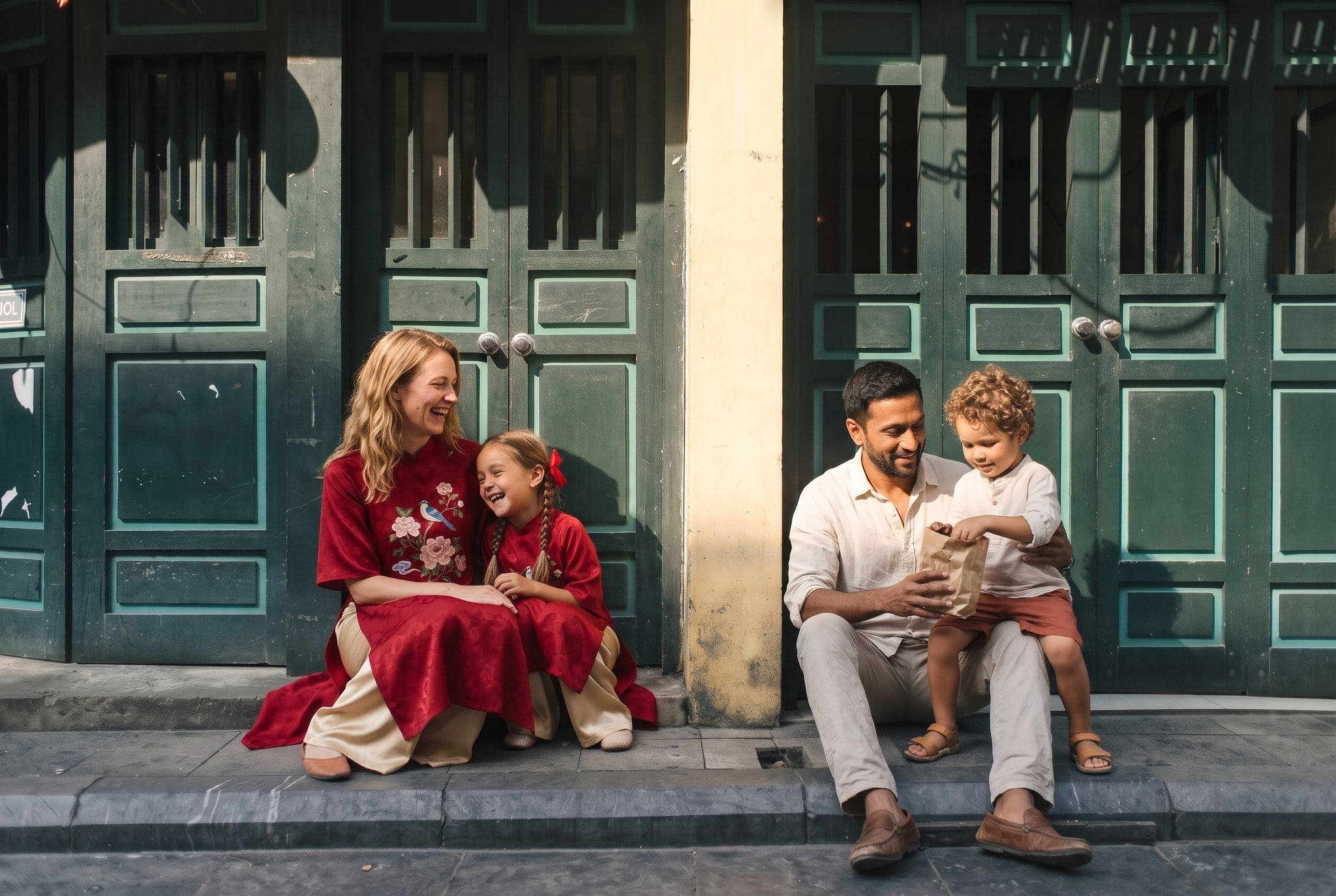
If the flower market doesn't fit your vision, consider couple photoshoots at Hoan Kiem Lake or our Old Quarter guide for colonial backdrops. Pre-wedding shoots often combine flower market (intimate, morning) with Train Street or lake (grand, afternoon). Family photoshoots work here too, though younger children tire in crowds; we shorten sessions and shift timing. Solo travel portraits thrive in markets because the environment does half the storytelling. If you want a broader comparison of Hanoi backdrops, read our photoshoot guide.
FAQ
Can we shoot at the flower market on weekends?
Weekends bring 3x the tourists and locals; vendor patience drops sharply by 7am. We recommend weekday early mornings (Tuesday–Friday, 6–7:30am) for calm, uncluttered frames. If weekends are your only option, we book 5:30–6:30am—market staff are setting up, not yet selling.
Do we need permission from the market management?
We handle vendor-by-vendor permission; there's no single gatekeeper. Early morning and respectful movement make this smooth. If a vendor declines, we move—we never argue. Management generally doesn't intervene if you're not blocking sales or using professional lighting rigs.
What if the weather is rainy or foggy that morning?
Light becomes flat and gray; ao dai colors look muted, and wet floors create slip hazards. We monitor the forecast 48 hours before and reschedule to the next suitable day at no extra cost. Humidity is fine (we reapply makeup), but rain requires a new date.
Can we bring props like parasols or fans?
Yes, if they don't block aisles or stalls. Traditional fans work beautifully and add cultural depth; parasols can interfere with vendor movement. We advise on prop sizing during the WhatsApp briefing.
How long does the full shoot take, including styling?
90 minutes on-site (30 min makeup/hair, 60 min shooting). Arrive 15 minutes early for a quiet briefing and final checks. We provide a detailed itinerary and confirm exact locations and timing 24 hours before.
Do you offer same-day edited proofs?
We deliver a gallery link within 5 business days. Same-day proofs aren't feasible given post-processing needs, but we prioritize flower market shoots because they're seasonal and time-sensitive.
Check dates
Send your dates, how many people and the style you like. We reply on WhatsApp in English with spots, timing and a quote.
FAQ
Can we shoot at the flower market on weekends?
Weekends bring 3x the tourists and locals; vendor patience drops sharply by 7am. We recommend weekday early mornings (Tuesday–Friday, 6–7:30am) for calm, uncluttered frames. If weekends are your only option, we book 5:30–6:30am—market staff are setting up, not yet selling.
Do we need permission from the market management?
We handle vendor-by-vendor permission; there's no single gatekeeper. Early morning and respectful movement make this smooth. If a vendor declines, we move—we never argue. Management generally doesn't intervene if you're not blocking sales or using professional lighting rigs.
What if the weather is rainy or foggy that morning?
Light becomes flat and gray; ao dai colors look muted, and wet floors create slip hazards. We monitor the forecast 48 hours before and reschedule to the next suitable day at no extra cost. Humidity is fine (we reapply makeup), but rain requires a new date.
Can we bring props like parasols or fans?
Yes, if they don't block aisles or stalls. Traditional fans work beautifully and add cultural depth; parasols can interfere with vendor movement. We advise on prop sizing during the WhatsApp briefing.
How long does the full shoot take, including styling?
90 minutes on-site (30 min makeup/hair, 60 min shooting). Arrive 15 minutes early for a quiet briefing and final checks. We provide a detailed itinerary and confirm exact locations and timing 24 hours before.
Do you offer same-day edited proofs?
We deliver a gallery link within 5 business days. Same-day proofs aren't feasible given post-processing needs, but we prioritize flower market shoots because they're seasonal and time-sensitive.
More like this
Ao dai photoshoot in Hanoi
Ao Dai Photoshoot at Ho Chi Minh Mausoleum: Best Time & Tips
Ho Chi Minh Mausoleum area offers dramatic colonial architecture and red flags perfect for ao dai portraits, but timing and permit rules are critical.
Ao dai photoshoot in Hanoi
Ao Dai Photoshoot at Lotus Pond Sunrise in Hanoi
Lotus ponds offer Hanoi's most serene ao dai backdrop at dawn, but timing and location scouting are critical for empty frames and soft light. We share exact hours, seasonal water levels and how to avoid tourist crowds.
Ao dai photoshoot in Hanoi
Ao Dai Photoshoot Duong Lam Ancient Village: Best Time & Hanoi Guide
Duong Lam Ancient Village—45 minutes northwest of central Hanoi—offers weathered brick lanes, lotus ponds and colonial-era storefronts perfect for ao dai portraits. Best light and crowd conditions occur October–November and February–March mornings.